Stamped concrete
Stamped concrete quotes: what goes into them and how to compare them
The items that make up the price of stamped concrete per square metre in Mallorca, how to read a quote, why cheap ones cut the sub-base or the sealer, and how to compare.
The price of stamped concrete (hormigón impreso in Spanish, also known as patterned concrete) per m² is not a fixed number. It depends on the area, the access, what has to be removed first, the thickness and the sub-base, the concrete and its additives, the number of colours and moulds, the type of sealer and the distance to the concrete plant. Two 80 m² terraces in the same municipality can have very different quotes without either of them being unreasonable. This guide explains what lies behind each item so that you can read a quote and compare several. It contains no figures: for your own project, ask for a quote.
The items in a quote
Area and shape
The cost per metre falls as the number of metres rises. A pour brings out the mixer lorry, a crew of three or four people, the moulds and the tools on the same day, whether the job is 30 m² or 150. That is why a 25 m² path is expensive per metre and an open area of 200 works out cheaper. Shape matters less than it seems: stamped concrete follows curves without cutting, although edges, junctions with walls and steps take more labour than the middle of a slab.
Access
Can the mixer lorry reach the edge of the area? If it can, the concrete is poured straight in. If there is a house in the way, a narrow gateway in the old centre of Sóller or Pollença, or a slope, the job needs a concrete pump, which is charged by the day, or the concrete has to be moved by wheelbarrow and dumper, which multiplies the hours.
Demolition and removal
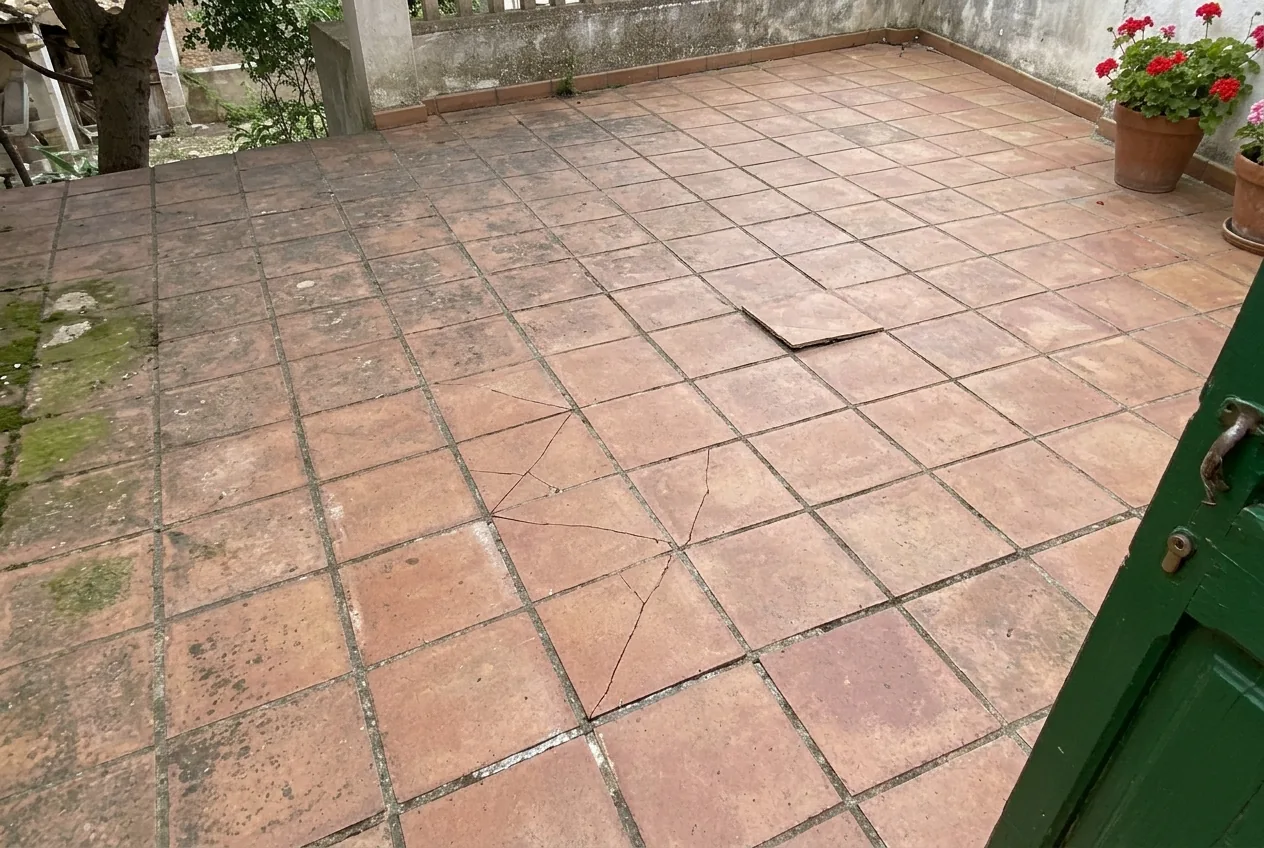
If there is an old floor, a broken slab or soil to dig out, it has to be broken up, loaded and taken to an authorised waste site. Waste disposal is charged by the tonne, and a 10 cm slab weighs about 240 kg per m². A quote that does not mention the rubble leaves that question for the end.
Sub-base
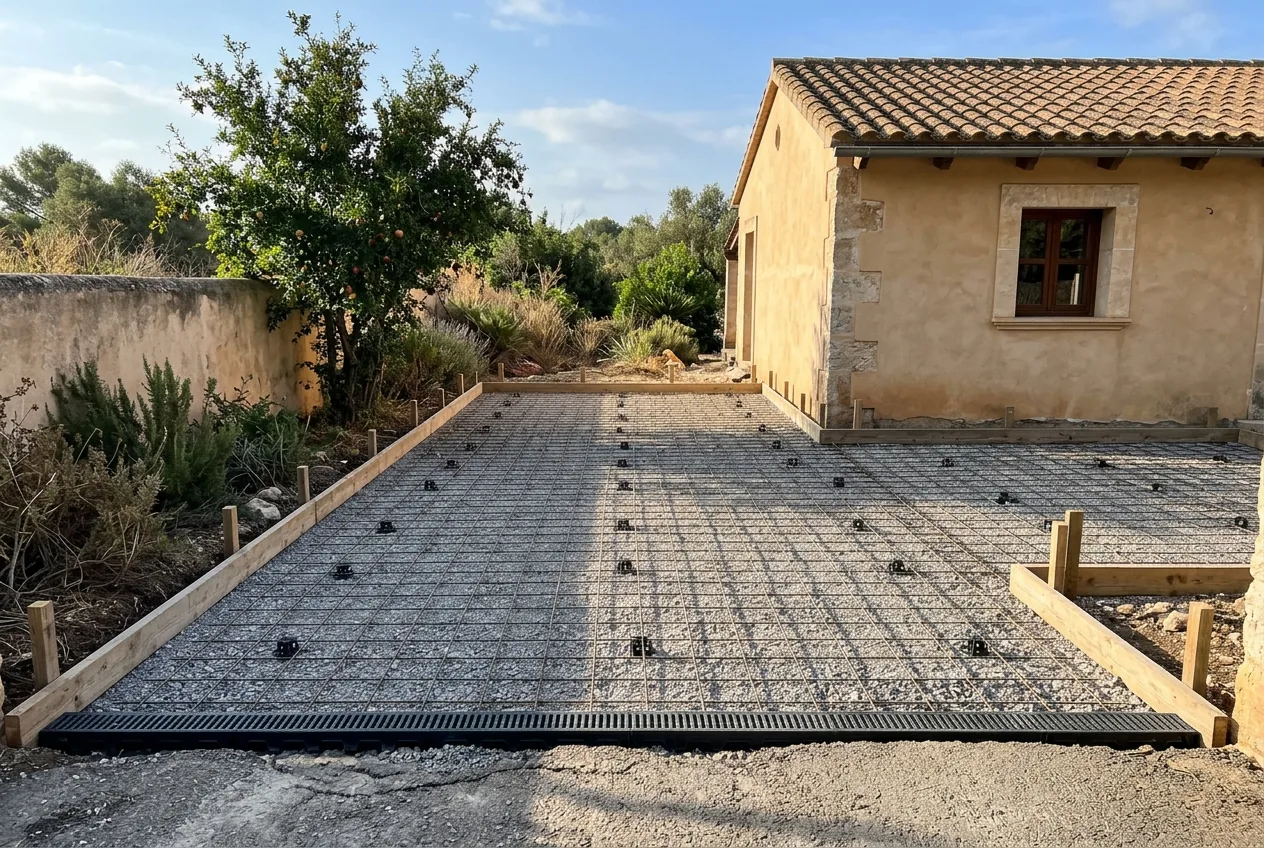
This is the item you never see and on which everything depends. The usual approach is to excavate, spread 10 to 15 cm of crushed aggregate (zahorra) and compact it, lay a polyethylene sheet to hold back moisture and, on top, welded steel mesh or fibres in the concrete. On the clay soils inland or on recent fill, the sub-base may need more depth or a geotextile. Whoever saves money here hands over a floor that cracks within two winters.
Thickness and type of concrete
For foot traffic, 8 to 10 cm. For driveways, 12 to 15 cm. For finca tracks used by tractors or lorries, more. Ready-mixed concrete is ordered to a set strength, normally HA-25 in the Spanish classification or higher, with fibres if they replace the mesh, and in summer with a set retarder so that there is time to stamp it. Every centimetre and every additive shows up in the price.
Colour, mould and finish
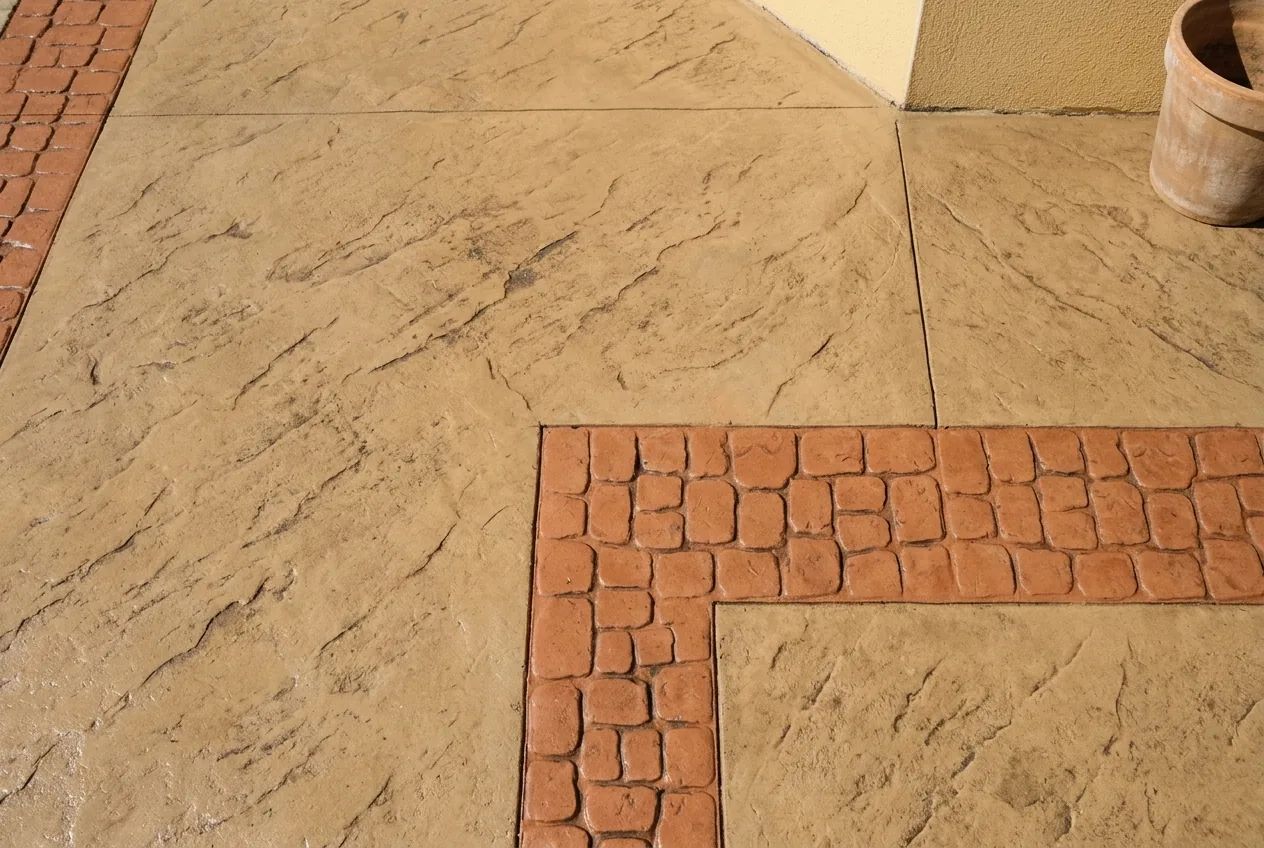
One colour and one mould is the base case. A second colour for borders, a different mould around the edge or a two-tone antique effect adds material and, above all, crew time on the day of the pour. Large random stone moulds cover ground faster than small cobble ones. The guide on colours and patterns explains the options.
Joints
They are cut with a disc 12 to 24 hours after the pour, every 3 to 4 metres, and sealed with polyurethane. It is a small item that some quotes leave out and that later shows up as cracks.
Sealing
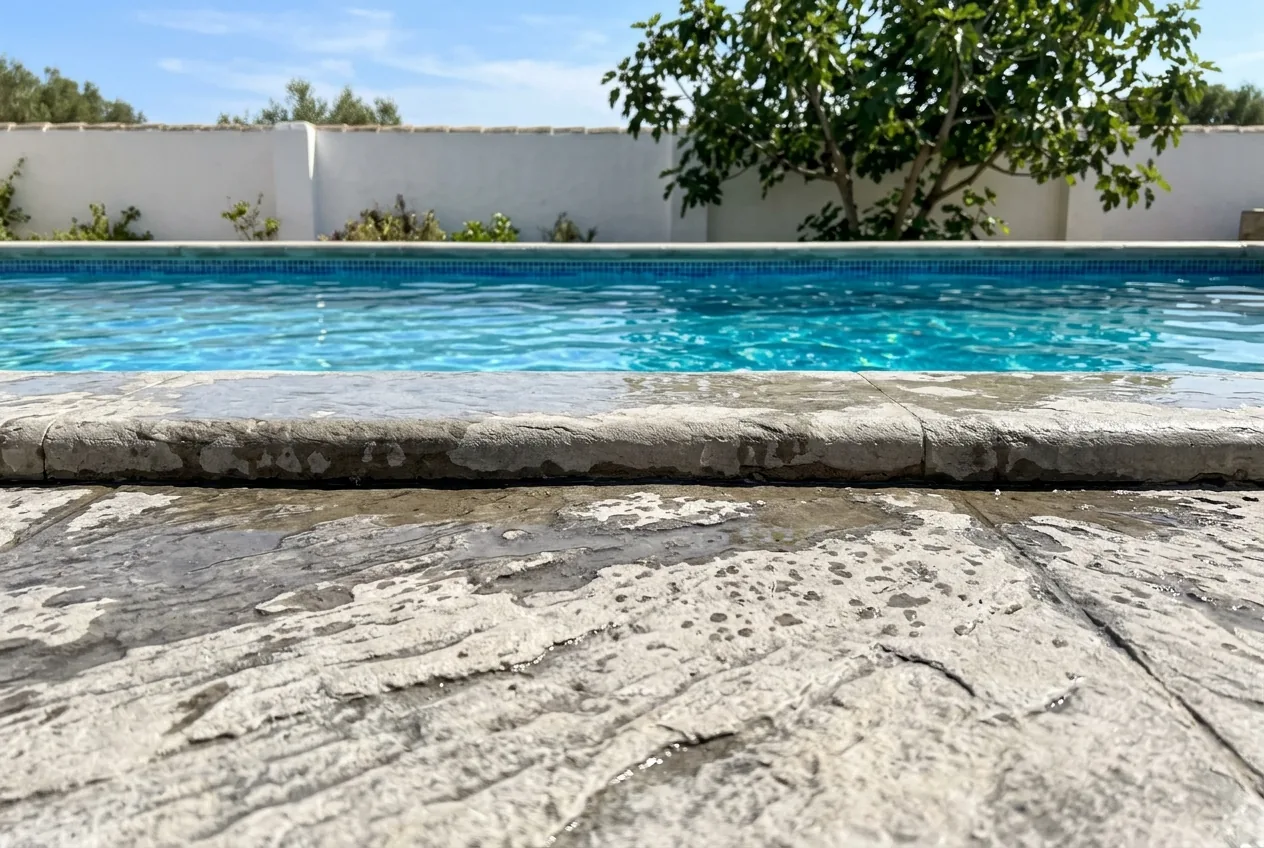
The finishing sealer goes on in two coats after the release agent has been washed off. There are real differences between a basic water-based acrylic, a good solvent-based acrylic and an aliphatic polyurethane, and between one coat and two. There is also a difference between including the anti-slip additive or not. The guide on water or solvent-based sealer helps you understand what is being offered.
Island logistics
Concrete comes from specific plants and has a maximum transport time before it starts to set, shorter in summer. A finca 40 minutes from the nearest plant means lorries waiting, a crew waiting for the second lorry and, sometimes, minimum orders. Palma, Marratxí, Inca and Manacor have plants nearby; the Serra de Tramuntana and the far end of the Llevant do not always.
How a quote usually breaks down
| Item | What it includes | What changes it |
|---|---|---|
| Preparation | Demolition, excavation, rubble removal | Existing floor, depth, access for the skip |
| Sub-base | Crushed aggregate, compaction, sheet, mesh or fibres | Thickness, type of ground |
| Concrete | Cubic metres, strength, additives, delivery, pump if needed | Thickness, distance to the plant, access |
| Stamping | Colour hardener, release agent, moulds, labour | Number of colours and moulds, edges, steps |
| Joints | Cutting and sealing | Linear metres |
| Sealing | Washing, two coats of sealer, anti-slip additive | Type of sealer, area |
| Finishing details | Junctions with walls, drains, thresholds | Complexity |
A single price per square metre with no breakdown means you have to ask what thickness, what sub-base and what sealer it includes.
Why cheap quotes are cheap
These are the usual ways of bringing the price per metre down, and all of them are paid for later:
- No sub-base, or a minimal one. The concrete goes onto raked soil. The floor settles and cracks.
- Less thickness than needed. A driveway at 8 cm instead of 12 or 15. It holds until a loaded van drives onto it.
- No mesh or fibres. Cracks open wider and the edges chip.
- One coat of sealer, or a basic one. It lasts a summer; after that the owner pays for resealing.
- Joints not cut, or cut too far apart. The concrete cracks wherever it wants.
- No rubble removal, no pump, no finishing details. They appear as extras on the day of the work.
This does not mean that the highest quote is the right one, only that a comparison is valid when the items are the same.
How to compare several quotes
- Ask for the concrete thickness, the thickness and type of sub-base, and whether it has mesh or fibres.
- Ask for the type of sealer, the number of coats and whether anti-slip is included.
- Check who handles the demolition and the rubble, and whether the pump is included.
- Ask how many joints are cut and what they are sealed with.
- Ask about the curing time and whether the company offers the future resealing itself.
- Compare the total, not the price per metre, with the same items in each quote.
The page on stamped concrete prices sums up what moves the cost on each type of job.
When to call a professional
Stamped concrete is made with plant concrete, a full crew and a well-organised pour day, or it does not work. A useful quote needs a site visit that measures, looks at the access and the ground, and asks how the surface will be used. Without a visit, any price per metre is an estimate that will change. Photos, measurements and a description of the access are enough for guidance; the visit settles it. The page on asking for a quote explains what information speeds things up.