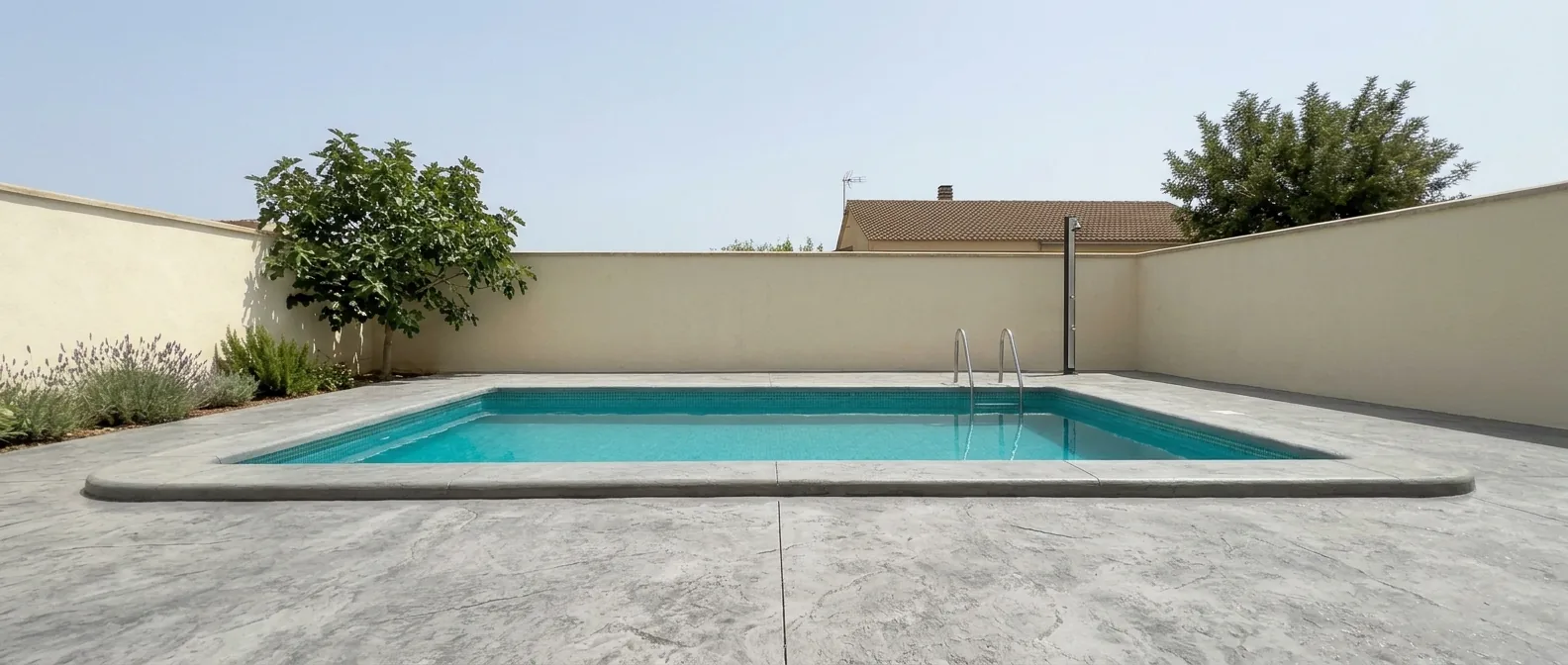
Stamped concrete for terraces and pool surrounds
The area around a pool is the most demanding floor of any house in Mallorca: wet bare feet, full summer sun, chlorine or salt, and drainage that has to work. Stamped concrete handles it well if the texture, colour, falls and joints are chosen properly.
A stamped concrete terrace and a pool surround are built like any other stamped concrete floor, but with four decisions that matter less elsewhere on the plot: slip resistance, heat underfoot, the rain that falls on it and the water that splashes onto it. This page deals with those four decisions; the general system is on the page on stamped concrete.
Non-slip pool surrounds: texture and slip class
For outdoor areas and pool surrounds, the Spanish building code, the Código Técnico de la Edificación, requires slip class 3, the highest, intended for wet floors walked on barefoot. Stamped concrete reaches it in two ways that add together. The first is the mould: random stone, slate and cobble textures have enough relief to give grip; smooth slabs and fine grain timber have less. The second is the sealer: a fine aggregate, normally silica or a clear polymer, is added to the second coat, creating a micro roughness that you cannot see but that works when the floor is wet.
That combination avoids the usual dilemma with pool flooring: the surfaces that do not slip tend to be rough, and the comfortable ones slip. A medium texture with aggregate in the sealer is pleasant to walk on barefoot and safe when wet. On pool steps and ramps we always ask for the aggregate, without exception. The different paving options are compared in the guide to non-slip pool surrounds.
Heat underfoot: light colours and a matt finish
In August, a dark floor in the Mallorcan sun can be impossible to walk on barefoot. Stamped concrete is no exception, so around a pool we work with the light colour family: sands, beiges, ivories and light greys. They reflect more radiation and heat up less than terracottas and dark greys. The release agent, which gives the shading in the joints, is also chosen in a light tone.
The sealer finish plays a part too: a matt or satin sealer heats up less than a gloss one and also hides wet footprints and limescale from the water better. A high gloss looks good in a photo on handover day and less good in July with the children climbing out of the pool.
Falls and drainage
Splashed water and rainwater have to go somewhere. Around a pool we give a fall of 1 to 2 per cent away from the pool, towards channel drains, gratings or the garden, never towards the house or into the pool itself, where it would carry soil and sun cream with it. On terraces over a roof slab the fall runs towards the existing drains and is checked before pouring, because a permanent puddle on stamped concrete ends up as a white patch, and as algae in winter.
With the torrential autumn rain, a large terrace also needs a plan for where the water goes when the channel drain overflows: an overflow towards a planted area stops it running into the porch.
Expansion joints
Concrete expands with heat and contracts with cold, and on a terrace in the sun the difference between morning and afternoon is large. The joints are cut within the first 48 hours, forming bays of no more than 3 to 4 metres a side, and perimeter joints are left where the floor meets the pool coping, the walls of the house and the porch pillars. The joints are filled with an elastic polyurethane sealant in the colour of the floor so that water and roots cannot get in. Stamped concrete without joints, or with bays that are too large, cracks wherever it likes.
Salt, chlorine and the coping
Neither salt water nor chlorinated water harms stamped concrete while the sealer is in good condition. Once the sealer wears, salt crystallises in the pores and chlorine dulls the pigment, which is why around a pool the sealer is renewed more often than on the rest of the property: every 2 to 3 years instead of every 3 to 4.
The coping, the edging that finishes the rim of the pool, is usually natural stone, marés (the local sandstone) or precast, and the stamped concrete meets it with a sealed joint. The rim itself can also be stamped with a bullnose edge mould, although stone stands up better to the constant rubbing of people climbing out of the water. If the coping is porous, it makes sense to give it a water repellent treatment at the same time as the floor is sealed, a job covered on the page on pavement sealing.
Terraces away from the pool
A stamped concrete terrace in a garden or under a porch follows the same rules with less demand on it: a fall away from the house, joints every 3 to 4 metres, the colour you like and a satin sealer. If the terrace sits on a roof slab with a room below, the terrace waterproofing has to be sorted out before the concrete goes down; stamped concrete is not waterproof in itself and does not replace a membrane.
FAQ
Questions
Something else? Ask us when you request a quote.
What does slip class 3 mean?
It is the highest slip resistance class in the Spanish building code, required in outdoor areas, showers and pool surrounds, that is, wherever the floor is wet and walked on barefoot. Stamped concrete reaches it with a deeply textured mould and an anti-slip aggregate in the sealer.
Does stamped concrete get hot in the sun?
Like any paving, it heats up, and the darker it is, the hotter it gets. Around a pool we choose sands, beiges and light greys with a matt finish, which stay at a temperature comparable to a light coloured tile. We do not recommend terracottas or dark greys where people swim and sunbathe.
Can stamped concrete go around a saltwater pool?
Yes. Salt does not attack the concrete while the sealer is intact. What matters is renewing that sealer every 2 to 3 years and hosing the floor down with fresh water now and then so that salt does not build up in the pores.
How long before the terrace can be used?
It can be walked on after 24 hours, light furniture can go back after 3 or 4 days, and the sealer is applied between 7 and 28 days later depending on humidity. After sealing, 24 hours without foot traffic and 48 without getting it wet. If the work falls in the swimming season, we plan it so the pool can be used as soon as possible.
Are the expansion joints visible?
Yes, and they should be, because they are what prevents cracks. Where the pattern allows, they are cut along the lines of the mould and filled with an elastic sealant in the colour of the floor, so they blend into the stone or cobble pattern.
Guides
Related guides
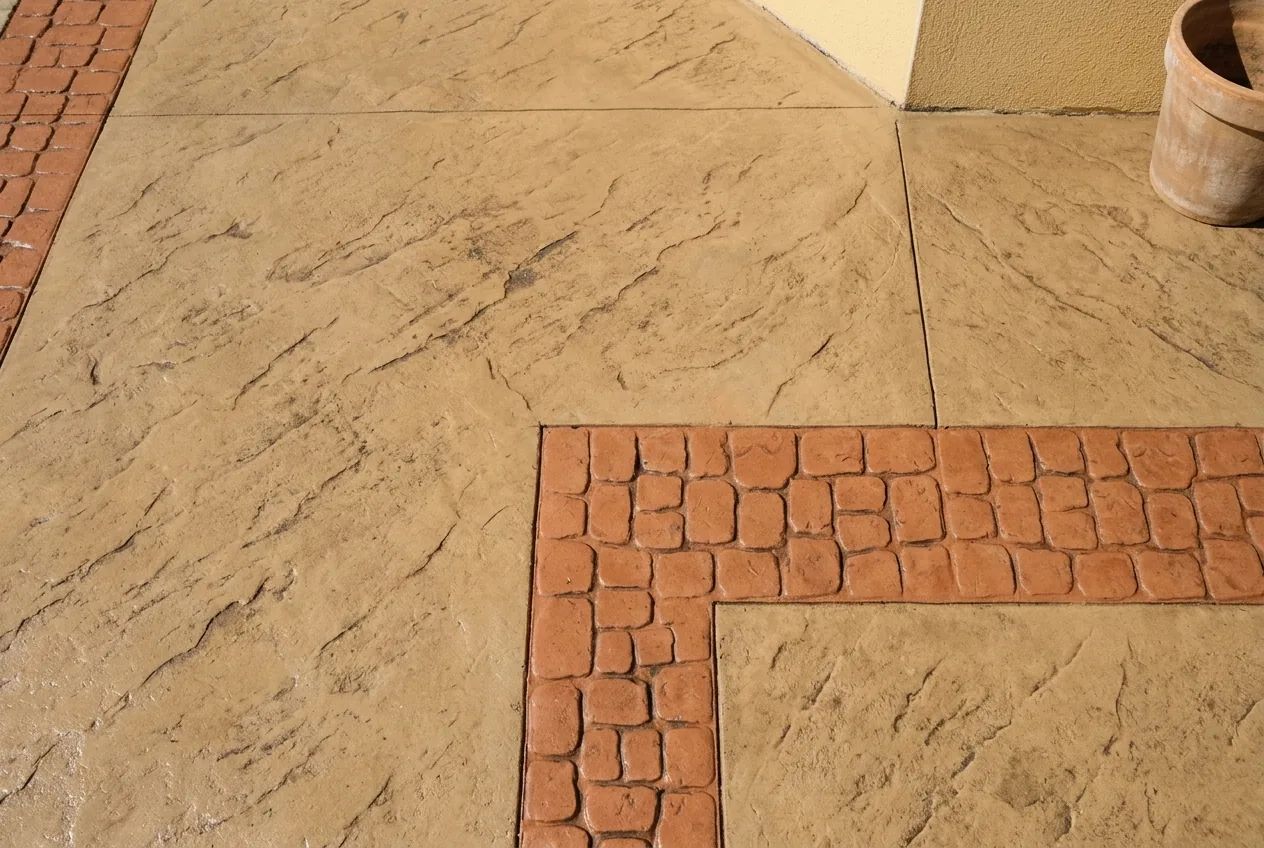
How to choose the colour and pattern of your stamped concrete
How to choose the colour and pattern of stamped concrete: colour and pattern families, how the colour is built up, how it ages in the sun and what suits houses in Mallorca.
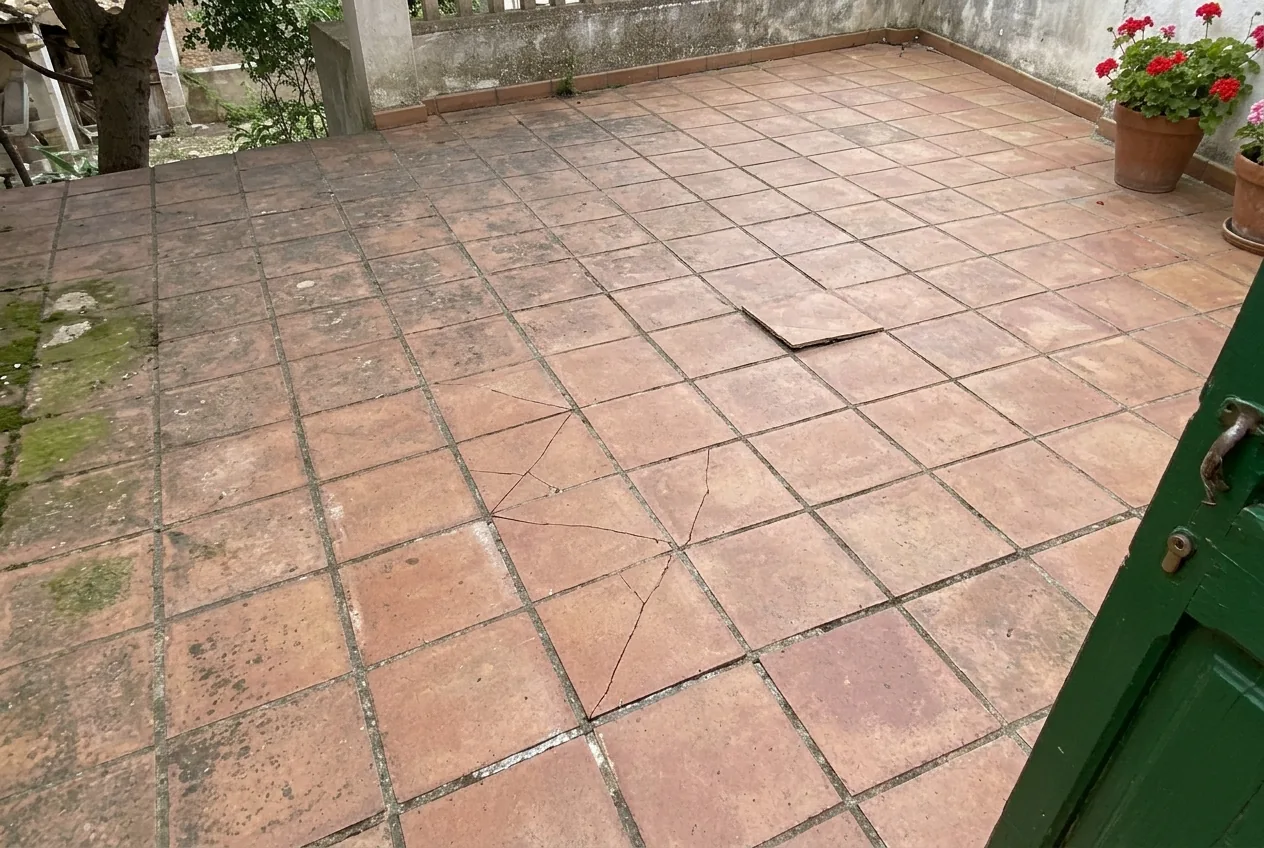
Stamped concrete or tiles for terraces and pools
Stamped concrete versus ceramic and stone tiles on terraces and pool surrounds: joints, slip resistance, heat, cost factors, repairs and lifespan.
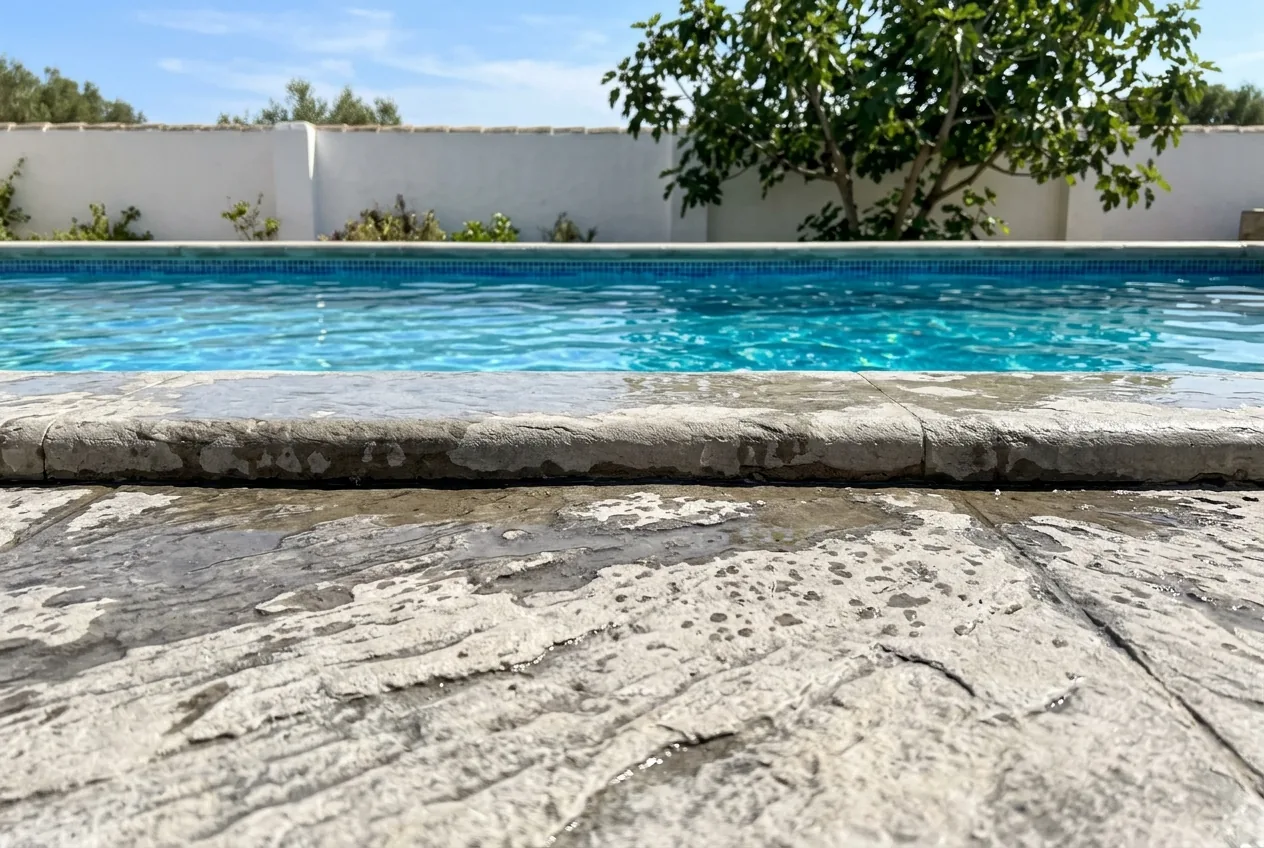
Non-slip floors around the pool
What slip class 3 requires around a pool, how textures and additives achieve it, and how stamped concrete, microcement, natural stone and porcelain tiles compare.
Solera Mallorca
Your terrace or pool surround in stamped concrete
Send us photos of the area, the approximate square metres and whether the pool is chlorine or salt. We suggest a texture, a colour and the falls.