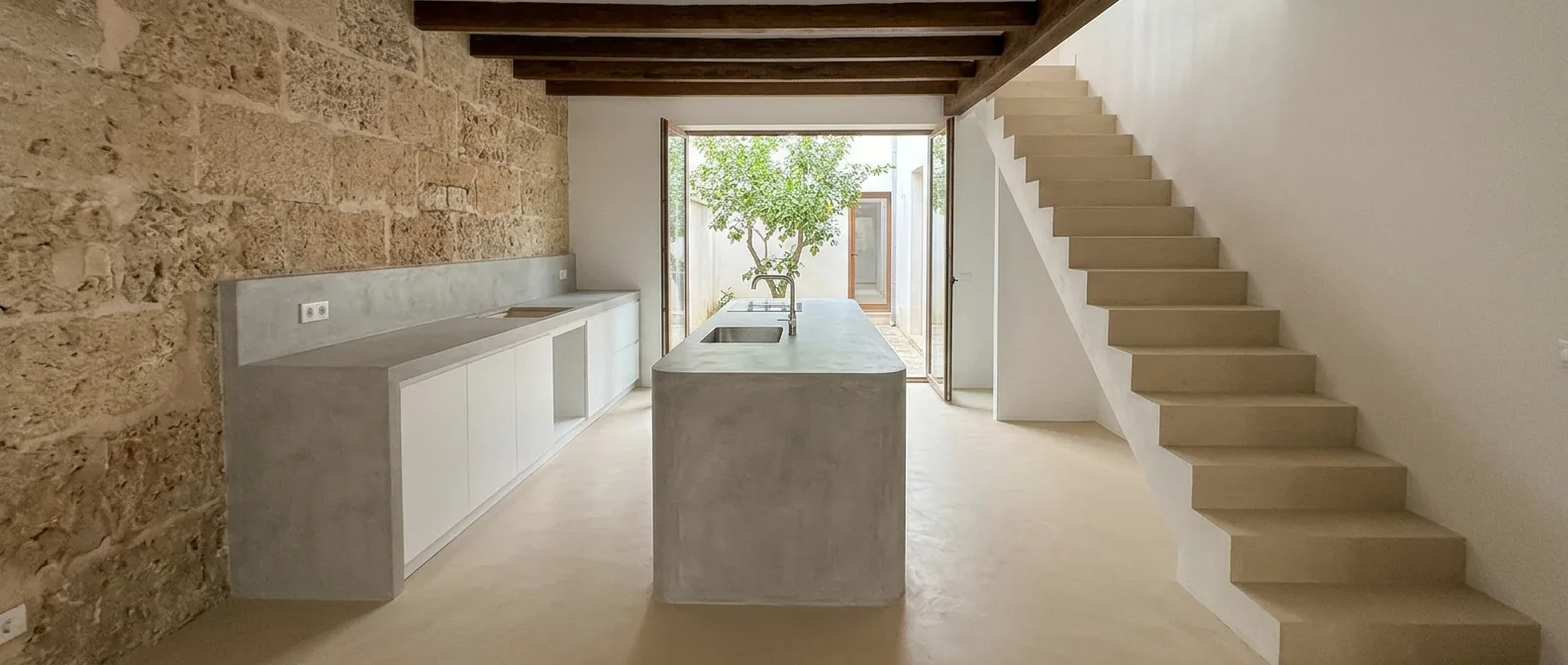
Microcement walls, kitchens and stairs
The same microcement as the floor goes up the wall, forms the kitchen splashback and worktop, covers a built-in bench and the treads of the stairs, at 2 to 3 mm and with no joints. Each surface needs its own preparation and has its own limits: damp in the walls, heat and acids on the worktop, the nosing and the anti-slip finish on the stairs.
Taking microcement from the floor up the walls, into the kitchen and onto the stairs gives a house without breaks, in the same colour from one floor to the next. Here we explain how each surface is prepared, how it is detailed and what not to ask of it.
Microcement on walls: which substrates
A wall can take microcement if it is firm, dry and flat. The usual substrates:
- Plaster, well bonded: cracks and hollow areas are repaired and a consolidating primer is applied, so the plaster does not draw the water out of the first coat.
- Plasterboard: joints taped, filled and reinforced with mesh. A board that moves will show its joint.
- Cement render: cured and dry, at least four weeks if it is new.
- Existing tiles: firm tiles, levelled joints and a bonding primer, as we explain in microcement over tiles.
Well bonded paint is sanded; flaking paint is removed. A wall that is out of true is straightened first: 2 to 3 mm will not correct it.
A microcement wall: one panel or the whole room
It can be a single feature wall, such as the wall behind a bed or the splashback of an open kitchen, or the whole room, floor and walls in the same material. On a wall, raking light from a window picks out the trowel marks and the clouding of the colour, and anyone who wants a calm wall chooses a fine, matt finish. Colour and texture are chosen from a sample, as we explain in microcement colours and finishes.
Corners, sockets, edges and skirting
- Internal corners: both faces are worked wet at the same time, with no joining line.
- External corners: mesh folded over the edge or an embedded corner bead. A slightly rounded edge takes knocks better.
- Sockets and switches: covers off with the power cut, microcement up to the box and covers back on over the sealed surface.
- Skirting: removed. With a microcement floor, the wall runs down with no skirting, with a rounded cove at the junction, or with a skirting in the same material.
- Ceiling and frames: a clean line with tape or a profile, and neutral cure silicone at the junctions.
Damp walls in old Mallorcan houses
Many old houses on the island have walls of marès, the soft local sandstone, or rubble stone laid in lime mortar, with a lower band that draws damp from the ground: blown plaster, salt deposits, a dark stain half a metre up. There, microcement waits until the cause has been dealt with.
Sealed microcement is a closed coating. Rising damp reaches it from behind, the salts it carries crystallise between the wall and the mortar, the sealer blisters and the coating comes away.
That is why we measure the damp at the visit and look for its source: the ground, a leaking terrace, a broken downpipe or condensation. Damp from the ground is treated first, with a damp-proof barrier, drainage or removal of the cement renders that trap it, and the wall is left to dry; a leak from above may call for terrace waterproofing. Where drying the wall is not realistic, the options are a dry lining with a ventilated cavity and the microcement on the board, or a lime render.
Microcement in kitchens: floor and splashback
A kitchen floor is just another microcement floor, although next to the hob and the sink the sealer wears sooner. The splashback usually goes over the existing tiles and works well: nobody walks on it or knocks it. The exception is a gas hob right against the wall, whose heat darkens the sealer over the years. With induction this does not happen; with gas, move the hob away from the wall or fit a glass or steel panel there.
Microcement worktops and islands
A worktop is coated over the existing one, if it is stone, quartz composite, laminate or tiles and is firm, or over a new rigid, moisture-resistant board fixed securely to the base units. If the board flexes, the microcement cracks. An island is done the same way.
The edges, which take the knocks, are wrapped in mesh and slightly rounded. The sink cut-out gets extra coats of sealer, because that is where water sits, and an inset sink is bedded on neutral cure silicone, never acid cure.
The limits, before you choose:
- Heat: a pan straight off the hob marks the sealer. Always use a trivet.
- Acids and oil: lemon, vinegar, wine or oil leave a ring if left for hours, and sooner if the sealer is worn.
- Knives: they scratch. Cut on a board.
The sealer is a two component polyurethane with high chemical resistance, in two or three coats, matt or satin. The sink and prep areas are checked every two or three years and resealed when water stops running off, usually after 3 to 5 years. If you cook a lot and cut without a board, porcelain or stone will stand up to it better. Cleaning is covered in the guide cleaning and maintaining microcement.
Built-in furniture: benches, shelves and vanity units
A built-in bench, a niche or a vanity unit in the same colour as the floor and walls has no joints and no change of material. The structure is built first, in brick, block or a metal frame with cement board, and it has to be rigid: a shelf that flexes cracks. Floor, wall and furniture are worked in the same coats so that the junctions are made wet, with rounded corners that do not chip. A built-in vanity unit is looked after like a worktop; a bench on the porch gets the exterior system.
Microcement stairs
Stairs can be coated over concrete, over firm tiled, terrazzo or marble steps, or over rigid, securely fixed timber, never over a staircase that creaks. Treads, risers and nosings are all coated, and the nosing, which works hardest, has two solutions:
- Nosing profile: an embedded metal profile that protects against knocks, at the cost of bringing in a second material.
- Rounded nosing with the mesh folded over the edge: continuous, but the first part to wear. A sharp, square edge chips at the first knock from a suitcase.
Smooth and sealed, microcement is slippery in socks and more so when wet, so the treads get a fine aggregate in the last coat of sealer and the risers are sealed smooth. Outdoor stairs get the outdoor microcement system: aliphatic sealer with UV filter, aggregate for class 3 and a slight fall on the treads.
How we organise the work in an occupied home
- Top down: walls, then worktops and furniture, and the floor last, so that nothing drops onto a sealed surface.
- Zone by zone, sealed off with plastic sheeting and sanded with dust extraction. The products are water-based and smell little.
- A temporary kitchen agreed with you, and the worktop done in one go.
- Stairs on alternate steps, so you can still go up and down with care.
- Timescale: a wall takes three to five working days, because of the drying between coats, and a kitchen with floor, splashback and worktop five to eight calendar days. You can walk on it 24 to 48 hours after sealing; worktop, plenty of water and furniture wait 7 days.
Solera Mallorca
How we work
- 01
Visit
We look at the substrate of each wall, the damp in the walls, the existing worktop and the state of the steps.
- 02
Preparation
We repair, level joints, protect what stays and remove covers, skirting and the sink if needed.
- 03
Base and mesh
Primer to suit the substrate, mesh in the first coat and reinforced edges on worktops and steps.
- 04
Finish
Two coats of fine microcement, sanded in between, in the same colour on floor, wall and furniture.
- 05
Sealing
Sealing primer and two coats of polyurethane, with aggregate on the stair treads.
- 06
Handover
We tell you when to use the worktop, when to walk on the stairs and how to look after each surface.
FAQ
Questions
Something else? Ask us when you request a quote.
Can microcement be used on walls?
Yes, over plaster, plasterboard, cement render or tiles, provided the wall is firm, dry and flat. A primer to suit the substrate is applied, mesh goes into the first coat and the system is the same 2 to 3 mm as on floors. It is not applied over flaking paint or over walls with active damp, which have to be dealt with first.
Can a kitchen worktop be done in microcement?
Yes, over the existing worktop if it is firm, or over a new rigid, moisture-resistant board. The edges are reinforced with mesh and rounded, the sink cut-out is sealed with particular care and the surface is protected with a two component polyurethane. It can be used normally 7 days after sealing.
Does a microcement kitchen stand up to heat and stains?
It stands up to daily use if its limits are respected. Hot pots and pans go on a trivet, because they mark the sealer. Lemon, vinegar, wine and oil are wiped up straight away: with the sealer intact they leave no trace, but if they are left for hours or the sealer is worn, they stain. Knives scratch it, so cut on a board. The prep area is checked every two or three years and resealed when water stops running off.
Can stairs be done in microcement?
Yes, over concrete, tiles, terrazzo, marble or rigid, securely fixed timber. Treads, risers and nosings are coated; the nosing is protected with a metal profile or rounded over mesh, and the treads get anti-slip aggregate in the sealer. Outdoors the exterior system is used, with a UV filter sealer and slip resistance class 3.
How long does a microcement wall or kitchen take?
A wall or single panel usually takes three to five working days, because of the drying between coats. A kitchen with floor, splashback and worktop takes five to eight calendar days. You can walk on it in clean footwear 24 to 48 hours after sealing, and the worktop, plenty of water and furniture wait 7 days.
Solera Mallorca
Tell us what you want to cover
A few photos of the wall, kitchen or stairs, rough measurements and what is there now underneath are enough for us to advise on the system and the working days.