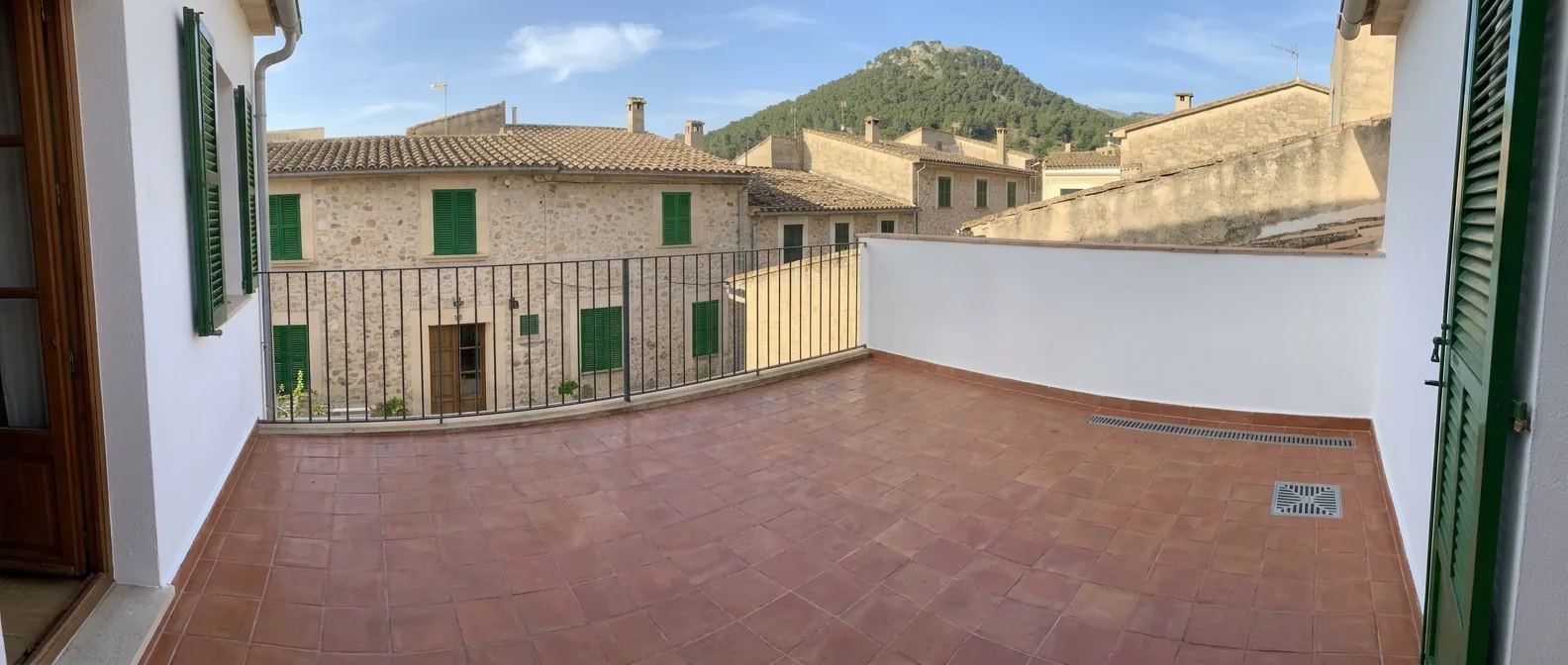
Waterproofing a terrace without lifting the tiles
A liquid membrane over the existing tiles solves most leaks in a few days of work and with no rubble. It works when the substrate is sound and the terrace has a fall, and we will tell you plainly when that is not the case.
Waterproofing a terrace without lifting the floor means applying a liquid membrane, usually polyurethane, directly over the tiles that are already there. The membrane forms a continuous, elastic layer that covers joints, cracks and junctions, and carries water to the drain without it ever touching the mortar underneath. It is the option we are asked for most, because it avoids breaking out the floor, carrying rubble down the communal stairs and going weeks without a terrace. Here we explain when it really works, when it does not, how the substrate is prepared and which finishes there are.
When it works
The system depends entirely on what is underneath. To apply it over the existing tiles, three conditions have to be met:
- Sound substrate. The tiles are firm and bonded. The odd loose or broken tile can be fixed or replaced, but the floor as a whole has to sound solid when tapped.
- A fall towards the drain. Water reaches the drain on its own, with no puddles left for hours after rain. The trade rule is 1 to 2 percent, and a membrane does not create a fall where there is none.
- Drains that work. The drains have a reinforcing collar or can be fitted with one, the pipe takes the water away and there is an overflow, or one can be opened.
If they are met, a liquid membrane is a complete system, not a patch-up: with 1.5 to 2 millimetres of polyurethane reinforced at the critical points, the terrace stays watertight for years with minimal maintenance.
When it does not work
We say so at the first visit, because a membrane over a poor substrate fails in the first heavy rain and the money is lost.
- Hollow tiles over a wide area. There is water and air underneath. The membrane bonds to a tile that moves, and the joint ends up opening beneath the new layer. If there are many hollow tiles, the floor is lifted.
- No fall, or a back fall. Ponding water eventually finds a pore, and it also ruins the finish. A fall can be built up with a lightweight screed, but that is already building work, and it has to be weighed against lifting.
- Drains that are blocked or sit above floor level. A drain that does not take the water turns the terrace into a pool. If the drain cannot be repaired or lowered, the floor around it has to be lifted.
- Damaged slab. Structural cracks, exposed reinforcement on the ceiling below or visible sagging are a problem with the slab, not the floor, and need to be assessed by an architect or surveyor before any waterproofing.
When the answer is to lift, we explain it on the page on terrace waterproofing, with a sheet or liquid membrane over new falls and a new floor on top.
Preparing the substrate
The membrane is only as good as what lies beneath it. Preparation takes as long as application.
- Cleaning. Degreasing, pressure washing and removal of old silicone, paint, moss and any loose cement grout. The surface has to be clean and dry right through.
- Repairs. Loose tiles fixed or replaced, cracks opened up and filled, empty joints filled with a flexible mortar.
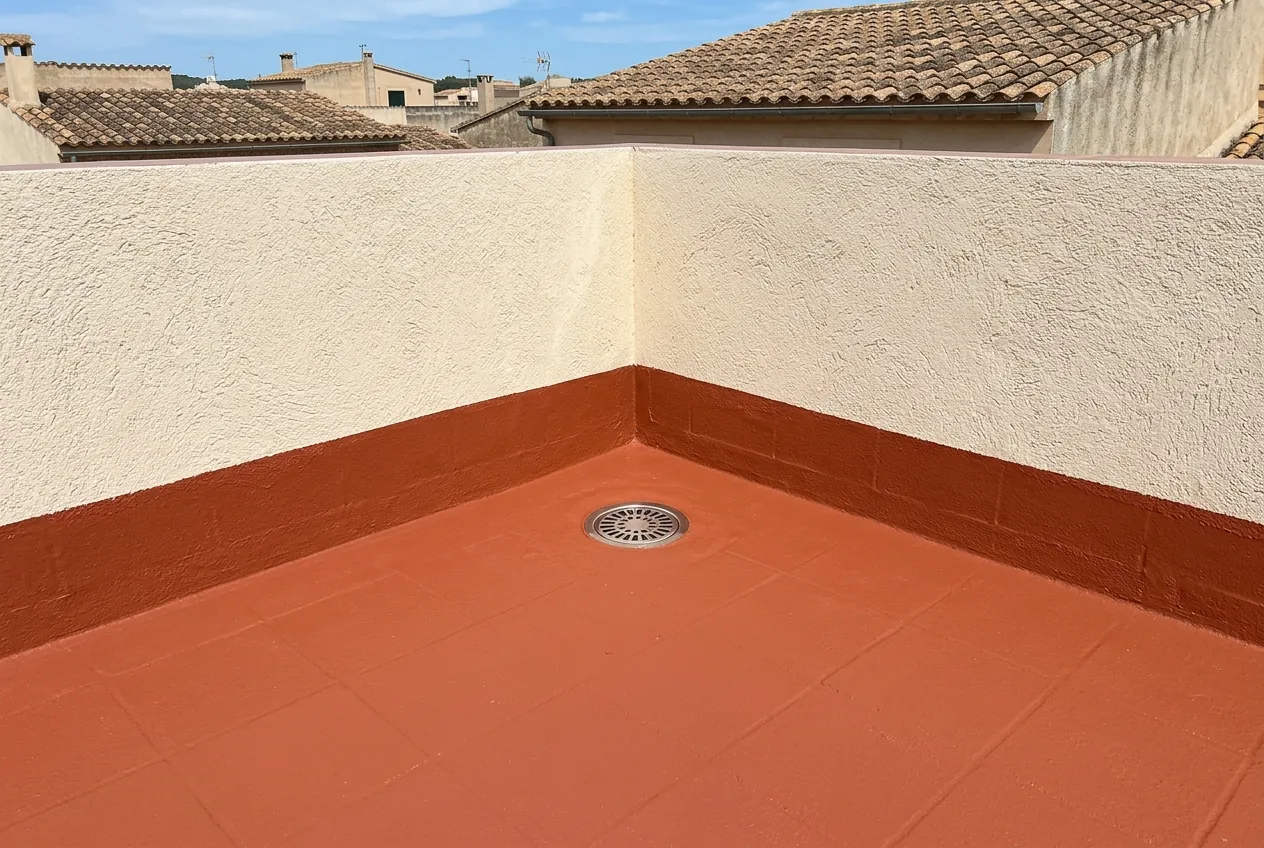
- Critical points. Each drain gets a reinforcing collar, and the membrane is taken down into the pipe and reinforced with polyester mesh. Junctions with parapets and walls are sealed with a cove fillet and reinforced in the same way, taking the membrane at least 15 to 20 centimetres up the wall. Door thresholds are dealt with one by one.
- Primer. One specific to ceramic or porcelain tiles, which have very little porosity. We carry out an adhesion test before priming the whole terrace: if the polyurethane does not grip on the sample, we change the primer or the system.
Finishes
- Walk on, in colour. The polyurethane membrane itself takes a final aliphatic coat that resists sun and foot traffic, in grey, white, terracotta or sand, with anti-slip aggregate if wanted. It is the most direct finish and the most economical.
- Clear. For those who want to keep the tiles on view. It works on ceramic and porcelain tiles in good condition; bear in mind that it darkens the tone a little and needs more frequent maintenance, because it has no pigment to protect it from UV radiation.
- With a new floor on top. The membrane becomes a hidden layer and new tiles are laid on it with a compatible adhesive, or a continuous finish of outdoor microcement is applied. It adds a few millimetres of height, which has to be checked at the thresholds.
How long it takes
A domestic terrace of 20 to 60 square metres usually takes two to four days: one day of preparation, one day for the critical points and primer, and one or two for the coats of membrane, with 6 to 24 hours of drying between them depending on the temperature. It can be walked on 24 to 48 hours after the last coat and furnished after three or four days. On community roof terraces, the timescale depends on the square metres and the number of drains. We work with no rain forecast and outside the hottest hours in summer, because polyurethane does not cure properly on a tile at 50 degrees.
The guide on waterproofing a terrace without lifting the tiles goes further into the comparison with lifting, and sets out the strengths and limits of each type of liquid membrane in a table.
Solera Mallorca
How we work
- 01
Substrate check
We tap the tiles, measure the fall and test the drains.
- 02
Cleaning
Degreasing and pressure washing, removing old silicone and loose grout.
- 03
Repairs
Loose tiles fixed or replaced, joints and cracks filled.
- 04
Critical points
Drains, corners and parapets sealed and reinforced with mesh.
- 05
Membrane
Primer and two or three cross applied coats of polyurethane.
- 06
Finish and test
Walk on top coat and a water test before handover.
FAQ
Questions
Something else? Ask us when you request a quote.
Can a terrace be waterproofed without building work?
Yes, when the tiles are firm, the terrace falls towards the drain and the drains work. A liquid polyurethane membrane is applied over the clean, primed tiles, with no breaking out and no rubble. If the substrate is hollow or there is no fall, the floor has to be lifted.
Which waterproofing product is used over tiles?
Liquid polyurethane with a primer specific to low porosity ceramic substrates, reinforced with mesh at joints, drains and wall junctions, and with a final aliphatic coat that resists the sun. It is applied in two or three coats up to 1.5 to 2 millimetres.
Is there a clear waterproofing for terraces?
Yes, clear polyurethanes for ceramic and porcelain tiles that keep the tiles on view. They slightly darken the tone and, having no pigment, need more frequent maintenance than a coloured finish. On badly deteriorated tiles they are not worth it.
How long does waterproofing over tiles last?
It depends on the system, the thickness and the maintenance: clean drains, nothing nailed or drilled through the membrane, and a check of the parapet seals every few years. The specific lifespan of the chosen system is set out in the quote and in the written guarantee.
Can a new floor be laid on top of the membrane?
Yes. Once the membrane has cured, tiles can be laid on it with a compatible adhesive, or a continuous outdoor microcement finish applied. It adds a few millimetres of height, which we check at the door thresholds before proposing it.
Solera Mallorca
Ask us whether your terrace can be done without lifting
Send us a general photo of the terrace, one of the drain and one of the ceiling below, and we will tell you whether the substrate allows a membrane over the tiles.