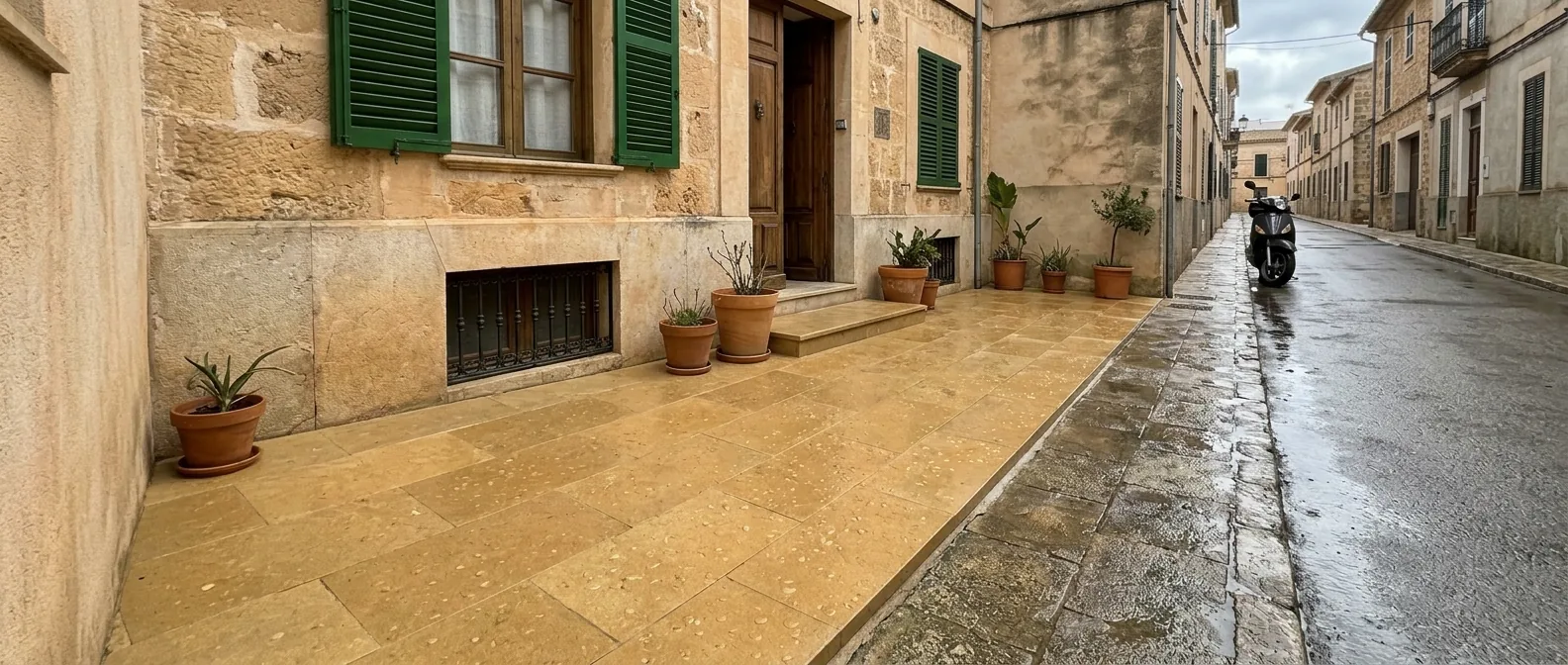
Pavement sealing in Mallorca
An unprotected outdoor surface, from a driveway to a pool terrace, absorbs water, salt, oil and dirt, and ages from the inside. For each surface we choose the product that suits it, a film sealer, a water repellent or an impregnator, apply it to a clean, dry substrate and tell you when it is due again.
Sealing a surface means protecting it from what wears it down: water that gets into the pores and carries salts, sun that breaks down the surface, salt in the air, oil from cars, algae in the shade and dirt that works its way in. Each material reacts in its own way and each calls for a different product. This page explains, in plain words, the difference between a film sealer, a water repellent and an impregnator, what each surface needs, how often it is repeated and what it protects against in Mallorcan conditions. Stamped concrete has its own section on restoration and resealing.
Film sealer, water repellent and impregnator
They are often confused, and the confusion leads to gloss where discretion was wanted, or to a floor that needed protection being left without it.
- Film sealer. An acrylic or polyurethane resin that forms a continuous layer on the surface. It changes the appearance: it deepens the colour, gives gloss or satin and a smooth feel. It protects against everything that comes from above, water, stains, sun, and it wears away through traffic and UV, so it is renewed every few years. It is what stamped concrete carries and what is used on exposed concrete and pavers when the colour is to be enhanced.
- Water repellent. A silane or siloxane based product that penetrates millimetres into the pores and makes them water repellent from within, without forming a film. It does not change the look or the feel, it lets the material breathe and it cannot peel because there is nothing to peel. It is the choice for natural stone, marés, terracotta and facades: water runs off and the material stays dry and free of efflorescence.
- Stain-proofing impregnator or oil repellent. A water repellent that also repels grease. For stone and terracotta in dining areas, barbecues and outdoor kitchens, where the problem is not rain but oil and wine. It gives no sheen either.
There are products in between, wet-look water repellents that slightly darken the tone without forming a film, and consolidants for stone that is powdering.
What each surface needs
Concrete
Exposed, trowelled or ground exterior concrete takes an acrylic or polyurethane sealer if colour and sheen are wanted, or a water repellent for protection without a change in appearance. On garage slabs and ramps with cars, polyurethane stands up better to tyres and oil. New concrete must cure for at least 28 days before sealing. Repeat: every 2 to 4 years for a film sealer, every 5 to 10 for a water repellent.
Private asphalt
Finca tracks, community and hotel car parks and garage ramps age under the sun, which oxidises the bitumen and turns it grey and brittle, and under water that gets into the cracks. Crack sealing, patching and a bituminous slurry or surface sealant every 3 to 5 years greatly extend the life of the surface. It is maintenance work, different from resurfacing, and where the asphalt has failed structurally it becomes a civil works job rather than a sealing one. The details are on the private asphalt page and in the guide to sealing and maintaining private asphalt.
Natural stone and terracotta
Marés, Santanyí stone, limestone and fired clay are porous and absorb water, oil and salt. A water repellent, or a stain-proofing impregnator in dining areas, protects them with no sheen and no film. Repeat: every 3 to 6 years depending on exposure and porosity, sooner on the seafront.
Pavers
Concrete pavers lose colour in the sun and stain with oil and algae; their sand joints empty with washing and rain. A film sealer enhances the colour and, if applied with the joints filled with dry sand, stabilises them. A water repellent protects without changing the look. Repeat: every 2 to 4 years for the sealer, every 5 or more for the water repellent.
What British owners call patio sealing is one of these products: on natural stone a water repellent or a stain-proofing impregnator, on concrete pavers a water repellent or a film sealer. The page on stone and pavers explains which suits each surface.
Preparation decides the result
No protective product bonds to a dirty floor or penetrates a pore full of water. The sequence is always the same: controlled pressure cleaning with whatever treatment each stain needs, repair of cracks, joints and edges, rinsing so that no residue is left, and complete drying. On stone and concrete we measure the moisture in the substrate when in doubt, because a water repellent applied to a damp pore does not penetrate and a sealer over moisture traps water and turns white. With products going over an earlier one, we check compatibility on a sample before spreading.
Anti-slip
A film sealer, especially a gloss one, reduces grip when the floor is wet. Wherever there are bare feet, water or a slope, pool copings, outdoor showers, external stairs, garage ramps, we add a fine aggregate or microspheres to the final coat; they sit in the film and give the grip back without being seen. Water repellents and impregnators do not change the slip resistance of the surface, because they form no layer: the stone stays as rough as it was.
What it protects against in Mallorca
- Sun. UV radiation bleaches the pigment in concrete and pavers and oxidises the bitumen in asphalt. A sealer with UV filter or an aliphatic polyurethane slows that process; sealed asphalt keeps its black and its flexibility.
- Salt air. On the coast, salt enters the pores with the night humidity, crystallises as it dries and breaks the material from within. A water repellent cuts off that entry and is the most effective maintenance measure for seafront stone, from Andratx to Alcúdia.
- Autumn rain. Water that saturates a surface carries salts to the top as efflorescence and, where there are frosts inland, in Inca or the Serra, breaks the edge of the pore. A protected substrate does not saturate.
- Algae. In shade and damp, moss and algae grow on any pore. A sealed or water repelled surface dries sooner and gives them less to hold on to.
- Oil and stains. Tyres, engine oil, pine and fig leaves, wine and barbecue grease stain an open pore permanently and a protected one only on the surface.
- Limestone dust. The pale dust from the island's tracks and building sites works into the pores and greys the colour; on a protected surface it washes off with water.
Solera Mallorca
How we work
- 01
Diagnosis
We identify the material, its porosity, any previous product and the exposure.
- 02
Cleaning
Pressure washing, degreasing and treatment of algae, rust or efflorescence.
- 03
Repair
Cracks, joints and edges before protecting.
- 04
Drying
The substrate dry in depth, with the moisture measured where needed.
- 05
Application
One or two coats of the right product, by roller or sprayer.
- 06
Handover
Traffic times and the guide date for the next treatment.
FAQ
Questions
Something else? Ask us when you request a quote.
Which is better, a water repellent or waterproofing?
They are different things. A water repellent makes a porous material repel water without forming a layer or changing its appearance, and lets it breathe; it suits stone, terracotta, concrete and facades. Waterproofing forms a continuous watertight layer and is what a terrace over a dwelling needs. A stone floor in the garden gets a water repellent; a terrace with a bedroom underneath gets waterproofing.
How is a water repellent applied?
On a clean, dry substrate with no previous product, by brush, roller or low-pressure sprayer, in one or two coats wet on wet until the material stops absorbing. Excess is removed so that no shiny patches remain, and it must not rain in the following 24 hours. The repellent effect shows after a few days.
Which product is used to seal concrete?
It depends on what you want. An acrylic or polyurethane sealer forms a film, deepens the colour and gives gloss or satin; a silane water repellent protects against water without changing the appearance; a lithium densifier hardens polished concrete. Outdoors with cars, polyurethane is the one that stands up to tyres and oil.
How often does an outdoor surface need sealing?
A film sealer every 2 to 4 years; a water repellent every 3 to 6 on stone and up to 10 on concrete; an asphalt seal every 3 to 5. Exposure to sun, sea and traffic shortens the intervals. The common sign is that water stops beading and starts to darken the surface.
Can a newly laid surface be sealed?
Concrete needs to cure for at least 28 days before taking a sealer or water repellent; new asphalt needs several months of traffic and sun before a surface seal; newly laid stone needs the joint mortar fully dry and the initial efflorescence cleaned off.
Does sealing make the floor slippery?
A gloss film sealer can when the floor is wet, which is why in pool areas, on stairs and on ramps we add anti-slip aggregate to the final coat. Water repellents and impregnators form no layer and do not change the grip of the surface.
Guides
Related guides

Water-based or solvent-based sealer for stamped concrete
What separates solvent-based acrylic, water-based acrylic and polyurethane sealers for stamped concrete, and when each one makes sense.
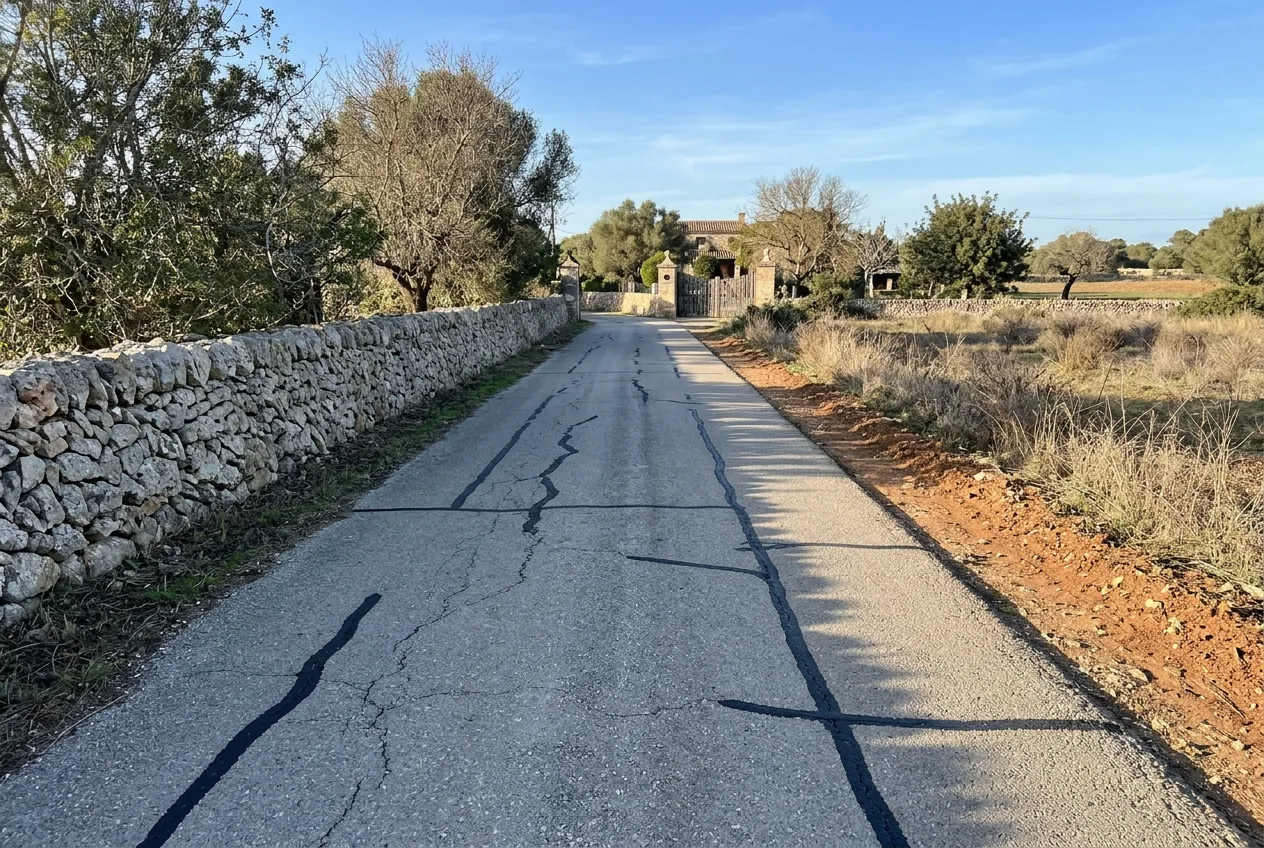
Sealing and maintaining private asphalt in Mallorca
How to maintain the asphalt on finca tracks, community and hotel car parks and garage ramps: crack sealing, patching, slurry seal, the right time of year and when it is not enough.
Solera Mallorca
Tell us which surface you want to protect
A few photos of the surface, the material if you know it and whether it faces the sun, the sea or shade are enough for us to tell you which product it needs.