Stamped concrete
How to choose the colour and pattern of your stamped concrete
How to choose the colour and pattern of stamped concrete: colour and pattern families, how the colour is built up, how it ages in the sun and what suits houses in Mallorca.
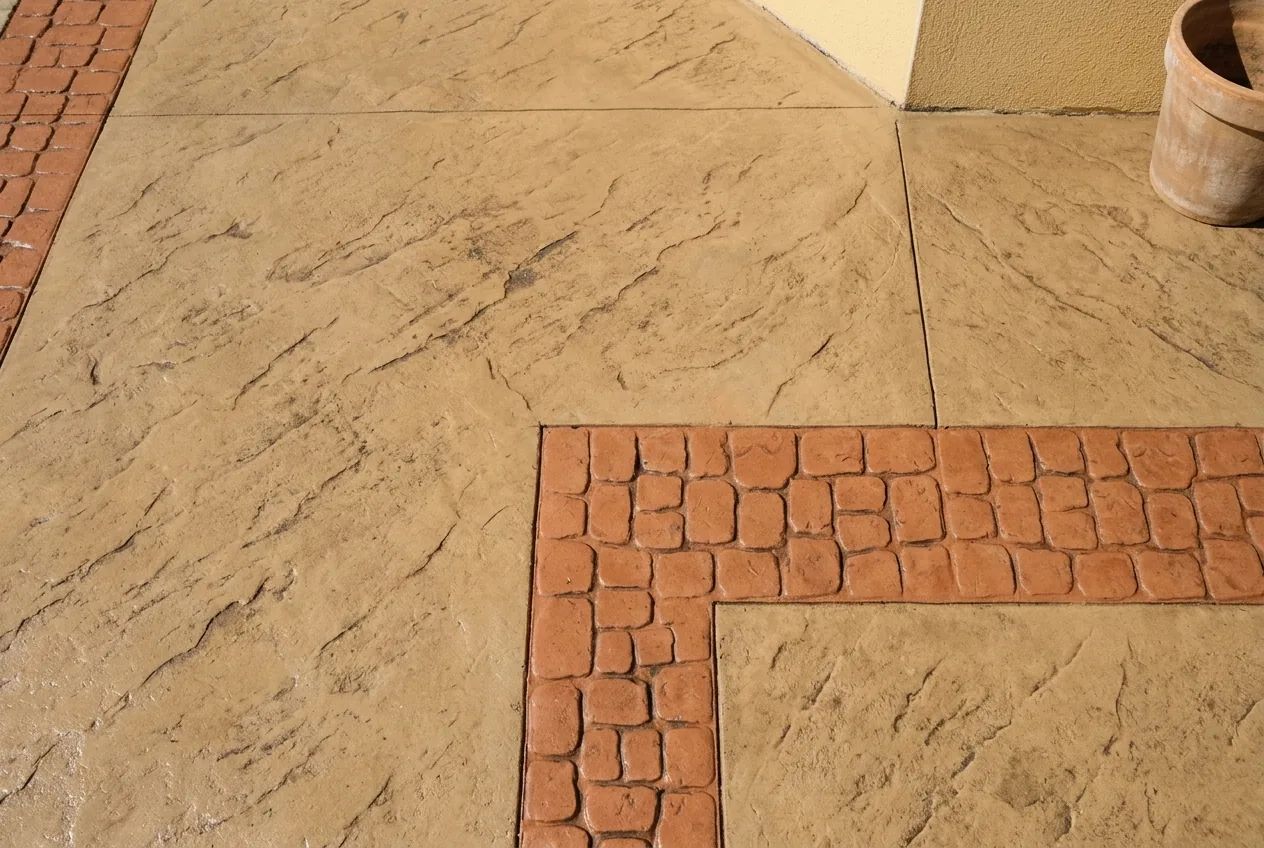
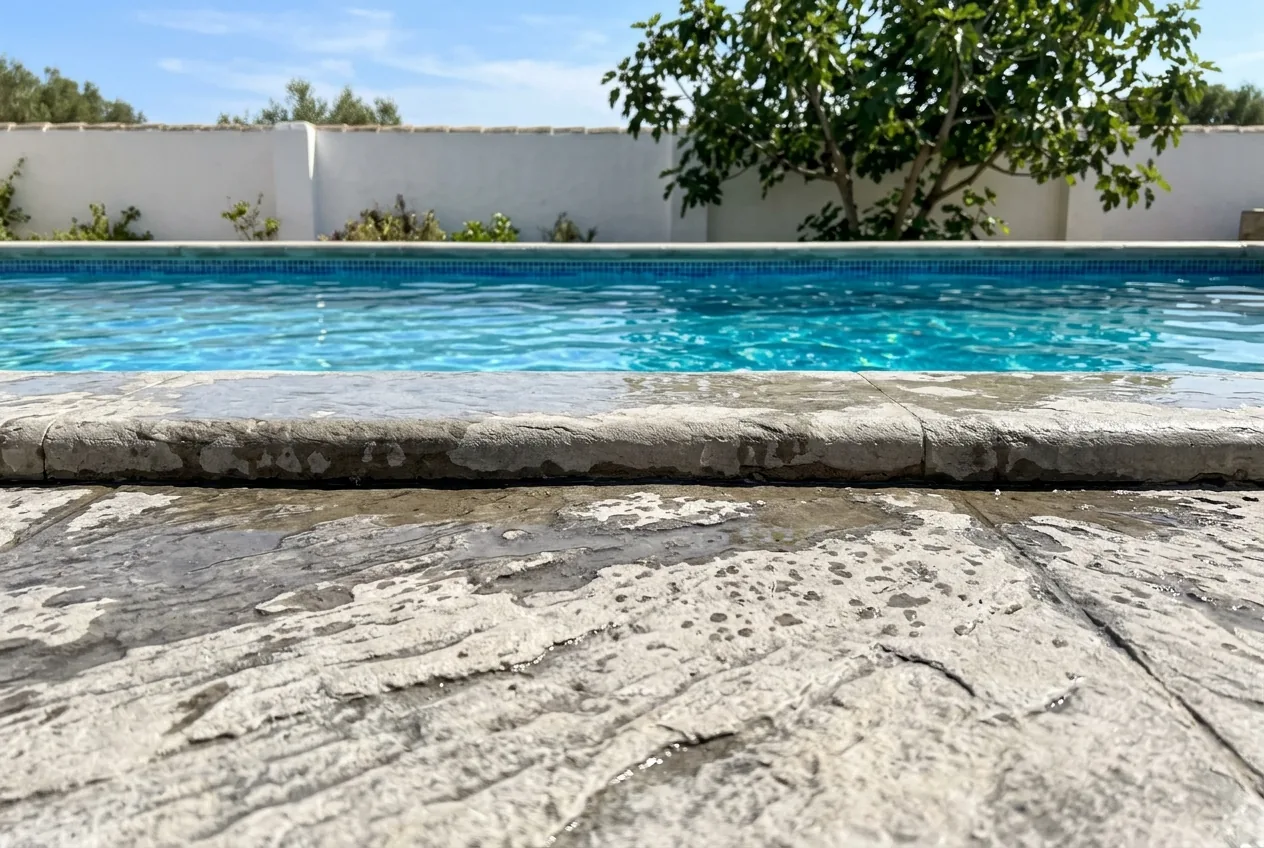
In Mallorca, the stamped concrete colour that works best is almost always one from the sand, beige or light ochre family: it goes with the island's stone and marès (the soft golden sandstone quarried on the island), stays comfortable to walk on in summer and hides limestone dust. The mould depends on the house and the area: random stone or large flagstone for terraces, cobble for driveways, slate or fine stone for pool surrounds. Before choosing from a catalogue, it is worth understanding how the colour is made, why it changes over the years and what happens in the heat, because a 10 by 10 cm sample in an office tells you none of that.
How the colour is made
Stamped concrete is not painted. Its colour comes from three layers:
Colour hardener. A powder of cement, fine sand, mineral pigments and additives that is broadcast over the fresh concrete and floated in until it becomes part of the top 2 or 3 mm. It gives the base colour and hardens the surface. This is the main decision.
Release agent. A powder in another shade, usually darker, spread before the mould is pressed in so that the mould does not stick. It stays in the hollows and joints of the pattern and gives the aged stone effect. A dark grey release agent on a sand base looks like old stone; one in the same shade as the base gives a uniform, more modern finish. Most of it is washed off after curing.
Sealer. The final resin saturates the colour, like water on a stone. A clear sealer darkens the shade by a tone or two; a tinted one lets you adjust or restore the colour years later.
Colour families
| Family | Shades | What it suits | Heat in the sun | How it ages |
|---|---|---|---|---|
| Sand and beige | Sand, bone, cream, beige | Marès, Santanyí stone, whitewashed façades | Low; walkable barefoot in summer | Very well; wear barely shows |
| Ochre and stone | Ochre, honey, golden stone | Village houses, fincas, dry stone walls | Low to medium | Well; loses some intensity |
| Grey | Light grey, stone grey, lead grey | Contemporary villas, black or anthracite window frames | Medium in light shades, high in dark ones | Light grey holds up; dark grey lightens in patches |
| Terracotta and tile red | Tile red, salmon, earth red | Fired clay, curved clay roof tiles, traditional patios | High | The family that fades most in the sun |
| Brown and chocolate | Walnut, tobacco, chocolate | Wood effect, gardens with a lot of planting | Very high; burns bare feet | Lightens and looks dusty without resealing |
| Off-white | Off-white, pearl | Mediterranean architecture, pools with clear water | Very low | Gets dirty faster; efflorescence shows more |
Moulds and patterns
The moulds are polyurethane mats with the texture of a real material. The most common are:
- Random stone or slate: flags with irregular edges and a strong texture. The pattern most used on terraces and pool surrounds, because it gives grip and hides the shrinkage joints.
- Flagstone or English stone: large rectangles with a soft texture. A tidier look, and quick to lay over large areas.
- Cobble: small pieces laid in fans, herringbone or straight rows. Common on driveways; it hides tyre marks and cracks.
- Wood: planks with grain. Convincing in colour, less so underfoot and over time.
- Plain or broom finish: no pattern, just a fine texture. This is the plain stamped concrete of contemporary villas.
- Borders: edge moulds that frame the surface with another pattern or colour.
Large moulds cover ground faster and leave fewer joints; small ones give more detail and more grip. On a curved pool surround, random stone adapts better than cobble.
How the colour ages
The sun is the main factor. Ultraviolet radiation breaks down the sealer first and, once that has gone, attacks the pigment. The red and yellow iron oxides in terracottas and ochres are the most sensitive; greys and sands hold up better. Rain washes the release agent out over the years and the contrast of the pattern softens. Limestone dust settles in the texture and lightens the whole surface.
None of this is irreversible as long as the floor is resealed. A clear sealer brings back the saturation; a tinted one restores the shade; a stain in the joints recovers the contrast. The guide on how often to reseal explains the cycle. What is worth knowing when you choose is that a strong terracotta will be a pale salmon after six years without maintenance, while a sand colour will still look like itself.
Choosing for a Mallorcan house
The island's palette is set by three materials: the golden marès from the quarries of Llucmajor and Santanyí, the light grey limestone of the dry stone walls, and the terracotta of fired clay floors and roof tiles. Sand or ochre stamped concrete with a grey or light brown release agent blends with the first two without effort. Terracotta suits village patios and houses with exposed roof tiles, but it is the one that needs the most colour maintenance. Light grey with a plain or large flagstone mould is the choice for the new villas of Calvià and Andratx.
A rule that avoids mistakes: the paving should sit one or two tones below the façade in intensity.
Light colours and heat
At three in the afternoon in August, a dark grey or brown floor in the sun goes above 55 °C and cannot be walked on barefoot. A sand or off-white one stays 10 or 15 degrees cooler. For pool terraces, this matters more than taste. A matt finish feels slightly less hot than a high gloss. Light shades have a downside: they show stains from pine needles, rust and tyres, and efflorescence is more visible. A good sealer makes up for it.
How to decide without getting it wrong
- Look at samples outdoors, in sun and in shade, next to the façade.
- Ask for a sample made with the mould and release agent that will actually be used.
- Wet it. The sealed colour will look like the wet colour of the unsealed sample.
- If you can, ask to see a floor in the same colour that is three or four years old.
- Choose the mould for the use first, then the colour.
The page on stamped concrete colours and patterns shows the range we work with.
When to call a professional
Choosing the colour and mould is the owner's decision, but it is worth making it with whoever will carry out the work, because the result depends on the combination of hardener, release agent and sealer. A contractor can lay a one square metre sample panel on your own plot before the pour, which is the only way to see the final colour in the real light of the place. If the floor already exists and you want the colour back, the route is restoration with a tinted sealer, not a new floor.