Stamped concrete
Non-slip floors around the pool
What slip class 3 requires around a pool, how textures and additives achieve it, and how stamped concrete, microcement, natural stone and porcelain tiles compare.
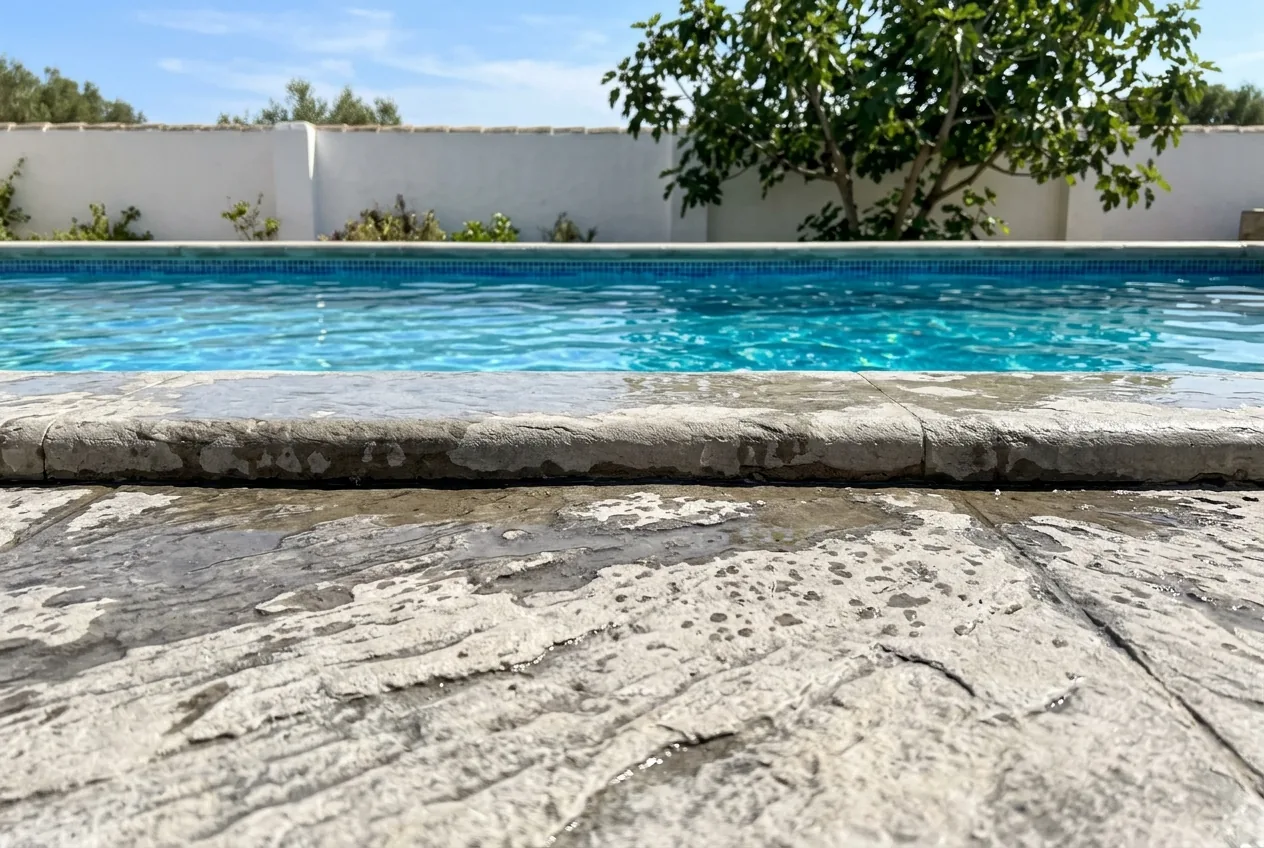
A floor around a swimming pool should be slip class 3 under the Código Técnico de la Edificación (CTE, the Spanish building code), the most demanding class, with a slip resistance above 45 in the pendulum test. The requirement applies to pools in public or shared use, such as those of hotels and of comunidades de propietarios (the owners' associations of shared developments), and it is the sensible reference for a private pool. Stamped concrete with a texture and an anti-slip additive reaches it, as do flamed or bush-hammered natural stone, porcelain tiles rated class 3 and textured microcement. No smooth, glossy surface reaches it, however good it looks when dry.
What the regulations say
Document DB-SUA 1 of the building code classifies floors by their slip resistance, measured with the pendulum friction test on a wet surface:
| Class | Slip resistance (Rd) | Where it is required |
|---|---|---|
| 0 | 15 or less | No requirement |
| 1 | Over 15 up to 35 | Dry indoor areas with a slope under 6% |
| 2 | Over 35 up to 45 | Wet indoor areas with a slope under 6%, dry indoor areas with a steeper slope, or stairs |
| 3 | Over 45 | Wet indoor areas with a slope of 6% or more, wet stairs, outdoor areas, pools and showers |
Pool areas include the surround, the showers and the floor of the shallow parts of the pool. The rule applies to public and shared buildings; in a single-family house it is not compulsory, but the reason it exists, wet bare feet on water, is the same in a house in Pollença as in a hotel in Alcúdia.
Tile boxes carry another scale: the German one, from R9 to R13, obtained on an inclined ramp with shoes. It does not translate directly into the CTE classes, although R11 usually matches class 3. There is also a third, from A to C, tested barefoot on a wet ramp and designed for pools: C is the most demanding. For a pool, ask for CTE class 3 or, failing that, barefoot class C.
How grip is achieved
Slip resistance depends on the microtexture, not on appearance. There are three ways to get it:
The texture of the material itself. Stamped concrete with a stone mould, flamed stone, porcelain with a relief. The texture breaks up the film of water under the foot.
Surface treatment. An acid that micro-etches the surface of porcelain or smooth stone, or sandblasting on concrete. These improve the class without changing the look, but they last a limited time where people walk.
An additive in the sealer. Polymer microspheres or fine aggregate mixed into the last coat of sealer, which leave a fine, rough surface. This is what is used on stamped concrete and microcement to reach class 3 without losing the finish. It lasts as long as the sealer, 2 to 4 years, and is renewed at each reseal.
Pool paving compared
| Paving | Class 3 | How it gets there | Heat in the sun | Barefoot comfort | Maintenance |
|---|---|---|---|---|---|
| Textured stamped concrete | Yes | Stone or slate mould plus additive in the sealer | Low in light colours | Good; the texture does not dig in | Resealing with additive every 2 to 4 years |
| Plain stamped concrete | Only with treatment | Plenty of additive or a broom texture | Low in light colours | Very good | As above |
| Outdoor microcement | Yes, in textured systems | Rough finish plus anti-slip sealer | Low in light colours | Good | Resealing every 3 to 5 years, more often at the pool edge |
| Flamed or bush-hammered natural stone | Yes | Factory finish | Low in light limestone, high in slate | Depends on the grain; coarse bush-hammering is uncomfortable | Water-repellent treatment every 2 to 5 years |
| Polished or honed natural stone | No | Would need an acid treatment | As above | Very good | As above, with a slip risk |
| Class 3 porcelain | Yes | Factory relief | Low in light colours | Good with a fine relief; rough with a strong one | Joints; clean grout |
| Wood or composite | Variable | Grooves | High in dark wood | Good | Oil or annual cleaning |
Stamped concrete on pool surrounds
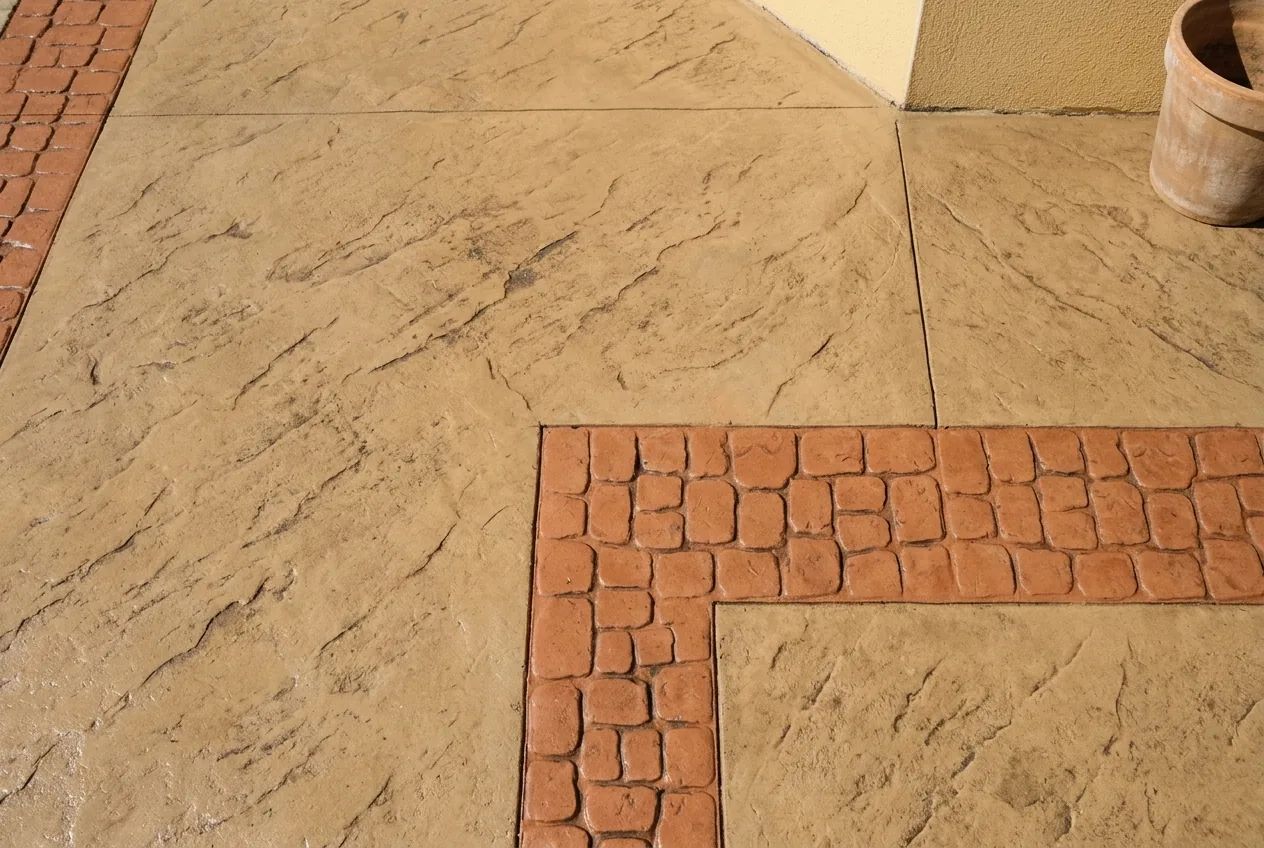
It is the most common option for villas on the island, for three reasons: it is continuous, with no joints for algae to grow in and no pieces to lift; it adapts to any pool shape; and with a stone mould and an anti-slip additive in the sealer it meets class 3. The coping can be in the same concrete, with a rounded edge mould, or in stone.
What you should insist on is that the anti-slip additive goes in the last coat, over the whole surface and in a sufficient proportion. A glossy sealer without additive on a smooth mould is exactly what you do not want next to water. The page on stamped concrete for terraces and pool surrounds describes the moulds and sealers used in this case.
Microcement in pools
Microcement is applied both on the surround and inside the pool, with systems made for immersion. Its natural finish is smooth, so for a pool surround it is worked with a more open texture and a sealer with an anti-slip additive. It is a seamless, contemporary solution with two conditions: the base must be a stable slab laid to falls, and you have to accept more frequent resealing in the area that gets chlorine and wet feet every day. The guide on outdoor microcement sets out what it withstands and what it does not.
Natural stone
The island's stone, a light limestone, works very well with a flamed or fine bush-hammered finish. It stays cool, ages well, and stone coping is the traditional material. Its limits: it needs a periodic water-repellent treatment so that it does not stain, the joints need upkeep, and a polished piece on a pool edge is slippery. Sealing and impregnating stone is part of its normal maintenance.
Comfort and heat
A floor can be class 3 and still unpleasant: coarse bush-hammering or porcelain with a strong relief hurts the feet and holds dirt. The balance lies in fine-grained textures. As for heat, on a pool surround in July the colour matters more than the material: any dark surface burns, and any light one can be walked on. Choosing sand, bone or light grey is the most effective step you can take.
When to call a professional
Slip resistance cannot be judged by eye: it is measured. If the pool is in public or shared use, the surround paving must prove class 3 with a test or the technical data sheet of the complete system, sealer included, and it is best for the company that installs it to handle this. In a private house, when the existing floor is slippery, there are three routes: an anti-slip treatment on what is there, a reseal with additive if it is stamped concrete or microcement, or a new floor. Deciding which one takes a look at the floor, its material and how it drains.