
Microcement floors in Mallorca
A microcement floor is applied over the tiles, terrazzo or screed you already have, 2 to 3 mm thick, with no breaking out and no trimming of doors. What decides how it ages is the preparation of the substrate, the treatment of the joints and the sealer that goes on top.
The floor is where microcement works hardest: it takes footsteps, chairs, sand from outside and the water from mopping. That is why a microcement floor is not only a question of colour and finish; it is a question of what is underneath and how it is protected on top. On this page we explain how it is applied over tiles and over screed, what happens to the joints, how thick it is, which sealers are used, how it wears and how it is cleaned, and what happens when there is underfloor heating.
Microcement floors over tiles and over screed
Over tiles or terrazzo, the work starts by checking that every piece is firm. Those that sound hollow are removed and the gap is filled with repair mortar. The joints between tiles are filled with a levelling paste until the surface is continuous; skip this step and the grid of the tiles reappears through the microcement as soon as the material dries and shrinks. The glaze is then sanded to open the surface, and a bonding primer for non absorbent substrates is applied.
Over cement screed or concrete, the process changes. The substrate must be cured, dry and free of surface laitance. A new screed needs at least four weeks; if it is covered sooner, the moisture still coming out of it lifts the sealer. Cracks are opened, sealed with resin and bridged with mesh; uneven areas are corrected with self-levelling compound before the microcement, because 2 to 3 mm levels nothing. The primer here is a consolidating one, so that the screed does not draw the water out of the first coat.
Expansion joints and cracks
Microcement is continuous, but the substrate is not always. The expansion joints in a slab are there because concrete moves with temperature, and that movement does not disappear because it has been covered over. The rule is to respect them: they are cut into the microcement in the same place and filled with an elastic sealant of the same colour, or marked with a profile. Covering them gives a perfect floor for a few months and a straight crack afterwards.
Shrinkage cracks, the fine ones that do not move, are treated and covered with mesh. Active cracks, the ones that open and close with the seasons, are a sign that the substrate is not suitable. We say so at the visit, even if it means not doing the job.
Thickness and flatness
The complete system adds up to between 2 and 3 mm: two coats of base microcement, which has a coarser grain, and two coats of fine finishing microcement, sanded in between. That thickness does not correct unevenness or undulations: whatever is out of level stays out of level. That is why flatness is dealt with beforehand, with self-levelling compound or a levelling layer, and the microcement only provides the surface. Doors hardly ever need trimming; skirting boards are taken off and refitted, or replaced with a microcement skirting or a recessed profile.
Sealers and finishes
The real protection of the floor is the sealer. The usual system is a sealing primer that closes the pores of the microcement and two coats of two component water-based polyurethane. The sheen is chosen from matt, satin and gloss; matt hides marks better and gloss brings out the watermarking of the colour more. The polyurethane reaches its working hardness after 7 days: until then, no dragging furniture, no mopping with lots of water and no rugs. In busy areas we add a water-based maintenance wax, a sacrificial layer that is renewed without touching the polyurethane.
Wear and cleaning of a microcement floor
Sealed microcement scratches with sand, with metal chair legs without felt pads and with office chair castors. It does not break up, but it marks, and the marks show more on gloss finishes and dark colours. In an entrance that gets a lot of soil, a large doormat and a matt finish are advisable.
Daily cleaning is water and pH neutral soap, with the mop well wrung out. Bleach, ammonia, vinegar, strong degreasers and limescale removers are out, because they attack the polyurethane. Wine, coffee or oil stains should be cleaned promptly; left for hours on a sealer that is already worn, they get into the mortar. A maintenance wax once or twice a year, and renewing the sealer when water stops running off, keep the floor going for many years.
Microcement over underfloor heating
It is compatible, on two conditions. The heating screed must have been through the commissioning protocol, with the temperature raised gradually and then lowered again, so that all the shrinkage happens before it is covered. And the heating is switched off 48 hours before work starts and stays off until a week after sealing; then it is brought back up gradually. Done this way, microcement transmits heat well, because it is thin and mineral, and it does not suffer.
Solera Mallorca
How we work
- 01
Substrate diagnosis
We tap the tiles, look for cracks and measure the moisture in the screed.
- 02
Preparation
We fix loose tiles, fill the joints, sand and vacuum.
- 03
Primer and mesh
A primer to suit the substrate and mesh embedded in the first base coat.
- 04
Base and fine coats
Four coats, sanded in between; the colour is set in the finish coats.
- 05
Sealing
Sealing primer and two coats of polyurethane in the chosen sheen.
- 06
Handover
Curing times, cleaning products and when to check the sealer.
FAQ
Questions
Something else? Ask us when you request a quote.
What is a microcement floor?
A seamless, continuous coating 2 to 3 mm thick, made up of four coats of cement based mortar with resins, applied over a fibreglass mesh and protected with a polyurethane sealer. It goes over the existing floor, with no joints and no demolition, and it looks like cement, with watermarks and variations in tone.
Can microcement be applied over cement or a concrete slab?
Yes, provided the screed or concrete is cured, dry, free of surface laitance and without active cracks. A new screed needs at least four weeks before it is covered. The expansion joints in the slab are respected and reproduced in the microcement.
How do you clean a microcement floor?
With water and a pH neutral soap, using a well wrung mop. No bleach, ammonia, vinegar, limescale remover or abrasive pads, because they damage the polyurethane. Stains should be cleaned promptly, and a water-based maintenance wax once or twice a year protects the walkways.
What happens if microcement gets wet?
A sealed floor copes easily with mopping water and normal splashes. What damages it is water left standing for hours or days, which eventually gets through the sealer and stains the mortar. That is why outdoor and bathroom floors need a fall and a drain, and plant pots need saucers.
Do the skirting boards have to come off for a microcement floor?
Usually they are removed, the microcement is taken up to the wall and they are refitted, or replaced with a skirting in the same microcement or a metal profile. Leaving them in place means finishing against them, which usually leaves a visible line.
Guides
Related guides

Does microcement last outdoors? Sun, salt, rain and pools
What microcement withstands outdoors and what it does not: sun, salt air, pools, torrential rain, thermal movement, sealers, slip resistance, maintenance and the base.
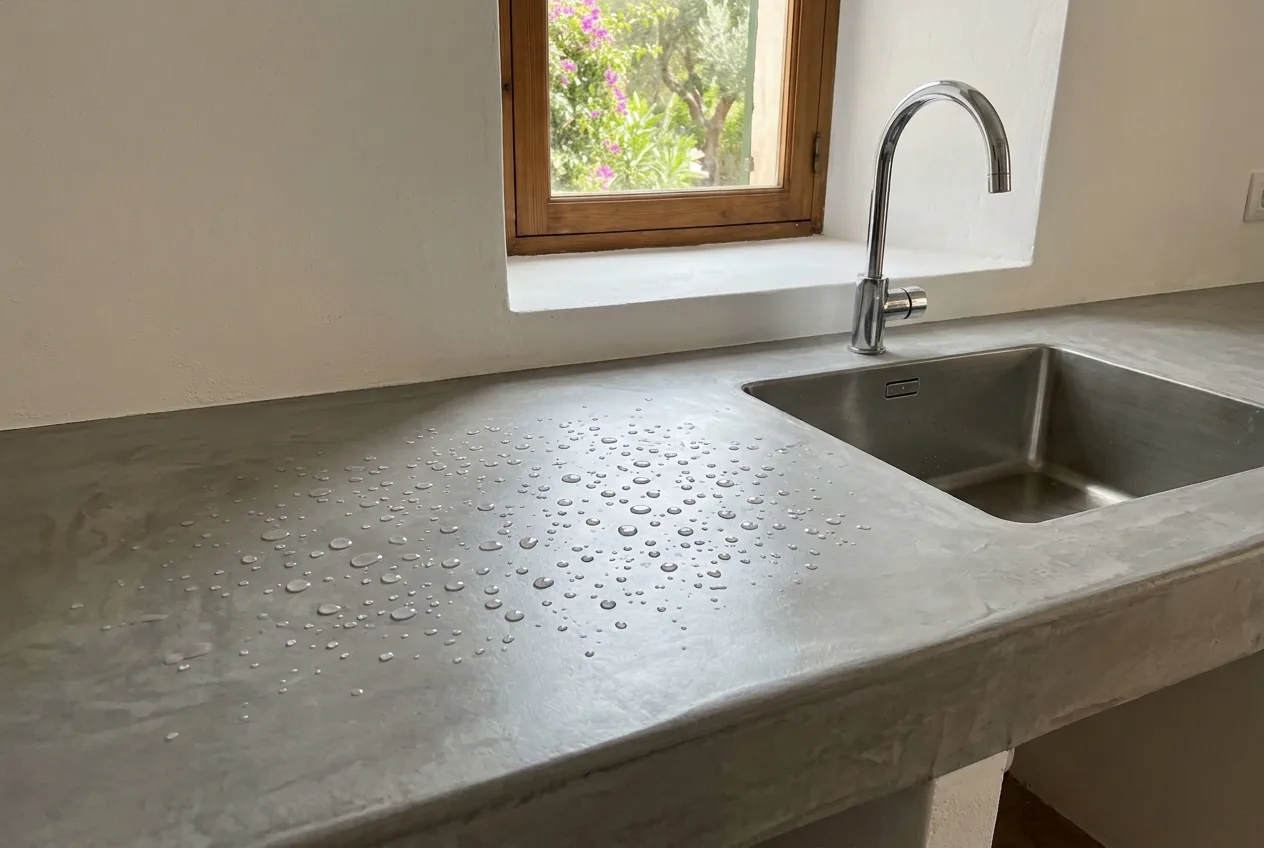
How to clean and care for microcement
Everyday cleaning of microcement, products that damage the sealer, limescale and stains, kitchens and outdoors, the water test and how often the sealer is renewed.

Microcement or epoxy resin: the differences and when to choose each
Microcement and epoxy resin compared in homes, on terraces, in garages and in commercial spaces: what each is, looks, sun, chemicals, damp, grip, repairs and cost.
Solera Mallorca
Tell us what floor you have now
The square metres, a photo of the current floor and whether there is underfloor heating are enough for us to advise on the system and the days of work.