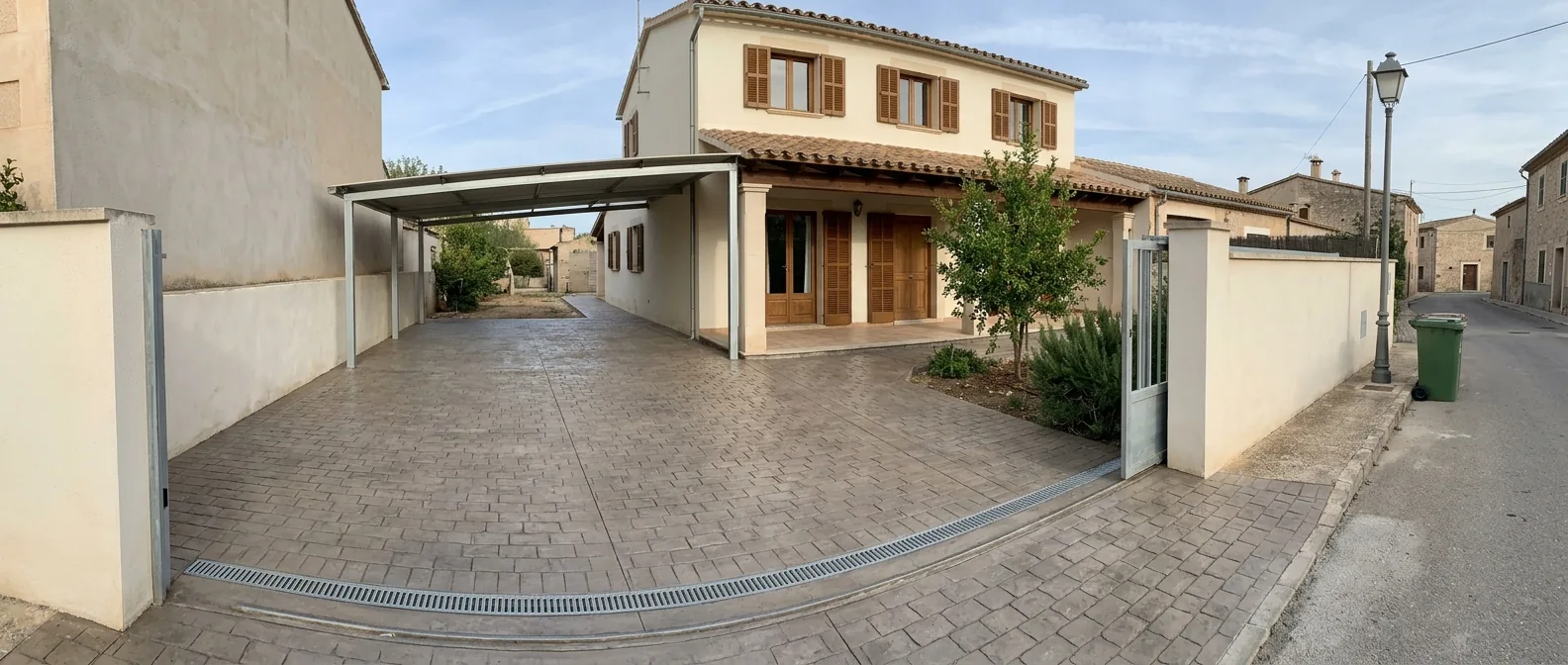
Stamped concrete for driveways and paths
A stamped concrete driveway or finca track, known in the UK as imprinted concrete, is designed for the load it will carry: more thickness, steel mesh, a well compacted sub-base and more frequent joints than a terrace. That way it takes cars, vans and the occasional delivery lorry.
Driveways and paths are the second most common use of stamped concrete in Mallorca after terraces, and the one least forgiving of savings on the sub-base. A badly bedded footpath develops hairline cracks; a badly bedded driveway breaks up into slabs. This page explains what changes compared with a terrace; the full system is on the page on stamped concrete.
Driveways and parking areas
The drive of a villa, a garage ramp or the car park of a residential community (comunidad de propietarios) takes point loads of more than a tonne per wheel, steering turned with the car stationary and, now and then, a removal lorry or a heating oil delivery. For that use we pour a 12 cm slab for cars and 15 cm where vans, caravans or small tractors pass, always with welded steel mesh placed at mid depth in the slab, not lying on the bottom, where it does nothing.
In community car parks, stamped concrete competes with asphalt and with block paving. It wins over asphalt on colour durability and ease of cleaning, and over block paving on stability, since pavers sink into the wheel tracks over time if the sub-base is not perfect. Parking bays can be marked out with a different mould or a change of colour instead of paint.
Finca paths and tracks
Inland, in Llucmajor, Manacor, Felanitx or Inca, a finca may have a very long gravel track that every September storm leaves rutted. Stamped concrete turns that track into a stable surface that does not wash away, raises no dust in summer and blends into the landscape with a random stone texture in a sand or earth colour.
A long track is planned in sections: sometimes it makes sense to concrete only the slopes, the bends and the approach to the house, and leave the flat stretches in gravel. It can also be laid as two concrete wheel strips with a central band of gravel or soil, which cuts the square metres and lets water through. On tracks with a lot of heavy farm machinery, asphalt or plain unstamped concrete may be more sensible; we say so at the visit.
Thickness, sub-base and steel mesh
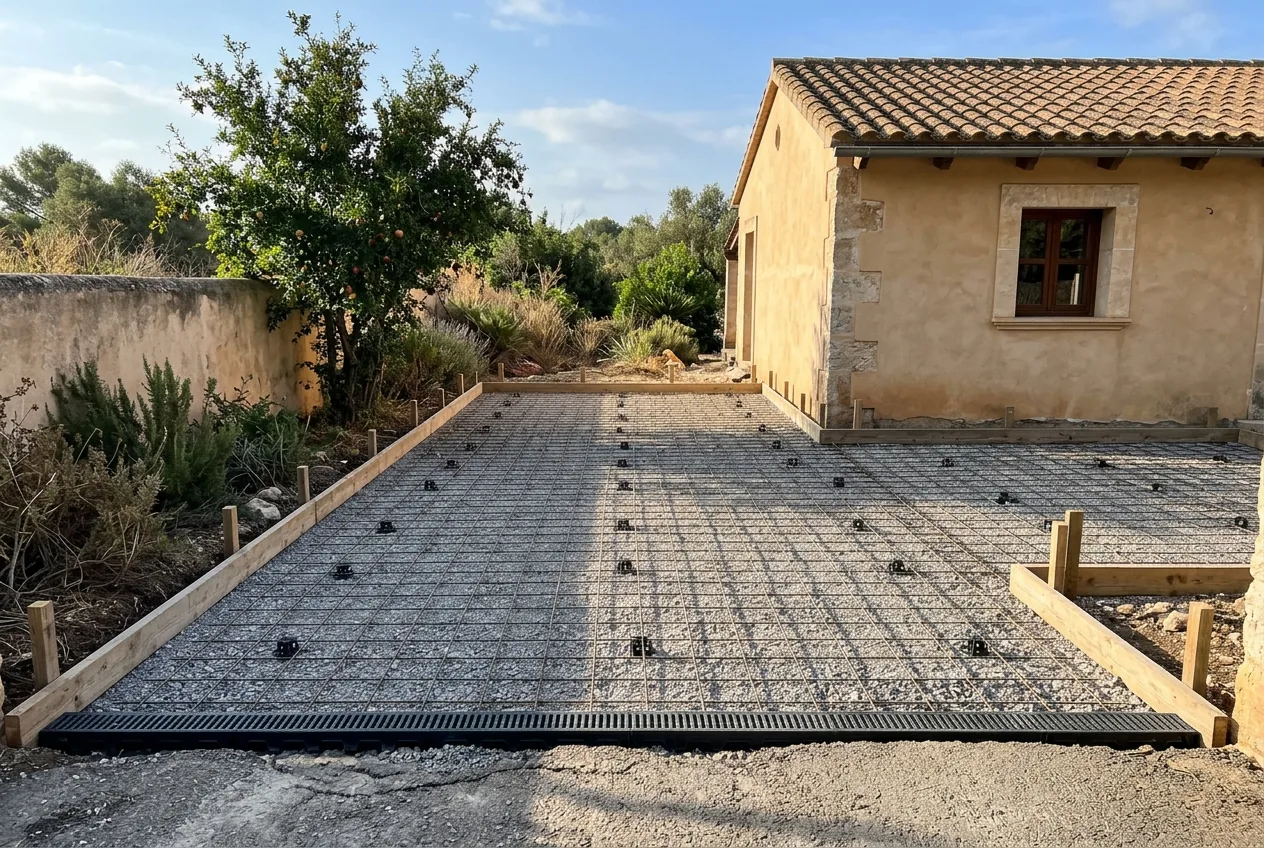
The sub-base of a driveway is 15 to 20 cm of crushed aggregate compacted in layers with a roller or vibrating plate, on ground from which the topsoil has been removed. If the ground is clay or recent fill, we lay a geotextile between the ground and the aggregate so they do not mix. On top of the sub-base, a polythene sheet stops the ground drawing the water out of the fresh concrete.
The usual mesh is 15 x 15 cm welded steel, set on spacers so that it sits inside the slab. Polypropylene fibres help against shrinkage cracking but do not replace mesh where vehicles drive. The concrete is ordered with a strength suited to outdoor use and traffic, and with an aggregate that allows stamping.
Drainage, gates and gradients
Water is what damages a driveway most. The fall runs towards the street or towards a cross drain in front of the gate or garage door, never towards the house. On finca tracks, a side ditch or culverts under the track stop storm water from crossing it and undermining the edge; on long slopes, humps or gratings are set at intervals to break up the run off.
Garage ramps steeper than 10 per cent get a textured finish and anti-slip aggregate in the sealer; above 15 per cent stamped concrete is still possible, but the transition to the street needs working out so that the car does not scrape. For an automatic gate we leave a joint and have the recess for the track sorted out before pouring, not after.
Tyre marks and maintenance
Hot tyres in summer, especially when turning with the car stationary, leave black marks on the sealer. They do not damage the concrete: they are rubber deposited on the sealer, and they come off with a neutral degreaser and a brush. Stone and cobble textures and mid tones hide them better than smooth slabs and very light colours. Once the sealer is worn, the marks get into the colour and no longer clean off, which is another reason to renew the sealer every 3 to 4 years, before a simple reseal turns into a full driveway restoration. Oil stains should be treated as soon as possible with an absorbent and a degreaser.
When asphalt or pavers make more sense
Stamped concrete is not always the right answer. On very long finca tracks used by tractors and heavy trailers, hot asphalt is usually cheaper per metre and is repaired by patching. On drives where trenches for water or electricity may be needed in future, pavers can be lifted and relaid; concrete has to be cut. And on extreme slopes with occasional ice in the Serra de Tramuntana, a rough texture without a gloss sealer matters more than the material. If you already have asphalt or pavers and what you need is to protect them, see private asphalt sealing and pavement sealing.
FAQ
Questions
Something else? Ask us when you request a quote.
How thick does stamped concrete need to be for cars?
12 cm for cars and 15 cm where vans, caravans or small tractors pass, always with welded steel mesh inside the slab and on 15 to 20 cm of compacted aggregate. The 8 to 10 cm of a terrace is not enough for a driveway.
When can I park on new stamped concrete?
From 7 days for cars, although it is better to wait until the sealer has gone on, which happens once the concrete is dry, between 7 and 28 days. Heavy vehicles from 28 days. After sealing, 48 hours without driving on it.
Do tyres mark stamped concrete?
They leave rubber marks in summer, especially when turning on the spot, as on any sealed surface. They clean off with a neutral degreaser and a brush while the sealer is in good condition. Stone textures and mid tones hide them better.
Can a finca track be done in stamped concrete in sections?
Yes, and it often is: the slopes, the bends and the approach to the house are concreted and the flat stretches are left in gravel. Two wheel strips with a central band of gravel are another option, which cuts the square metres and lets water drain through.
Is stamped concrete or asphalt better for a driveway?
For a villa driveway or a community car park, stamped concrete offers longer lasting colour, easier cleaning and more design options. For long tracks with heavy machinery, asphalt is usually cheaper and easier to repair by patching. We compare them at the visit according to area, use and access.
Guides
Related guides
Stamped concrete quotes: what goes into them and how to compare them
The items that make up the price of stamped concrete per square metre in Mallorca, how to read a quote, why cheap ones cut the sub-base or the sealer, and how to compare.
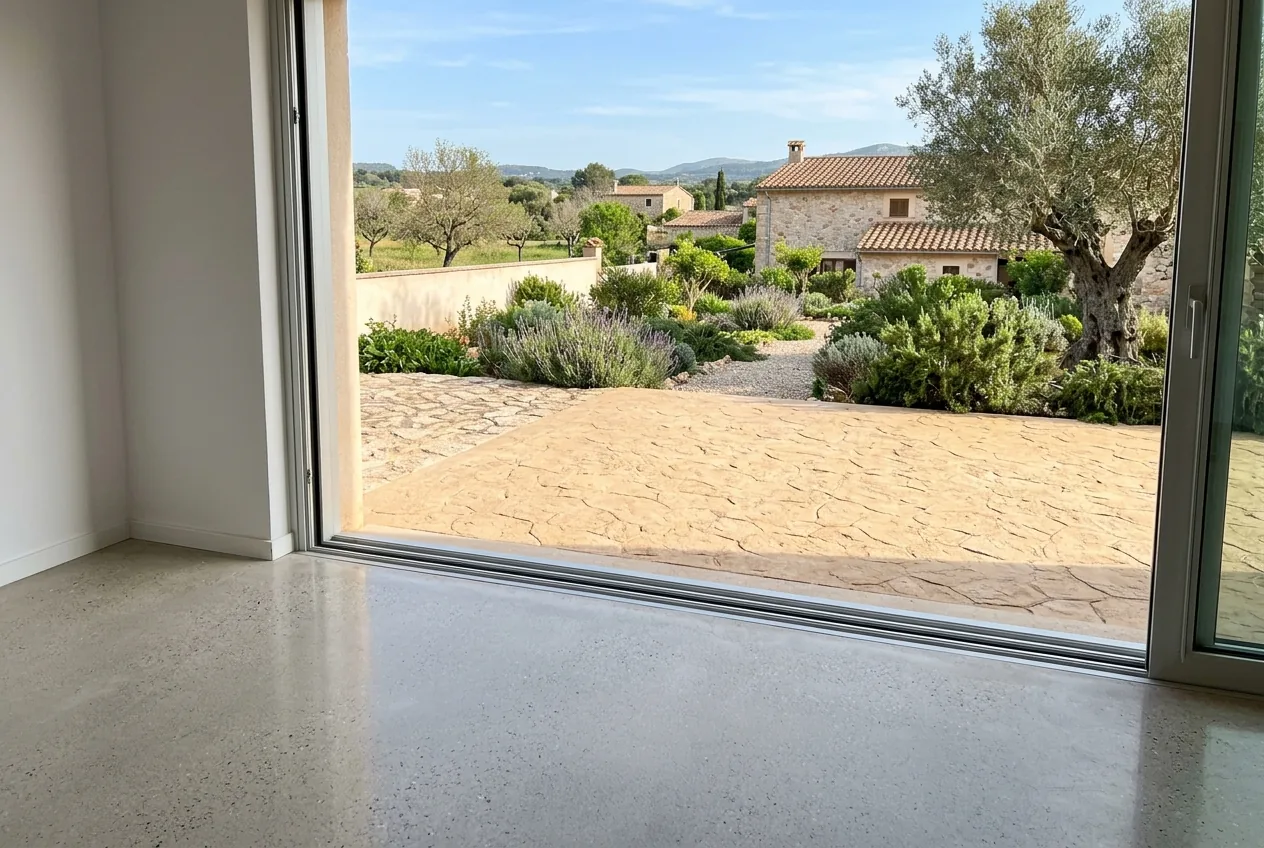
Stamped or polished concrete: which to choose
Stamped and polished concrete compared on terraces, pool surrounds, driveways and interiors: looks, grip, heat, maintenance and repairs.
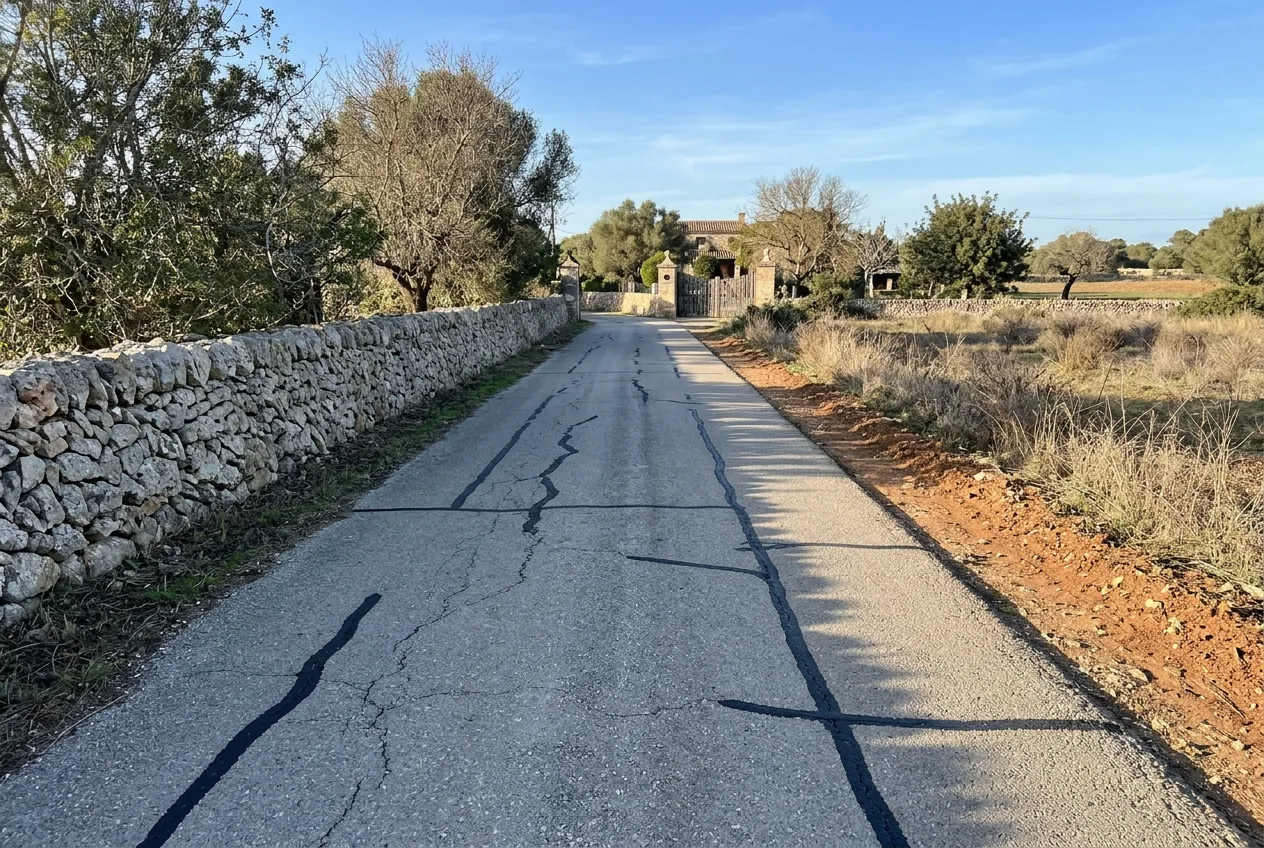
Sealing and maintaining private asphalt in Mallorca
How to maintain the asphalt on finca tracks, community and hotel car parks and garage ramps: crack sealing, patching, slurry seal, the right time of year and when it is not enough.
Solera Mallorca
Your driveway or track in stamped concrete
Tell us the square metres, which vehicles will use it and whether there is a slope or a gate. With a few photos of the access we set out the sub-base, thickness and quote in detail.