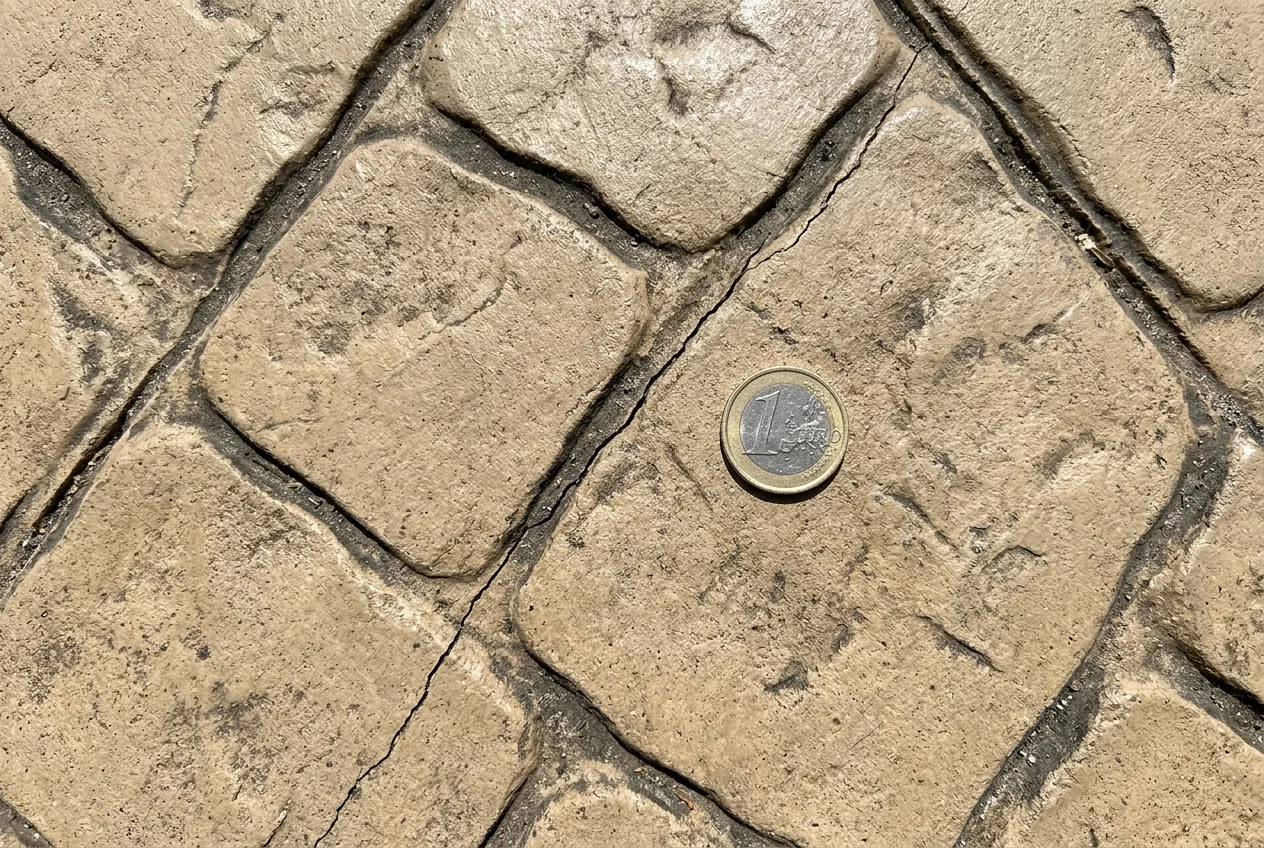
Restoration
How to seal stamped concrete and how often to reseal it
The resealing cycle for stamped concrete in Mallorca, the signs that it is due, the right steps and the mistakes that ruin a coat of sealer.
Stamped concrete is resealed every 2 to 4 years. In Mallorca, with direct sun all summer or less than a kilometre from the sea, it is wise to plan on the short end of that range. The acrylic sealer that protects the colour and closes the pores wears away under ultraviolet light, traffic and water, and once it has gone, the floor starts to lose colour and soak up stains. Resealing on time is the difference between a terrace that lasts for decades and one that needs a full restoration after ten years.
What the sealer does and why it wears out
Stamped concrete has three layers that work together: the concrete slab, the colour hardener that forms the pigmented surface, and the sealer. The sealer is the only one designed to wear. It does four jobs:
- It closes the pores of the concrete so that water, oil and soil cannot get in.
- It protects the pigment from ultraviolet radiation, which is what fades it.
- It brings out the colour and gives the matt, satin or gloss finish.
- It fixes the release agent that gives the aged effect in the joints of the pattern.
A coat of acrylic sealer is 50 to 100 microns thick. Mallorca's sun breaks it down from above; the sand and limestone dust carried in on shoes wear it away like sandpaper; rain and irrigation water wash it. Near the coast, salt spray crystallises on the surface and speeds up the wear. That is why a shaded floor in Pollença can last four years, and a pool terrace in full sun in Santanyí two.
How often to reseal, by situation
| Floor and exposure | Guide interval |
|---|---|
| Shaded terrace, foot traffic, inland | 3 to 4 years |
| Terrace in full sun, foot traffic | 2 to 3 years |
| Pool surround with chlorinated or salt water | 2 years |
| Driveway where wheels turn | 2 years, sooner in the turning area |
| Seafront, salt wind | 2 years or less |
What decides it is the actual condition of the surface, not the calendar.
Signs that resealing stamped concrete is due
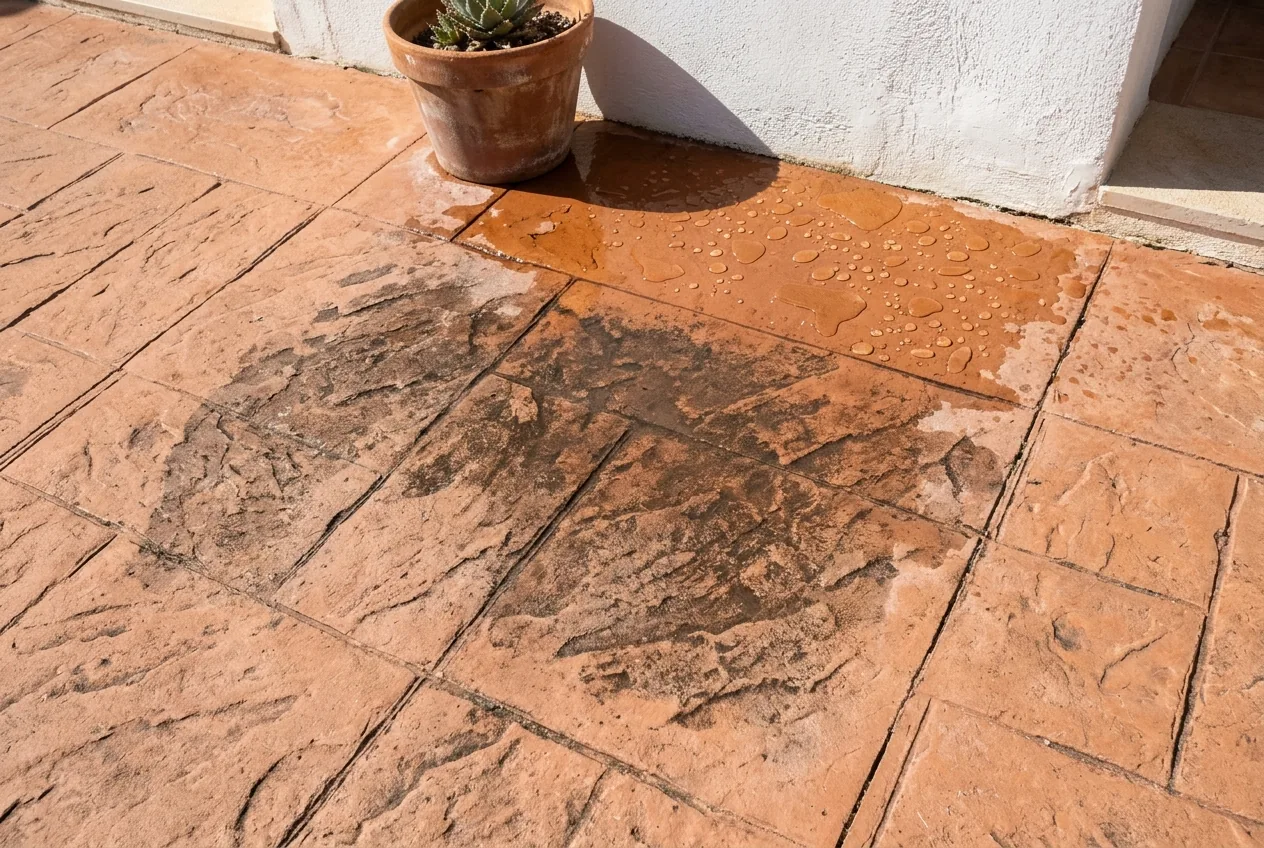
There is a simple test: pour a glass of water on the clean floor. If the water beads and runs off, the sealer is still closing the pores. If it darkens the concrete and soaks in within seconds, the sealer has gone. Other signs:
- The colour looks dull or greyish, especially where people walk.
- Lighter patches appear where the sun hits hardest, and the pattern loses contrast.
- Stains from pine needles, barbecue grease or tyres no longer come off with water.
- Green algae takes hold in shaded areas because the pores are open.
- Running your hand over the surface leaves a fine dust: that is the colour hardener, now unprotected.
If there are also white patches or milky veils, the problem may be something else, and it is worth reading the guide on white patches and grey areas before applying anything.
The steps of a proper seal
1. Thorough cleaning
The floor is cleaned with a pressure washer at moderate pressure, with a fan nozzle and the lance never closer than 30 cm, so as not to mark the concrete. Green algae and mould are treated with an alkaline cleaner or an algaecide, and grease stains with a degreaser. Then everything is rinsed with plenty of water until no foam or residue is left. A sealer applied over dirt locks it in for years.
2. Complete drying
The concrete must be dry right through, not just on the surface. In summer 24 hours is enough; in spring or autumn, with night-time dew, it can take 48. A useful test is to tape down a 50 by 50 cm sheet of clear plastic and wait a few hours: if it mists up underneath, the concrete is still damp.
3. Repairs first
Fine cracks, chipped edges and open joints are repaired before sealing, because the sealer fills nothing and the defects stay visible. If colour is missing, a pigmented sealer or a stain is applied before the final coat. The details are in the guide on repairing cracks.
4. Thin coats
The sealer is applied with a short-pile roller or a low-pressure sprayer, in two thin coats. The first soaks in and the second forms the film. Between coats you allow the time given on the product's technical data sheet, usually 4 to 8 hours depending on temperature. The work is done in strips, wet on wet, without going back over areas that are already starting to set.
5. Curing
Foot traffic after 24 hours. Vehicles, heavy furniture and irrigation water after 72 hours. If the floor surrounds a pool, it is better to keep chlorinated splashes off it for a week.
Mistakes that ruin a reseal
Sealing a dirty or damp floor. This is the most frequent cause of white veils and of sealer that peels after a few months. The moisture is trapped under the film and pushes it off.
A coat that is too thick. A heavy coat does not last longer; it lasts less. It takes days to cure, stays soft, marks under chair legs, turns milky in the rain and ends up flaking. Always two thin coats.
Applying at midday in summer. With the concrete at 45 or 50 degrees, the solvent evaporates before the sealer can soak in. The result is bubbles, roller marks and a film that does not bond. In Mallorca, from June to September, sealing is done first thing in the morning or in the evening, with the surface cool to the touch.
Mixing sealer families. A water-based sealer over an old solvent-based coat may not bond. The guide on water or solvent-based sealer explains what can go over what.
Ignoring the forecast. Rain or heavy dew in the 12 hours after application leaves the surface whitish. Mallorca's autumn, with its sudden storms, means checking the forecast for the next day, not just for today.
Sealing without anti-slip in wet areas. A gloss sealer around a pool is slippery underfoot when wet. An anti-slip additive is mixed into the final coat.
When to call a professional
Maintenance resealing of a small terrace, with the original sealer in good condition and no repairs needed, is a job a careful owner can do. It is worth calling in a company when the area is over 60 or 80 m², when an old sealer that is peeling has to be removed, when the colour has gone and has to be restored with pigmented sealer, when there are cracks or chipped edges to repair, or when the floor surrounds a pool and the anti-slip finish has to be even. The page on resealing stamped concrete describes how we approach the work and what it includes.