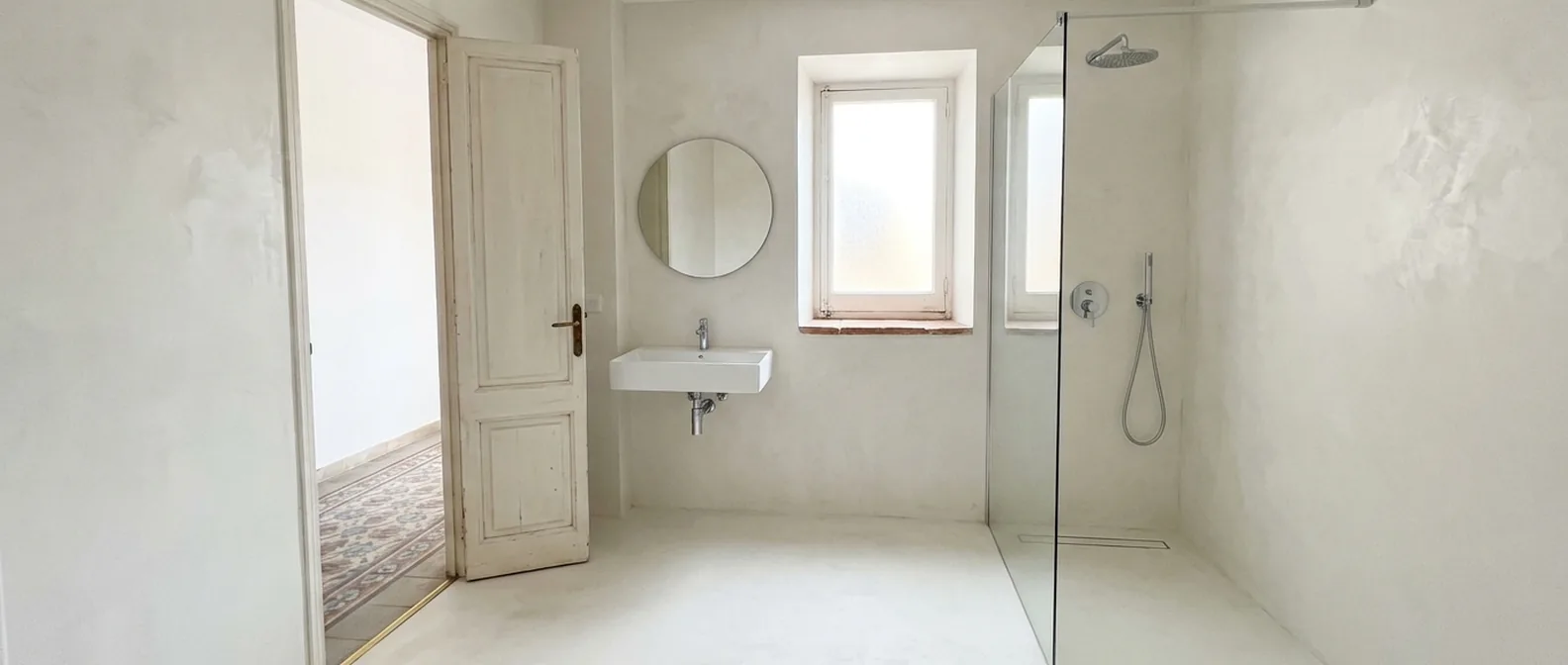
Microcement over tiles in Mallorca
Applying microcement over tiles lets you renovate a bathroom, a kitchen or a floor with no breaking out, no rubble and no retiling. It works when the tiles are firm and dry, and what decides the result is checking them one by one and preparing the joints and glaze before the first coat.
The question we are asked most about microcement is whether it can go on top of the tiles that are already there. Almost always, yes. Microcement for tiles is not a different product: it is the same 2 to 3 mm system with a preparation designed for a ceramic substrate that is smooth and full of joints.
Why put microcement over tiles instead of breaking them out
Breaking out a bathroom or a kitchen means days of hammering, rubble carried down the stairs, a skip in the street and then a new substrate and new tiling. In a Palma flat with no lift, getting the rubble down is half the job. Over the existing tiles there is no demolition, the rubble comes down to the few hollow tiles that are removed, and the plumbing stays where it is.
For the household, that means less dust, only the dust from sanding, which is vacuumed up; fewer days, because a complete bathroom takes five to eight calendar days including curing, against the weeks it takes to demolish and retile; and fewer surprises, because nothing behind the tiles is opened up. The room is still out of use while we work: if the house has only one bathroom, it is worth planning for. The saving comes from the work that is not done; we explain it on the page on microcement cost.
What we check before quoting
Microcement is only as good as the tiles underneath, which is why we give a price after seeing them:
- Tapping, tile by tile. We tap every tile on the floor and walls. One that sounds hollow has air behind it and would come away with the microcement on top.
- Cracks and movement. A single broken tile is an impact; several cracked in a line, expansion joints or partition walls that shake when a door closes point to a substrate that moves.
- Damp behind. Dark joints, loose tiles near a pipe or stains on the other side of the wall. We measure the moisture; a leak is repaired first.
- Joints. Their width and depth decide how much levelling paste is needed; tiles with relief need a full skim.
- Type of tile. Glazed tiles, stoneware and porcelain are closed substrates: they are sanded and take a bonding primer. Terracotta and unglazed tiles absorb: we check that they bring no damp or salts with them and use a consolidating primer.
Where the tiles are matters too. On the floor, footsteps and furniture rule, and the mesh and four coats are essential. On walls there is less wear, but old wall tiles often have more hollow pieces than you would expect. On a kitchen splashback, the grease built up behind the hob stops anything bonding and has to be removed thoroughly. Whole kitchens, worktops included, are covered on microcement walls and kitchens.
How the tiles are prepared
Preparation takes almost as long as the microcement, and it is what stops the grid of the joints appearing a few months later.
- Hollow and broken tiles. They are removed and the gap is filled with repair mortar flush with the rest.
- Cleaning and degreasing. Soap, grease, old silicone and the limescale left by Mallorca's hard water are all removed. Any residue acts as a release agent.
- Joint levelling. The joints are filled with levelling paste until the surface is continuous. Skip this step and the microcement shrinks over the joints as it dries and the grid shows through.
- Sanding the glaze. It opens up a surface made so that nothing sticks to it.
- Primer. A bonding primer for non absorbent substrates, or a consolidating primer on terracotta and porous tiles.
- Fibreglass mesh. Embedded in the first base coat, it spreads stresses and bridges the joints between tiles.
Then come two base coats, two finish coats sanded in between, and sealing with a primer and two coats of water-based polyurethane. In the shower, a cementitious waterproofing goes on first, as we explain on microcement bathrooms.
How much height it adds: doors, skirting and shower trays
The system adds 2 to 3 mm, a little more where the joints are very wide or the tiles have relief. It is not much, but we go over every junction:
- Doors. They hardly ever need trimming; we check the ones that already catch.
- Skirting. A tiled skirting can be coated in the same microcement or replaced with a profile; a timber one is taken off and refitted.
- Shower trays. A tiled built-in tray is kept; a ceramic or resin tray is usually replaced with a built-in one laid to a fall.
- Appliances. Under the worktop, an extra 3 mm can leave an integrated dishwasher with barely enough room. We measure and, if needed, the feet are adjusted.
- Walls. Switch and socket plates, tap flanges and accessories come off and go back on over the microcement.
- Thresholds. Where the coated floor meets one that is not touched, there is a step of a few millimetres, finished with a threshold strip.
Tiled floors with underfloor heating
They can take microcement. The heating screed did its shrinking long ago; what we watch is the tiles, because heating and cooling cycles loosen them, so tapping matters even more here. The heating is switched off 48 hours before work starts and stays off until a week after sealing; then it is brought back up gradually. The full protocol is on microcement floors.
Outdoor tiles on a terrace
Over the tiles of a terrace or porch we use an exterior system: a tougher microcement, aliphatic polyurethane with a UV filter and anti-slip aggregate wherever it is walked on wet. First we check the fall towards the drain and locate the expansion joints, which are cut through in the same place. The details are on outdoor microcement and pools.
If the terrace leaks into the room below, microcement will not fix it: it is not a membrane, and putting it on top only hides the problem until the autumn rain. First the terrace is waterproofed, often with a liquid membrane over the same tiles, and the microcement goes on top as the finish.
When microcement over tiles is the wrong answer
There are cases where we will not do it, even when asked:
- Tiles that move. If they sound hollow over large areas, removing the loose ones is not enough: the rest will follow.
- Damp from below. On ground floors laid on soil with no damp-proof membrane, moisture reaches the microcement from behind and blisters the sealer. The same goes for an active leak inside a wall.
- Cracked screed. Cracks running across several tiles in a line show that the substrate moves, and the microcement will copy the crack.
- Flexible substrates. Tiles on timber boards, on a floating floor or on a plasterboard partition that flexes.
What we do then depends on the cause. If the problem is one area, only that area is lifted, the substrate is rebuilt in mortar and, once it has cured, at least four weeks for new screed, the microcement goes on top. If there is damp or a leak, it is solved first and measured again. If the whole substrate moves, we say so plainly: sometimes the sensible thing is to lift and retile, and we compare both in microcement or tiles.
Solera Mallorca
How we work
- 01
Visit and tapping
We tap every tile on floor and walls and look for cracks, damp behind and expansion joints.
- 02
Removal and filling
Hollow or broken tiles come out and the gap is filled with repair mortar.
- 03
Joints and glaze
We degrease, level the joints with levelling paste and sand the glaze.
- 04
Primer and mesh
A primer to suit the substrate and fibreglass mesh in the first base coat.
- 05
Microcement and sealing
Two base coats, two finish coats sanded in between and two coats of polyurethane.
- 06
Finishing and handover
Skirting, sanitaryware, switch plates and neutral cure silicone, with the times for use and cleaning.
FAQ
Questions
Something else? Ask us when you request a quote.
Can microcement go over bathroom or kitchen tiles without removing them?
Yes, if the tiles are well bonded and dry. Every tile is tapped, hollow ones are removed and filled, the joints are levelled with levelling paste, the glaze is sanded and a bonding primer for non absorbent substrates is applied. In the shower, a cementitious waterproofing also goes under the microcement, and on a kitchen splashback the grease has to be removed thoroughly first.
Do the tile joints show through the microcement?
Not if they are levelled first. The joints are filled with levelling paste to leave a continuous surface and covered by the fibreglass mesh in the first coat. When this step is skipped, the microcement shrinks over the joints as it dries and the grid of the tiles appears within a few months, which cannot be put right without redoing the job.
How much height does microcement add over tiles?
2 to 3 mm for the complete system, a little more if the joints are very wide or the tiles have relief. Doors hardly ever need trimming. We check the skirting, the space for integrated appliances, thresholds with other floors and the plates around sockets and taps, which come off and are refitted.
How long does microcement last over tiles?
As long as the tiles underneath, if they were firm and properly prepared: the mortar does not come away from a stable substrate. What ages is the polyurethane sealer, which in normal interior use needs renewing in walkways after 5 to 8 years and on a shower tray every 3 to 5. Renewing it means sanding lightly and applying two new coats, without touching the microcement.
Can microcement go over tiled floors with underfloor heating?
Yes. The tiles are tapped with particular care, because heating and cooling cycles loosen them, and the heating is switched off 48 hours before work starts and not turned back on until a week after sealing, then gradually. Microcement, thin and mineral, transmits heat well.
Solera Mallorca
Tell us what tiles you have now
A close-up photo of the tiles, another of the whole space, the square metres and whether any tile sounds hollow or is broken are enough for us to advise you.