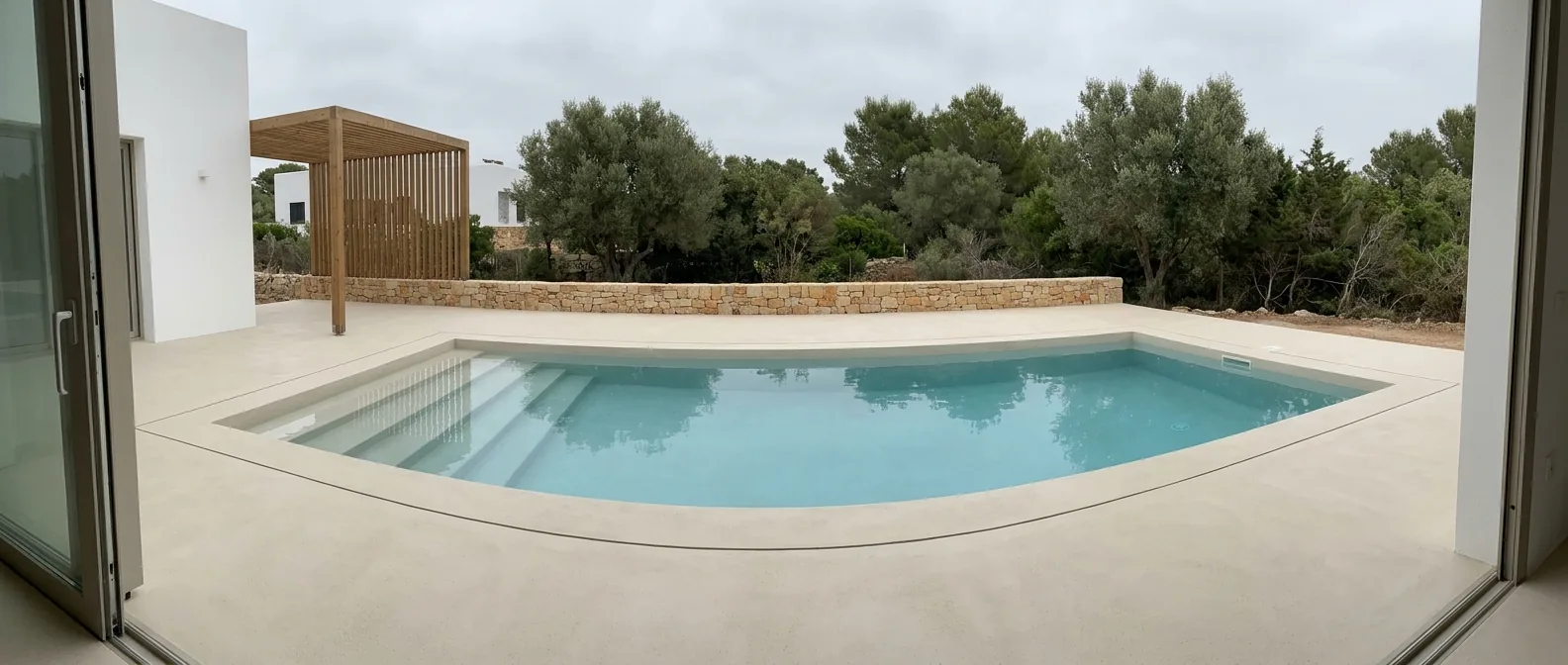
Outdoor microcement and pools
Microcement works outside the house, on terraces, porches and pool copings, but not with the same system as indoors. Mallorca's sun, the autumn rain, salt and chlorine call for a sealer with a UV filter, an anti-slip finish, a fall for the water and a shorter resealing cycle.
The question we get is always the same: does microcement work on a terrace or a pool coping in Mallorca? The honest answer is yes, with an exterior system applied as one, and with the right expectation of what will happen over the years. Interior microcement laid outside yellows, wears and stains within a couple of summers. Well sealed exterior microcement behaves like any other continuous outdoor surface on the island: it ages through the sealer, and the sealer is renewed.
What changes compared with indoors
Three things. The material: exterior microcements contain a higher proportion of resin and tougher aggregates, to cope with expansion and abrasion from sand. The sealer: indoors a standard water-based polyurethane is used; outside you need an aliphatic polyurethane, which does not yellow under ultraviolet radiation, in two full coats. And the schedule: indoors the sealer is checked after five years or more; on a south-facing terrace, after two or three.
Sealer with a UV filter
The sun is what wears an outdoor floor most in Mallorca, ahead of water. An aromatic polyurethane, the usual one indoors, yellows and turns brittle after a few months of exposure. An aliphatic one keeps its tone and elasticity for years, and it is the one we always use outside, including on covered porches, because reflected light counts too. In summer it is applied first thing in the morning or at the end of the day: on a surface above 35 degrees the sealer dries before it levels and leaves roller marks.
Anti-slip: class 3 where it is walked on wet
Smooth sealed microcement is slippery when wet, just like polished porcelain. On pool copings, outdoor showers, stairs and ramps, Spanish building regulations call for floors with slip resistance class 3, and microcement reaches it when a fine aggregate, usually silica or polymer, is added to the last coat of sealer. It feels slightly rough, much like a fine sandstone, and it is cleaned in the same way. On terraces that do not usually get wet, a matt finish without aggregate, or with a smaller dose, is enough. We compare it with other materials in the guide to non-slip pool surrounds.
Water, falls and drains
Microcement does not tolerate standing water. A terrace with no fall, or with the fall towards the wall, ends up with a dark ring wherever the water sits after each rain. Before applying, we check that the fall reaches 1 or 2 percent towards the drain and that the drains take the water away; if not, it is corrected with a levelling layer before the microcement, not after. On terraces over rooms, microcement does not replace waterproofing either: it goes on top of it, and if the terrace leaks, that has to be solved first. We explain it on the page on terrace waterproofing.
Salt, chlorine and pools
Within two kilometres of the coast, from Portals to Cala Ratjada, salt settles on every surface and crystallises in the pores. A sealer in good condition keeps it out; a spent sealer lets it in, and white efflorescence appears. Chlorinated pool water does the same on the coping and the pool steps. That is why for pools we ask for a rinse with fresh water now and then and a check of the sealer every season.
The pool shell is a different job. Microcement under permanent immersion needs a specific system, with cementitious waterproofing underneath and an epoxy or polyurethane sealer suitable for immersion, applied with the shell dry and with a curing time of one to two weeks before filling. The water chemistry has to be kept balanced; a low pH over a long period attacks any cementitious coating.
Thermal movement and joints
An outdoor slab expands and contracts with every cycle of day and night, and in Mallorca the difference between the surface at midday in August and before dawn in January is more than 50 degrees. The expansion joints in the slab are there to absorb that movement, and microcement respects them: they are cut in the same place and sealed with an elastic sealant the colour of the floor. Covering them guarantees a straight crack in the first winter. On large terraces with no joints, we say so at the visit, because the substrate is not suitable as it is.
What to expect over the years
Well executed outdoor microcement behaves like this: in the first year it does not change; from the second, in sunny areas and walkways, the sheen dulls and water starts to darken the surface instead of running off; between the second and the fourth year it is time to sand it lightly and apply two new coats of sealer, without touching the microcement. Done in time, the cycle can be repeated indefinitely. Left too long, water and salt get into the mortar, stains appear and the recovery work is greater. It is the same logic as resealing stamped concrete, and that is why we raise it from the first quote.
Solera Mallorca
How we work
- 01
Visit
We look at the substrate, the fall, the drains, the joints and how it faces the sun.
- 02
Preparation
Crack repair, levelling and primer, keeping the existing joints.
- 03
Application
Mesh, two base coats and two finish coats, sanded in between.
- 04
Exterior sealing
Primer and two coats of aliphatic polyurethane with UV filter, with anti-slip aggregate where it is walked on wet.
- 05
Handover and schedule
We tell you when to walk on it, when to fill the pool and when the sealer is due for a check.
FAQ
Questions
Something else? Ask us when you request a quote.
Can microcement be used on an outdoor terrace in Mallorca?
Yes, with an exterior microcement, an aliphatic polyurethane sealer with UV filter, a fall towards the drain and the expansion joints respected. Under those conditions it behaves like any other continuous outdoor surface: the sealer is renewed every 2 to 4 years depending on how much sun it gets.
Is outdoor microcement non-slip?
Smooth and sealed, it is slippery when wet. On pool copings, showers, stairs and ramps, a fine aggregate is added to the last coat of sealer to reach the slip resistance class 3 that the regulations require in wet outdoor areas. It feels slightly rough and is cleaned in the same way.
Can microcement be used inside a pool?
Yes, with a system specific to immersion: cementitious waterproofing underneath, pool microcement and a sealer suitable for use under water, applied with the shell dry and cured for one to two weeks before filling. It is a different job from the coping or the terrace.
How often does outdoor microcement need resealing?
Every 2 to 4 years in sunny areas and walkways, and somewhat longer on covered porches and in shade. The sign is that the sheen dulls and water stops running off and darkens the surface. Resealing means sanding lightly and applying two new coats of polyurethane.
What about salt near the sea?
With the sealer in good condition, salt stays on the surface and is washed off by rain or a hose. When the sealer is spent, salt gets into the pores, crystallises and white stains appear. A rinse with fresh water now and then and resealing on time prevent the problem.
Guides
Related guides
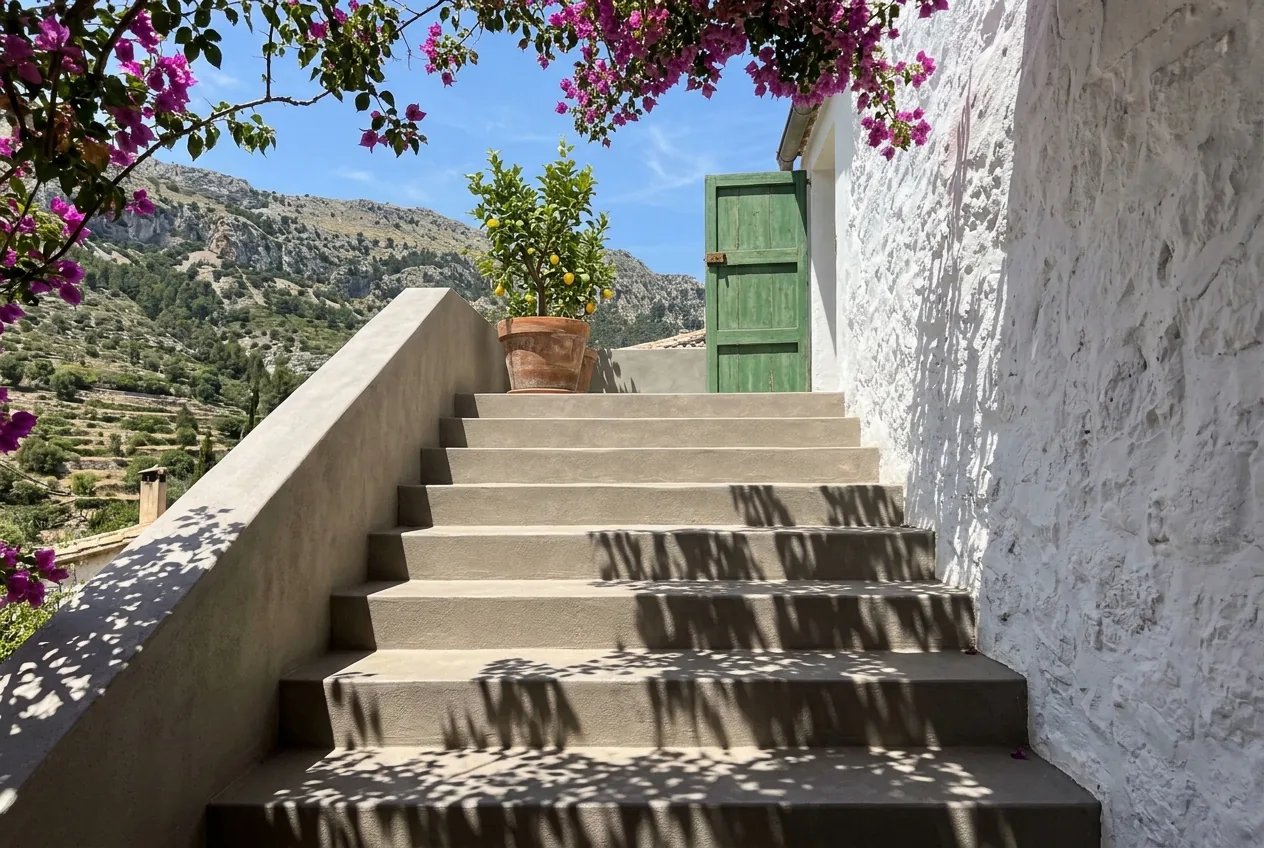
Does microcement last outdoors? Sun, salt, rain and pools
What microcement withstands outdoors and what it does not: sun, salt air, pools, torrential rain, thermal movement, sealers, slip resistance, maintenance and the base.
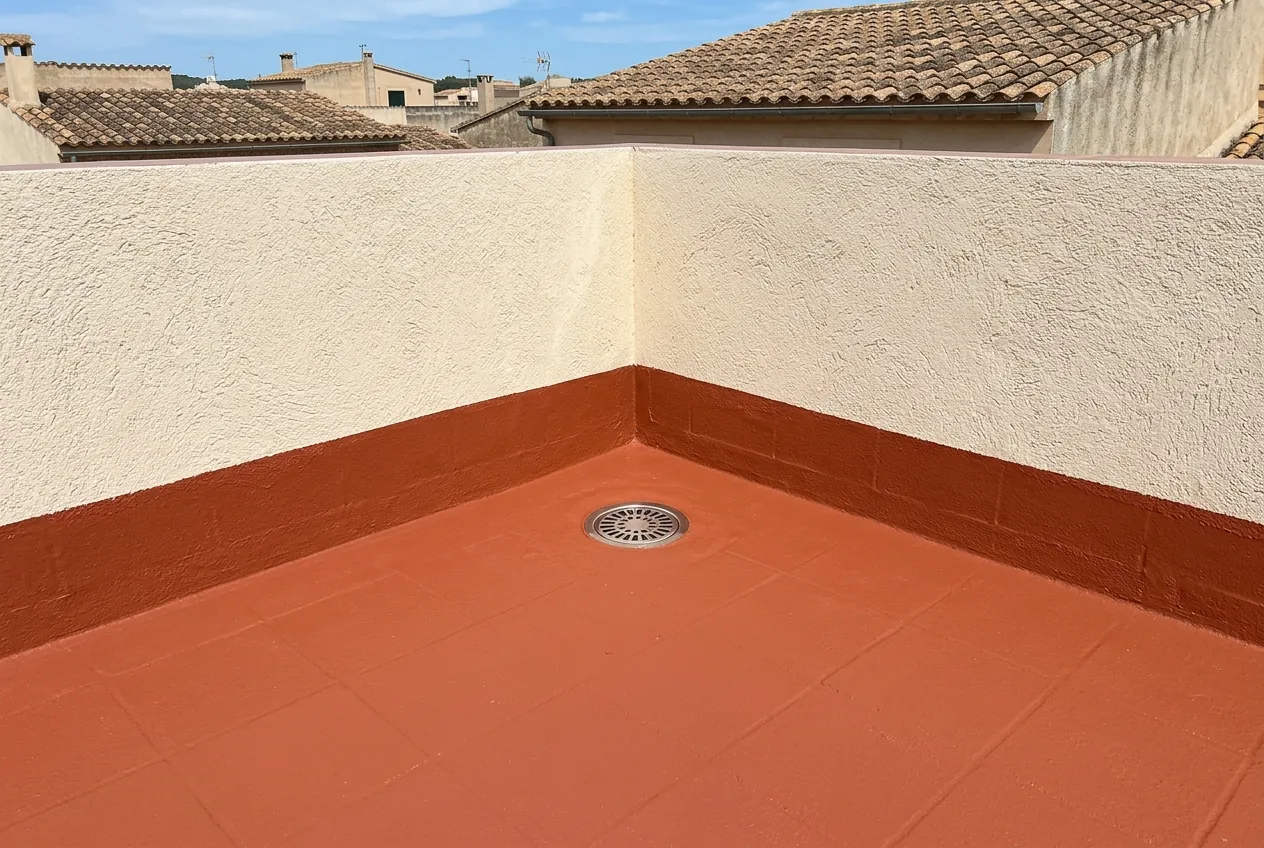
Waterproofing over the existing tiles: when it works and when it does not
When terrace waterproofing with a liquid membrane over the tiles works, when it does not, how the surface is prepared, what happens with drains and falls, and how long it lasts.
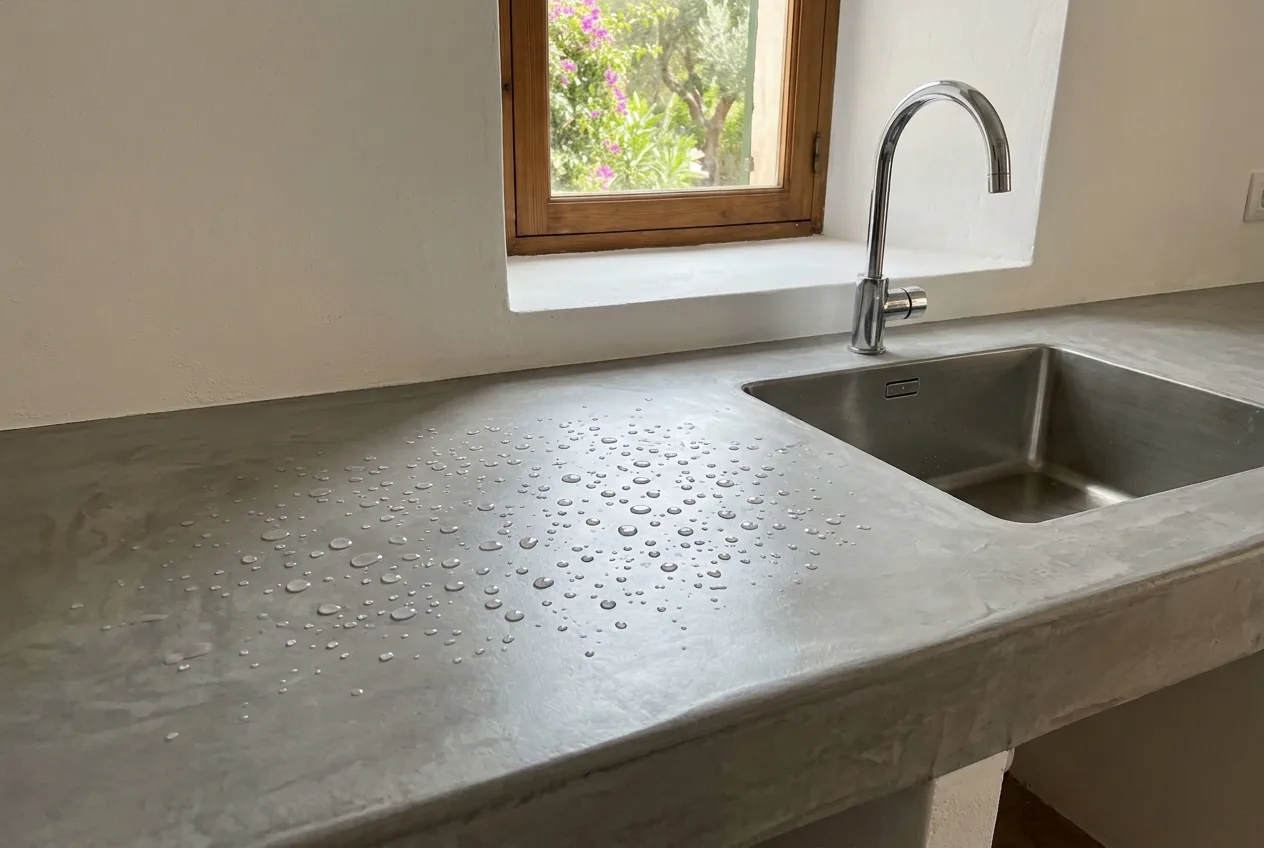
How to clean and care for microcement
Everyday cleaning of microcement, products that damage the sealer, limescale and stains, kitchens and outdoors, the water test and how often the sealer is renewed.
Solera Mallorca
Tell us about your terrace or pool
A photo of the area, the square metres, which way it faces and whether the water has somewhere to drain are enough for us to advise you.