
Pressure washing stamped concrete: cleaning is not resealing
A pressure washer, or jet wash, makes a tired driveway or patio look new for a few weeks. Used the wrong way, it also strips the sealer that protects the colour, and on a floor whose sealer is already worn it only brings the problem forward. This guide explains what the jet does to stamped concrete, how we clean without damage and how to tell whether a floor needs cleaning or resealing.
Before the season, many owners in Mallorca have the driveway, the patio and the pool surround pressure washed, or do it themselves on a spare weekend. The day after, the floor looks clean and bright. Whether it stays that way depends on something a wash cannot fix: the sealer. This guide explains what a pressure washer does to stamped concrete, why the wrong nozzle leaves marks that only a restoration can remove, and how to tell whether your floor needs cleaning or resealing.
What the sealer does on stamped concrete
The colour of stamped concrete sits in the top few millimetres. A coloured hardener is worked into the fresh surface, and a darker release powder is pressed into the texture by the mould to give the antique effect. On top goes the sealer, a film of acrylic or polyurethane resin a fraction of a millimetre thick. It holds the release colour in place, gives the colour its depth, keeps water, oil and salt out of the pores and takes the wear of feet and tyres.
The concrete lasts for decades. The sealer lasts a few years in Mallorca's sun, and everything that makes the floor look good depends on it.
What a pressure washer does to it
The jet cuts the film
A pressure washer concentrates a lot of energy on a small area. With a fan nozzle at a sensible distance, that energy spreads across a wide strip and lifts dirt without harming the film. A pencil jet or a rotary (turbo) nozzle puts all of it on a circle a few millimetres across. Held close to the floor, it cuts into the sealer, and once the film has an edge, every pass peels a little more. The result is the striped, patchy look we see on many garage approaches: lighter bands where the lance moved slowly and darker ones where it did not.
The accent colour goes first
The darker release colour sits in the low parts of the texture and is held there mainly by the sealer. On a floor whose sealer is worn, even a moderate jet washes it out of the joints and grooves, and the floor turns flat and uniform. That colour does not come back with cleaning; it is put back during a colour restoration.
Water stays in the floor
Washing pushes water into a porous, worn surface. If sealer goes on before that water has dried out, it is trapped under the film and turns the resin milky white. Washing and sealing on the same morning is one of the most common causes of white stamped concrete, and putting it right means stripping the sealer and starting again.
Strong products do the rest
Hydrochloric acid, sold in Spain as salfumán, dissolves the cement paste that holds the pigment and leaves a lighter, more porous patch. Concentrated bleach leaves an acrylic sealer dull and brittle. Both are used to speed up a wash, and both shorten the life of the floor.
Cleaning is not resealing
A wash removes what sits on the surface: dirt, green algae, tyre marks, pine resin, limestone dust and the red dust that comes with the calima. It does not put the protection back.
On a floor with a sound sealer, cleaning is all it needs. On a floor whose sealer is spent, a wash makes it look better for a few weeks, and then it greys, stains and grows algae faster than before, because the pores are open and the wash has taken off what little film was left.
Some cleaning treatments finish with a water-repellent impregnation. On natural stone and pavers that is the right product, as the page on pavement sealing explains. On stamped concrete it repels water for a while, but it does not form the film that holds the accent colour, gives the colour its depth and takes the wear. It does not replace resealing.
The water test
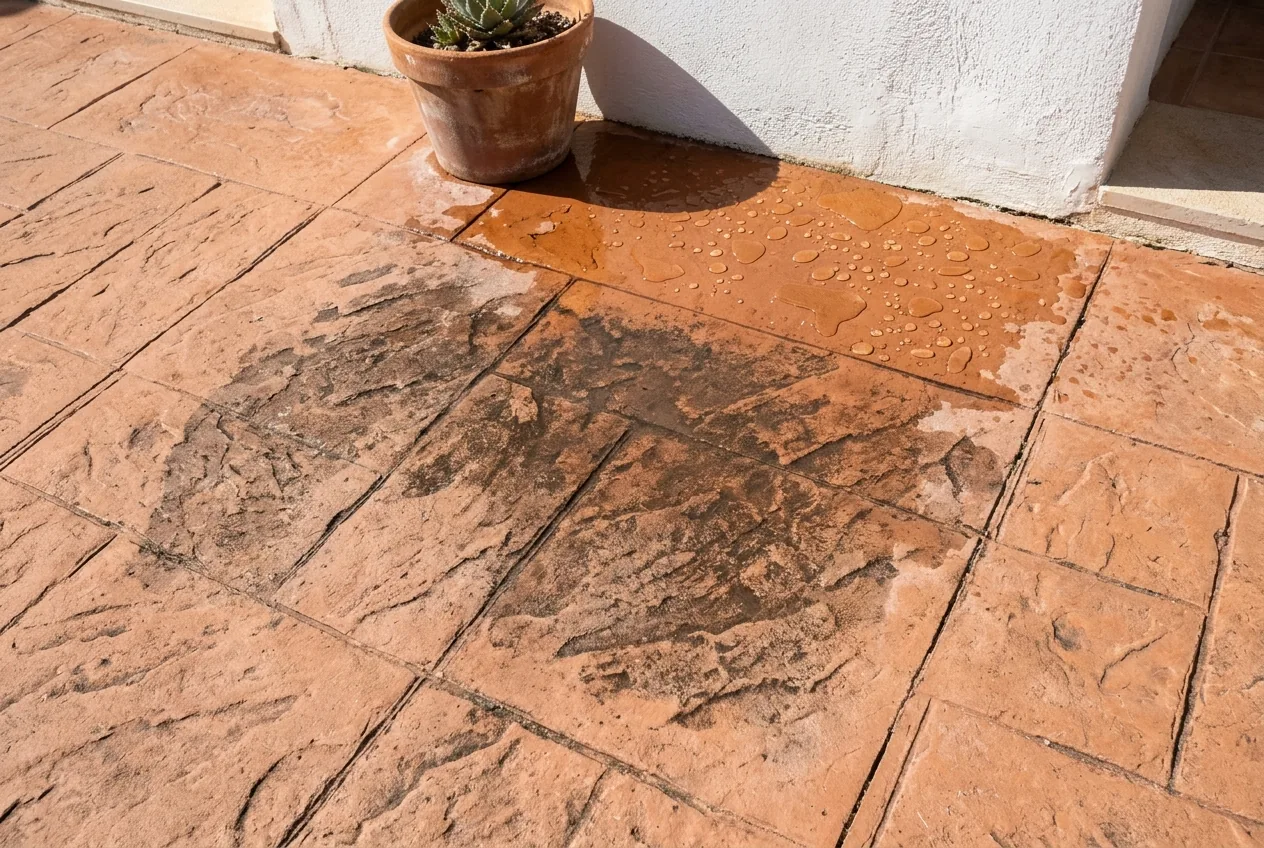
Pour a glass of water on a sunny part of the floor and watch it for a minute.
- It beads and runs off. The sealer is working. The floor only needs cleaning.
- It darkens the floor and soaks in. The sealer is spent. The floor needs resealing, and cleaning is the first step of that job.
- It beads in some places and soaks in others. The sealer has worn through where people walk and cars turn. Those areas are due now, and the rest will follow.
How we clean stamped concrete
On sealed stamped concrete we work at 80 to 150 bar with a 25 to 40 degree fan nozzle or a surface cleaner head, at 20 to 30 centimetres and always moving, in overlapping passes. Each stain gets its own pre-treatment before the wash:
- Green algae and moss in shade and under pines: an algaecide left to act, then washing. Pressure alone takes algae off the surface but not out of the pores, and it comes back within weeks.
- Tyre marks: an alkaline degreaser, contact time and brushing. Marks that have gone into the sealer are covered by the next reseal.
- Oil and grease: degreaser or an absorbent poultice left for hours, then brushing and rinsing. An old stain can leave a shadow.
- Rust and efflorescence: a mild acid cleaner, diluted, with a controlled contact time, then neutralised and rinsed thoroughly.
Then everything is rinsed so that no product stays on the floor to interfere with a sealer later, and the floor is left to dry.
When cleaning and resealing go together
On most of the floors we see, the honest answer is both. Driveway restoration in Mallorca usually means: wash, strip the sealer where it is loose, repair cracks and broken edges, restore the colour, and apply two thin coats of sealer once the floor is dry. The washing happens on the first day and the sealing after at least 24 hours of dry weather, longer in shade or after rain. We avoid the middle of the day in summer and never seal with rain forecast. The full process is on the page on stamped concrete restoration and resealing.
Cleaning between reseals
A sealed floor needs one gentle wash a year, normally at the end of winter before the season, and a light second one in autumn on shaded areas that grow algae. If you use a household pressure washer yourself:
- Use the fan nozzle, never the pencil or rotary one.
- Keep 30 centimetres or more from the floor and keep the lance moving.
- Try a hidden corner first and look at it dry.
- Do not use salfumán or neat bleach.
- If the water no longer beads after the wash, book the reseal rather than washing again.
Solera Mallorca
How we work
- 01
Inspection
We identify the sealer, how worn it is and each kind of stain.
- 02
Pre-treatment
Algaecide, degreaser or mild acid for each stain, with its contact time.
- 03
Washing
Fan nozzle or surface cleaner, overlapping passes, controlled pressure.
- 04
Rinsing
Every trace of product removed so it cannot interfere with the sealer.
- 05
Drying and check
We look at what has come off and tell you whether the floor needs resealing or repair.
FAQ
Questions
Something else? Ask us when you request a quote.
Can I pressure wash stamped concrete?
Yes, with a fan nozzle, at 30 centimetres or more and without dwelling on one spot. A pencil or rotary nozzle close to the floor cuts the sealer and strips the colour.
Why does my stamped concrete have stripes after pressure washing?
Because the jet cut through the sealer unevenly. Where the lance moved slowly or came close, it removed more film and more of the darker accent colour, leaving lighter bands. The stripes do not wash out; they are evened out by restoring the colour and resealing.
Does pressure washing remove the sealer?
A controlled wash on a sound sealer does not. A concentrated jet at close range does, and so does washing a sealer that is already worn and loose. That is why a wash on an old floor can make the next reseal more urgent.
How long after pressure washing can stamped concrete be sealed?
When the floor is dry right through: at least 24 hours of dry weather, longer in shade, in cool weather or after rain. Sealing a damp floor traps the water under the resin and turns it white.
Is a water-repellent impregnation the same as resealing?
No. An impregnation goes into the pores and repels water without forming a film, which is right for natural stone. Stamped concrete relies on a film of acrylic or polyurethane sealer to hold the accent colour, give the colour depth and take the wear. Only a reseal renews that film.
How often should stamped concrete be cleaned?
Once a year is usually enough on a sealed floor, at the end of winter. Shaded areas with algae and driveways with a lot of traffic may need a light second clean in autumn.
Guides
Related guides
How to seal stamped concrete and how often to reseal it
The resealing cycle for stamped concrete in Mallorca, the signs that it is due, the right steps and the mistakes that ruin a coat of sealer.

White patches and grey areas on stamped concrete
Four different causes make stamped concrete look white or grey, each with its own diagnostic test and its own solution.
Solera Mallorca
Tell us what needs cleaning
A few photos of the stains and of the whole surface, and what they are if you know, are enough for us to tell you whether it needs cleaning, resealing or both.