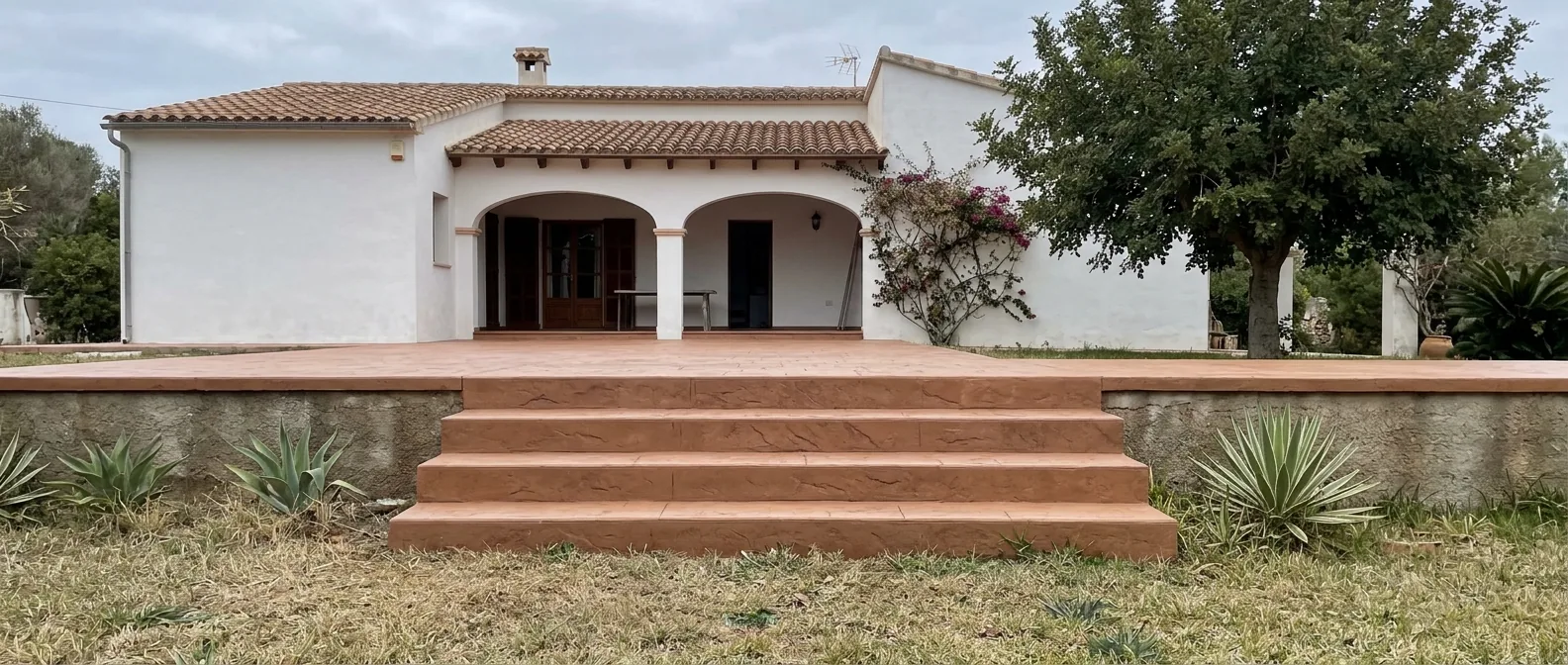
Crack repair in stamped concrete
Not all cracks in stamped concrete are the same. Fine shrinkage cracks are filled and blended into the pattern; cracks that grow or step out of level point to a problem with the sub-base. Here we explain how to tell them apart and how each one is repaired.
Concrete cracks. It cracks as it dries, because it loses volume; it cracks with changes in temperature, because it expands and contracts; and it cracks when the sub-base beneath it gives way. Well built stamped concrete has cut joints precisely so that those cracks appear where they are planned and not wherever they like. When they appear away from the joints, you need to understand why before covering them up. Here we explain the types of crack we see in Mallorca, how each one is repaired and when repair is no longer the answer.
Hairline cracks and structural cracks
Hairline shrinkage cracks
These are the most common and the least serious. They are under a millimetre wide, with no step between one side and the other, and usually appear in the first months after the pour, on large slabs without enough joints or on concrete that dried too quickly in the July sun. They do not compromise the floor. They are filled with a low viscosity resin that soaks in by capillary action, then tinted and sealed. Once that is done, you have to know where they were to find them.
Movement or structural cracks
These are wider than two or three millimetres, have one side higher than the other, or keep opening from one season to the next. They show that the sub-base has settled or washed out, that a root is pushing up, that a heavier vehicle than planned is driving over it or that the slab has no steel mesh. Simply filling them covers up the symptom: the crack opens again through the filler. First the cause is found, and depending on what it is, the crack is repaired with mortar and resin, turned into an expansion joint, or the affected slab is cut out and poured again.
Cracks at the joints
Contraction joints are cut shortly after the pour, and expansion joints are left between the floor and the house, a wall or the pool edge. Over the years their filling breaks down, water and soil get in, weeds grow and the edge of the joint starts to chip. The repair is to clean the joint out thoroughly, insert a foam backer rod and seal it with a polyurethane sealant that moves with it. A well sealed joint stops the water from the autumn rains reaching the sub-base, which is how most settlement problems begin.
Broken edges, steps and chips
The edges of a terrace, stamped concrete steps and corners next to manholes are the areas that take the most knocks. A broken edge or a step with a chipped nosing is rebuilt with a thixotropic repair mortar, which holds its shape on a vertical face, over a bonding agent that makes sure it grips the old concrete. The edge is shuttered if needed, the texture is recreated and the colour tinted in. Isolated chips in the colour layer, where the aggregate shows through, are treated the same way, in a thin layer.
How it is repaired and blended in
- Opening. The crack is opened into a V with an angle grinder or a hand tool, so that the filler has body and grips the sides, not just the surface.
- Cleaning and priming. The dust is vacuumed out and a primer or bonding agent is applied. Without this step, the new mortar comes away from the old.
- Filling. Low viscosity resin in hairline cracks; repair mortar mixed with resin in medium ones; polyurethane sealant in joints that need to move.
- Texture. While the mortar is fresh, it is stamped with a flexible mould of the same pattern or with hand texturing tools, following the lines of the stone or timber being imitated.
- Colour. The repair is tinted with pigment or pigmented sealer to the tone of the floor, matched on site, bearing in mind that stamped concrete is never a single colour and that the aim is for the eye not to stop on it.
- Sealing. After 24 to 48 hours, the repaired area is sealed together with the rest of the floor. It is the sealer that finally evens out the tone.
We are honest about this: a repaired crack can be disguised until you have to look for it, but on a freshly sealed floor and against the light, a trained eye will find it. With time and the next reseal, the difference fades.
When a slab has to be replaced
There are three situations in which we do not repair, and we say so at the visit: when a slab is broken into several pieces that move underfoot, when the step between the two sides of a crack is more than a centimetre and becomes a trip hazard, and when the sub-base beneath is hollow or washed out. In those cases the affected section is cut out along the joints, the sub-base is recompacted, and the slab is poured again with mesh and stamped with the same mould and colour. The new slab stands out at first and is evened out with the general reseal. It is a new stamped concrete job on a small scale, and it is the only way to stop the problem coming back.
If you want to understand the process before calling, the guide on repairing cracks in stamped concrete explains it in more detail, including what you can do yourself on a hairline crack.
Solera Mallorca
How we work
- 01
Diagnosis
We measure the width and check for any step and whether the crack is still opening.
- 02
Opening and cleaning
The crack is opened into a V, vacuumed and primed so that the filler grips.
- 03
Filling
Resin or repair mortar depending on the width and the movement expected.
- 04
Texture and colour
The mould pattern is pressed in and tinted to the tone of the floor.
- 05
Sealing
The repaired area is sealed with the rest so that the coat is even.
FAQ
Questions
Something else? Ask us when you request a quote.
Why does stamped concrete crack?
Through shrinkage as it dries, expansion and contraction with changes in temperature, and movement of the sub-base. Joints cut in time concentrate shrinkage cracks where they cannot be seen; cracks away from the joints usually point to slabs that are too large, drying that was too fast or a sub-base that has given way.
How are cracks in stamped concrete filled?
They are opened into a V, cleaned and primed, filled with resin or repair mortar depending on the width, stamped with the mould texture, tinted to the tone of the floor and sealed with the rest. A movement crack also needs its cause dealt with.
Will the repair show?
On a hairline crack or a joint, hardly at all. On an edge or a replaced slab, it stands out at first and is evened out with the general reseal. Stamped concrete varies in tone by nature, and that helps.
How long does crack repair take?
A day to open, fill and texture; 24 to 48 hours for the mortar to cure; and then the sealing, which can be walked on after 24 hours. In a full restoration, the repair is done before the colour and the sealing.
When does a whole slab need replacing?
When it is broken into pieces that move, when the step between the sides of the crack is more than a centimetre or when the sub-base beneath is hollow. It is cut out along the joints, the sub-base is recompacted and it is poured again with the same mould and colour.
Solera Mallorca
Send us a photo of the crack
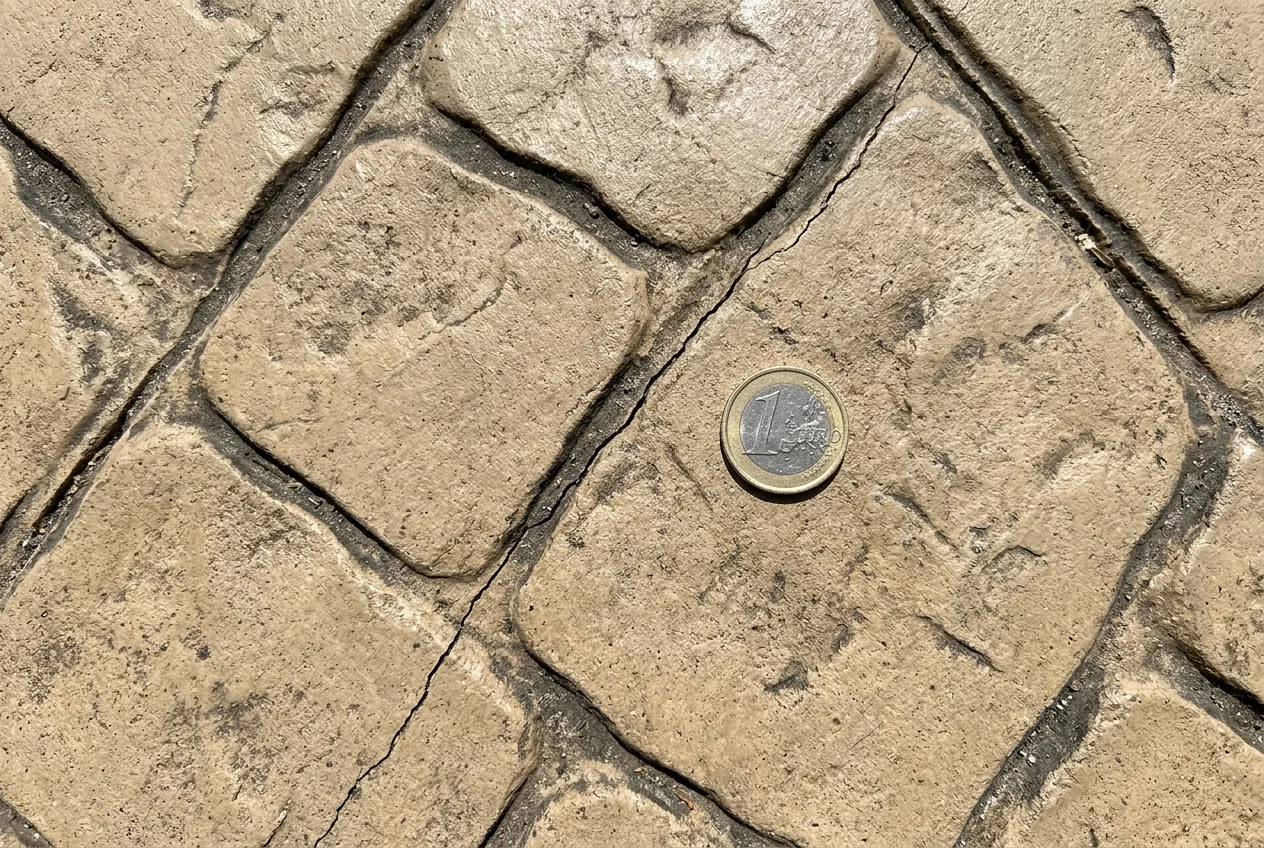
A close up with a coin beside it for scale and a general shot of the area let us tell you whether it is a simple repair or something more.