Microcement
Does microcement last outdoors? Sun, salt, rain and pools
What microcement withstands outdoors and what it does not: sun, salt air, pools, torrential rain, thermal movement, sealers, slip resistance, maintenance and the base.
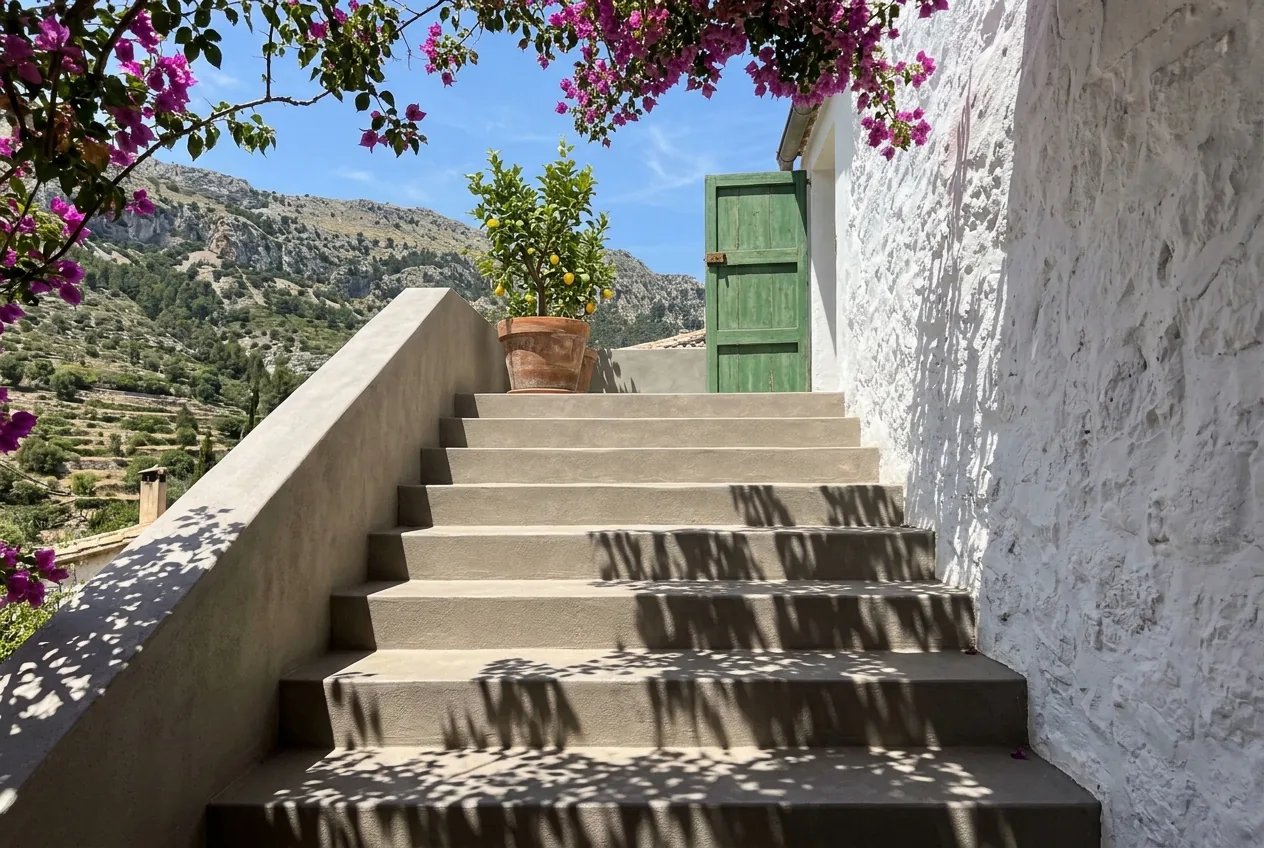
Microcement holds up well outdoors when the base is a stable concrete slab, laid to falls and with no damp coming up from below, and when it is sealed with an aliphatic polyurethane that resists ultraviolet radiation. Under those conditions it stands up to sun, rain, salt air and the edge of a pool for years, with periodic resealing. What it cannot take is a base that moves or cracks, standing water, vehicle traffic and the expectation that it will waterproof on its own. It is a coating 2 to 3 mm thick: whatever happens underneath will show on top.
What it is and why the base is everything
Microcement is a seamless coating of cement, resins, fine aggregate and pigments, applied by trowel in several layers of less than a millimetre each, over a glass fibre mesh and a primer, and sealed with a polyurethane varnish. The total thickness is between 2 and 3 mm. It has no structure of its own: it bonds to whatever is underneath and copies its behaviour. If the slab cracks, the microcement cracks in the same place. If the tile underneath sounds hollow, the microcement will lift with it. If damp rises from the ground, the microcement takes it from behind and the sealer blisters. That is why the question outdoors is not whether microcement holds up, but whether the base does.
Factor by factor
Sun and ultraviolet radiation
The cement layer is not degraded by the sun; the sealer is. Two-component aliphatic polyurethane varnishes keep their colour; aromatic ones, which are cheaper, yellow within months. With the right sealer, colours may lighten slightly over the years, more in strong shades than in greys and sands. A light colour also heats up less and stays comfortable underfoot in summer.
Salt air
On the seafront, salt spray settles and crystallises. On well-sealed microcement it does not penetrate, but it speeds up the wear of the varnish. The surface is rinsed with fresh water after storms and the resealing cycle is shortened: in Portals, Illetes or the bay of Pollença, every 2 to 3 years instead of every 4 or 5.
Pools
There are microcement systems for continuous immersion, with epoxy or pool-grade polyurethane sealers, applied inside the pool shell and on the coping. They work on two conditions: the shell has to be waterproofed underneath, because microcement is not the waterproofing, and the system has to be tested for chlorinated or salt water. On the surround, it is applied with a more open texture and a sealer with an anti-slip additive to reach slip class 3. The guide to non-slip floors around the pool explains the classes.
Rain and standing water
Rain does not harm sealed microcement. Water standing for days does: it softens the sealer and eventually finds a pore. That is why the base must fall towards the drains, at least 1% and preferably 1.5 or 2%, with no hollows. If puddles formed after the autumn rain before the microcement went down, the same puddles will form afterwards, on a more sensitive material.
Thermal movement
A terrace in the sun can go from 10 °C at a winter dawn to 50 °C at midday in August. The slab expands and contracts at its joints. The microcement has to respect them: the joints are cut in the same place and sealed with elastic sealant. If they are covered over, the microcement cracks right above them, in a straight line, in the first summer. The same happens where different materials meet.
Vehicle traffic
It is not a surface for cars. A wheel turning on the spot wears it through in a season, and point loads mark it. On driveways, the seamless alternative is stamped concrete or power-floated concrete.
Suitability by base and use
| Situation | Suitable | Condition |
|---|---|---|
| Terrace on a sound concrete slab, laid to falls | Yes | Joints respected, moisture in the base under control |
| Terrace on firm tiles, no leaks | Yes | Specific primer, hollow tiles removed, joints bridged with mesh |
| Terrace on tiles that leak into the floor below | Only after waterproofing | Compatible membrane underneath; microcement does not waterproof |
| Outdoor stairs and walls | Yes | Edges protected, same sealer |
| Pool surround | Yes | Open texture, anti-slip sealer, more frequent resealing |
| Inside the pool shell | Yes, with a specific system | Shell waterproofed, product made for immersion |
| Slab on the ground without a membrane, with rising damp | No | The damp blisters the sealer |
| Base with cracks, or with active cracks | No | Repair and stabilise first, or choose another floor |
| Driveway, garage ramp | No | Wheel traffic and point loads wear it out |
| Timber decking or flexible bases | No | They move more than microcement can take |
Sealers: the technical decision
The sealer is the only barrier between the microcement and water, and outdoors it has four requirements: ultraviolet resistance (aliphatic polyurethane, not aromatic), elasticity to follow the fine movements of the base, resistance to occasional standing water and, in wet areas, an anti-slip additive. Two or three thin coats are applied over the dry microcement. Matt and satin are the usual finishes outside; gloss shows every scratch and is slippery.
Slip resistance
Smooth microcement, sealed and wet, is slippery. Outdoors it is given a more open texture in the last layer or microspheres in the sealer, and on pool surrounds and stairs class 3 of the Spanish building code is the standard to ask for. It is a decision to make beforehand, because adding texture later means resealing the whole surface.
Maintenance
- Clean with water and neutral soap. No hydrochloric acid (salfumán), bleach or harsh degreasers, which attack the sealer.
- Use a pressure washer only at low pressure, with a fan nozzle held well back.
- Rinse with fresh water after storms on the coast.
- Reseal every 3 to 5 years on terraces and every 2 to 3 on pool surrounds and seafront properties, with the same sealer, after cleaning and a light sanding.
- Deal with rust and oil stains early; after weeks in the sun they get into the sealer.
An isolated crack is repaired with the same material and the area is resealed, although the patch will show in the tone. Widespread cracks or blisters point to a problem in the base, and repairing them on the surface does little good.
When to call a professional
Outdoor microcement is not a job for an amateur: controlling the moisture in the base, the times between coats, the sanding, the choice of sealer and respect for the joints decide whether it lasts ten years or two. Before hiring anyone, make sure whoever will apply it inspects the base, measures the moisture, taps the tiles if there are any, checks the falls and states in writing which sealer they will use. If the terrace leaks, waterproofing comes first and the microcement comes after. The page on outdoor microcement explains how each case is approached and when another solution is recommended.