Restoration
White patches and grey areas on stamped concrete
Four different causes make stamped concrete look white or grey, each with its own diagnostic test and its own solution.

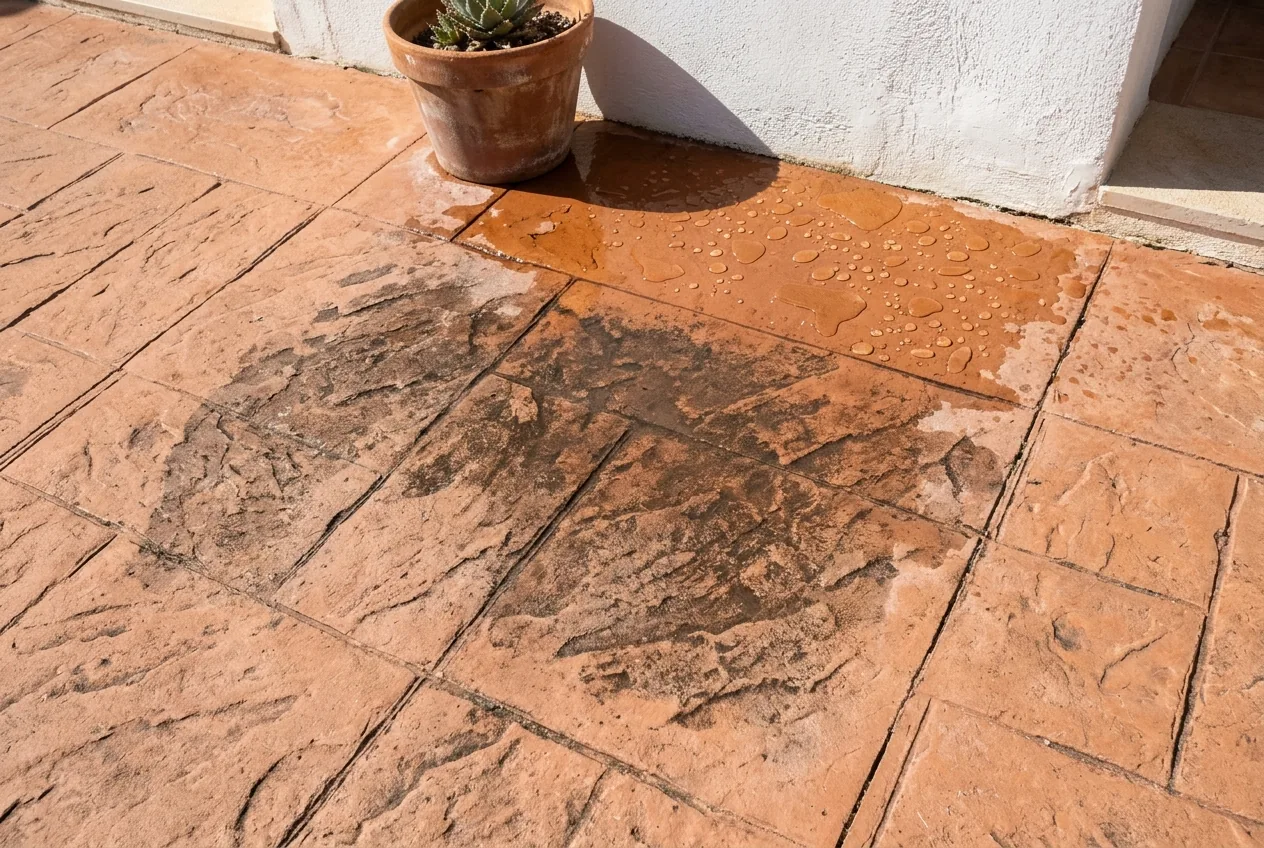
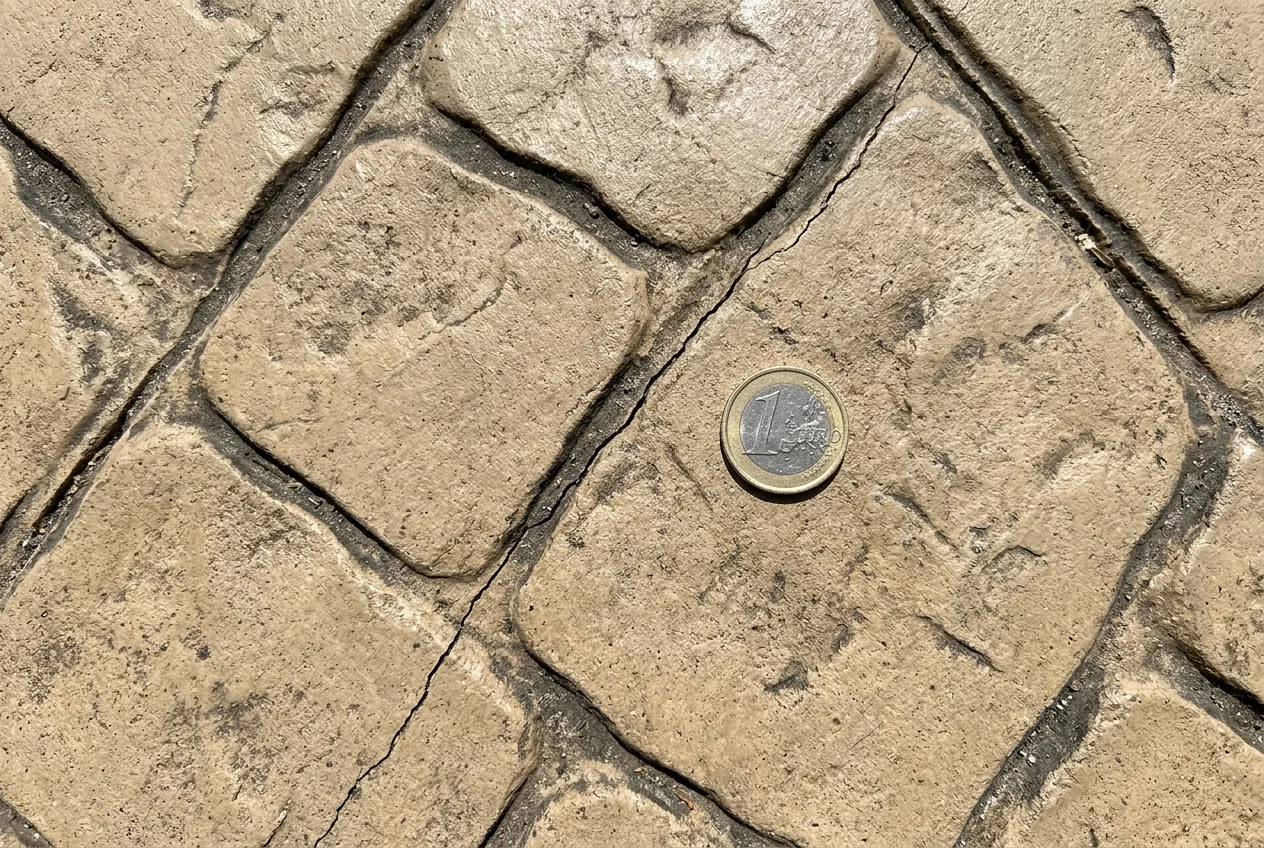
Stamped concrete turns white or grey for four different reasons, each fixed in a different way: efflorescence, salts rising from the concrete itself; moisture trapped under the sealer that turns it milky; sun wear of the sealer and the pigment; and sea salt deposits near the coast. Before applying anything, find out which one you have, because the remedy for one makes another worse: more sealer over a moisture veil seals it in for good, and scrubbing a worn sealer with acid does nothing.
The four causes
Efflorescence
Concrete contains free lime and soluble salts. When water passes through the slab from below or from a joint, it dissolves them and carries them to the surface, where the water evaporates and the salts crystallise. The result is a white powder, sometimes like frost, concentrated along edges, joints and low spots. It is most common on new floors, in the first one or two years, and on slabs laid without a polythene sheet or on ground that holds water, such as the clay soils of inland Mallorca in the Pla and the Raiguer.
How to recognise it: it comes off when rubbed with a dry brush. It comes back after rain. A drop of vinegar makes it fizz.
White veil of moisture under the sealer
Acrylic sealers, especially solvent-based ones, turn milky when water is trapped under or inside the film. It happens when the concrete was sealed before it was dry, when the coat was too thick, when it rained or dew fell in the hours after, or when moisture rises from the ground and cannot escape because the sealer is not breathable enough. The veil is even or in diffuse patches, like misted glass, and it is not a powder: it is inside the coat.
How to recognise it: it does not come off with a brush or with water. It appears or gets worse after rain and sometimes improves in the heat. If you dampen a cloth with xylene thinner and rub one spot, the veil disappears and the colour shows again.
Wear from sun and use
The most common cause on floors over three or four years old that have not been resealed. Ultraviolet light breaks down the sealer and then attacks the pigment in the colour hardener. The surface loses saturation and turns grey and matt, and the most exposed or walked-on areas end up lighter than those under an awning or a planter. It is not a stain: it is the absence of the layer that gave the colour.
How to recognise it: water no longer runs off the surface; it soaks in. Wet, the grey area gets its colour back; dry, it loses it again. Areas under fixed furniture keep the original tone.
Sea salt
On the seafront at Portals, Cala Rajada, Port d'Alcúdia or in any urbanización (residential estate) less than a kilometre from the sea, the wind deposits salt spray that crystallises in the sun. It forms a thin whitish crust, similar to efflorescence, that also speeds up sealer wear. It comes from outside, not from the slab.
How to recognise it: it dissolves in fresh water and returns not after rain but after days of sea wind. It is heaviest on the side facing the wind.
Diagnosis table
| Symptom | Efflorescence | Veil under the sealer | Sun wear | Sea salt |
|---|---|---|---|---|
| Comes off with a dry brush | Yes, partly | No | No | Yes, partly |
| Comes off with fresh water | Temporarily | No | No | Yes |
| Xylene makes it disappear | No | Yes | No | No |
| Water beads on the surface | Usually yes | Yes | No, it soaks in | Depends |
| Where it appears | Joints, edges, low spots | Diffuse patches, shady areas | Sunny areas and walkways | Side facing the wind |
| When it gets worse | After rain, on new floors | After rain or dew | Every summer | After days of sea wind |
What fixes each one
Efflorescence
First, dry brushing to remove the powder. If residue remains, a wash with a mild acid solution (citric acid or an efflorescence cleaner diluted as the manufacturer specifies), always after wetting the floor so that the acid does not soak in, followed by plenty of rinsing. Neat salfumán, the hydrochloric acid sold in Spanish hardware shops, attacks the colour hardener and lightens the concrete permanently. Then the floor dries for several days and is sealed with a breathable sealer. If the cause is water rising from the ground, the efflorescence will return until the drainage is fixed; sealing only holds it back.
Moisture veil
On solvent-based acrylic sealers, a light veil is corrected by reactivating the film: xylene is rolled over the area, the sealer softens, the moisture escapes and the coat turns clear again as it dries. It is work with a strong solvent, done outdoors and out of direct sun. If the veil is extensive, or the sealer is thick and soft, the right approach is to strip it, let the concrete dry thoroughly and seal again in two thin coats. On water-based sealers xylene does not work; they are stripped. If the moisture comes from the ground, the new sealer must be breathable.
Sun wear
There is nothing to clean off. The floor is washed, left to dry and sealed again. If the pigment is intact, a clear sealer brings back the colour, because the film saturates the tone again. If the pigment has gone too and the concrete looks grey even when wet, it needs a pigmented sealer or a stain before sealing. The procedure is set out in how to seal stamped concrete and how often.
Sea salt
Washing with fresh water at moderate pressure, drying and resealing. On the seafront the resealing cycle shortens to two years or less, and the floor should be hosed down after winter storms.
What not to do
- Apply new sealer over an untreated white veil. It gets sealed in and only stripping removes it.
- Use neat salfumán or concentrated bleach. They discolour the colour hardener for good.
- Use a pressure washer with a concentrated jet a few centimetres from the floor. It strips the release agent and the colour layer.
- Paint the floor with floor paint. It covers the pattern, wears in patches and later has to be removed.
When to call a professional
An owner can make the diagnosis with the tests in this guide and deal with light efflorescence or sun wear on a small terrace. It is worth calling a company that does stamped concrete restoration when an extensive veil has to be stripped with solvents, when the pigment has gone and the colour has to be evened out with pigmented sealer across the whole surface, when efflorescence comes back year after year and the water entry has to be traced, or when several of the four causes are mixed on the same floor, which is usual on terraces more than ten years old.