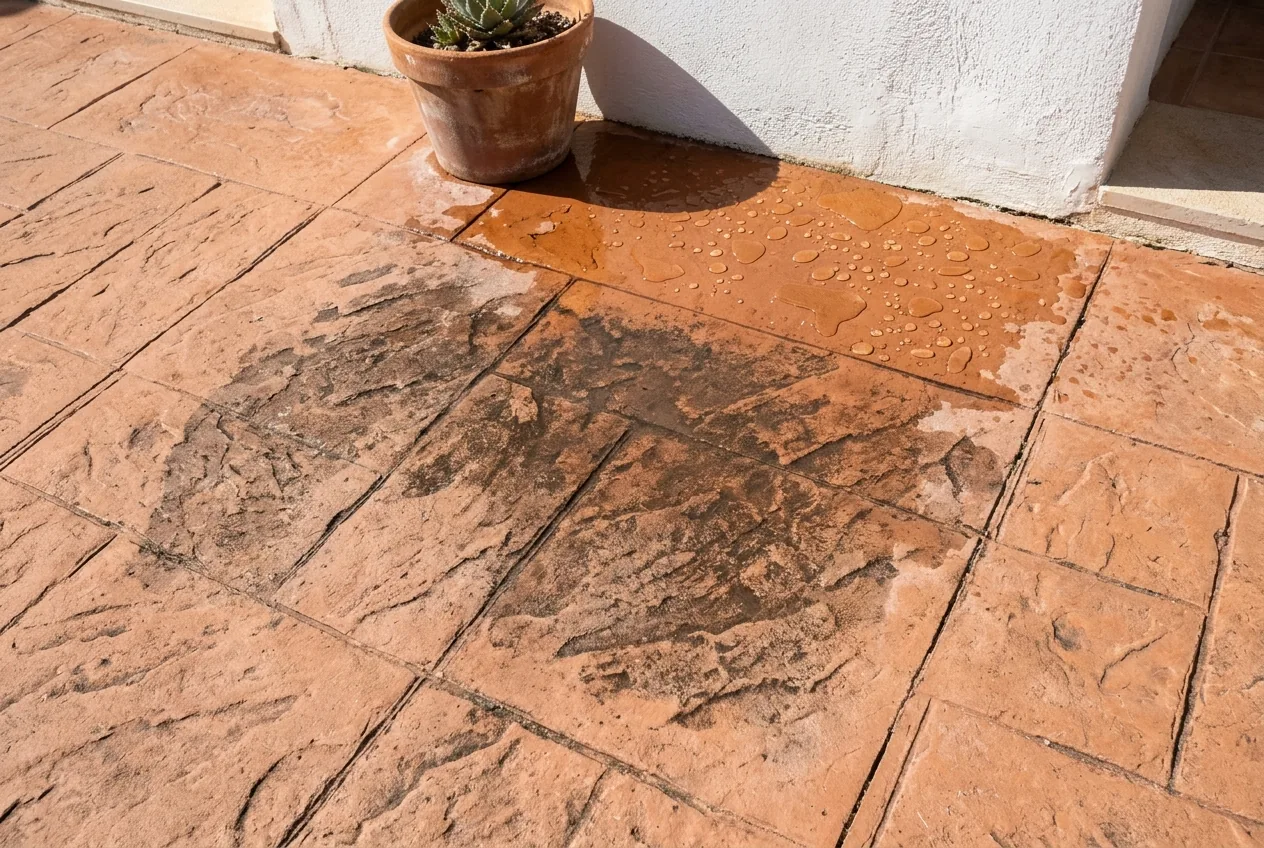
Restoration
Cracks in stamped concrete: why they appear and how they are treated
Which cracks appear in stamped concrete, what causes them, how they are repaired and disguised, and when a section has to be replaced.
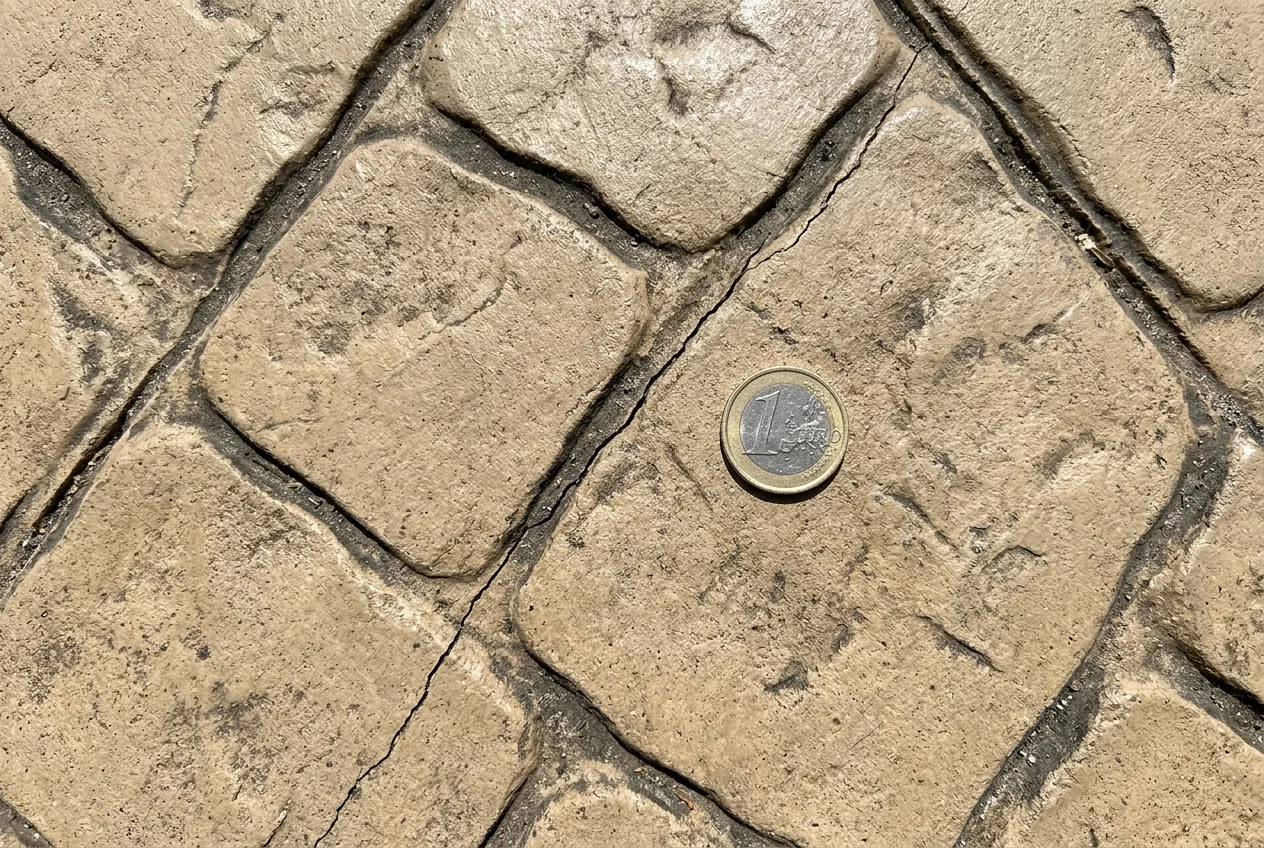
Fine cracks in stamped concrete, those no wider than half a millimetre that do not move, are sealed with the floor's own sealer and become almost invisible. Cracks of one to five millimetres are opened up, filled with a repair mortar or a flexible sealant and touched up in colour and texture; they show close up, not from standing height. Wide cracks, cracks with one side higher than the other and cracks that keep reopening are not repaired: the section is cut out and poured again. Knowing which of the three cases you have saves paying for a repair that will not survive the next summer.
Why stamped concrete cracks
Concrete always cracks; the question is where. A well built floor has joints that tell it where to break, and the cracks stay hidden in them. When cracks appear elsewhere, there is a cause:
- Too few joints, or joints cut late. Contraction joints are cut 12 to 24 hours after the pour, every 3 to 4 metres, to a depth of a quarter to a third of the slab thickness. Otherwise the concrete breaks where it likes.
- Poorly compacted sub-base. Uncompacted aggregate or recent fill settles, the slab is left unsupported and breaks under bending. This is the cause of cracks with a step between the two sides.
- Loads it was not designed for. An 8 cm terrace built for people takes a delivery van.
- Roots. Pines and fig trees lift whole slabs. The crack follows the root and one side is higher.
- Fast curing. In July, with wind and the concrete at 35 degrees, the water evaporates before the concrete has gained strength. Fine cracks appear in a network; they are superficial and do not grow.
- No reinforcement. Without steel mesh or fibres, any crack opens wider and the edges chip.
- Ground movement. Clays that swell with the autumn rain and shrink in summer, common inland on the island, move the slab every year.
Types of crack and what they mean
| Type | Appearance | Usual cause | Repair or replace |
|---|---|---|---|
| Hairline or plastic shrinkage crack | Under 0.5 mm, often in a network or parallel | Fast curing, too much water | Sealed with sealer; cosmetic |
| Shrinkage crack away from a joint | 0.5 to 3 mm, straight or slightly curved, edge to edge | Joints cut late or too far apart | Repaired and turned into a joint |
| Structural crack | Over 3 mm, with a step between the sides | Settling sub-base, excess load, roots | The section is replaced |
| Chipped edge or joint | Pieces breaking off the edge | Water and frost, wheels, no reinforcement | Repaired with mortar |
| Active crack | Reopens after each repair, changes with the seasons | Moving ground, living root | Expansion joint or replacement |
To find out whether a crack is active, a plaster tell-tale is stuck across it and checked after a season. If it breaks, the crack is moving.
Repair methods
Hairline cracks
They are cleaned with a brush and a vacuum and sealed with the same sealer as the floor, brushed in before the general coat. If the colour is intact, they disappear. If the network of cracks is extensive and faded, a pigmented sealer over the whole surface evens them out.
Cracks of 1 to 5 mm that do not move
- The crack is opened into a V with a diamond blade, 5 to 8 mm wide and as deep, to give the filler a grip.
- Dust is vacuumed out and the crack primed with bonding resin or water, depending on the mortar.
- It is filled with polymer-modified repair mortar, flush with the surface. Where vehicles drive, an epoxy mortar is used.
- Before it hardens, colour hardener in the floor's shade is dusted on and the texture is pressed in with a texture skin or with the original mould.
- After 24 hours, release agent or a stain is applied in the joints of the pattern to bring back the contrast.
- The area is sealed, and then the whole floor.
If the crack runs through an area where there should have been a joint, it is better to turn it into one: it is cut straight with a blade along the crack and filled with a flexible polyurethane sealant.
Cracks that move
They are not filled with rigid mortar, because they will break again beside the repair in the next cycle. They are treated as expansion joints: opened to 10 mm, fitted with a foam backer rod and sealed with elastic polyurethane in the colour of the floor. If the cause is a root, the tree's future has to be decided with a gardener.
Chipped edges
The edge is cut back to sound concrete, primed and rebuilt with thixotropic mortar, with simple formwork if needed. It is coloured and retextured the same way.
Matching colour and pattern
Whether a repair shows depends on the colour, not the filler. For a patch to blend in:
- Colour hardener of the same shade is used. The original floor will have lightened over the years, so the catalogue colour usually comes out darker; it is mixed with a lighter shade or corrected with stain.
- The texture is recovered with texture skins, flexible mats without edges. If the crack falls on a joint in the pattern, the patch hides in it.
- Release agent or a stain in the joints brings back the contrast of the aged effect.
- The whole floor is resealed, not just the patch. An area with new sealer next to one with three-year-old sealer always shows.
Even so, a patch in the middle of a plain slab will be visible from a metre away, especially when wet. It is best to say so before starting.
When a section has to be replaced
A section is cut out and poured again when the crack has a step between the two sides, because the slab is broken and has settled; when one area has several cracks crossing each other, a sign that the sub-base has failed; when chipping goes deeper than a third of the thickness; or when the section has taken loads it will keep taking. It is cut along the nearest joints, the sub-base is compacted, mesh is added, it is poured with the same colour hardener and mould, and everything is sealed. The new bay will look somewhat stronger in colour for a year or two.
When to call a professional
Hairline cracks and an isolated one-millimetre crack on a terrace with foot traffic can be sealed at home with the floor's sealer. It is worth calling a company that does crack repair in stamped concrete when the crack is over 3 mm or has a step, when it moves with the seasons, when colour and texture have to be recovered in a visible area, when the floor takes vehicles, or when a section has to be replaced with the original mould and colour hardener.