Waterproofing
Waterproofing over the existing tiles: when it works and when it does not
When terrace waterproofing with a liquid membrane over the tiles works, when it does not, how the surface is prepared, what happens with drains and falls, and how long it lasts.
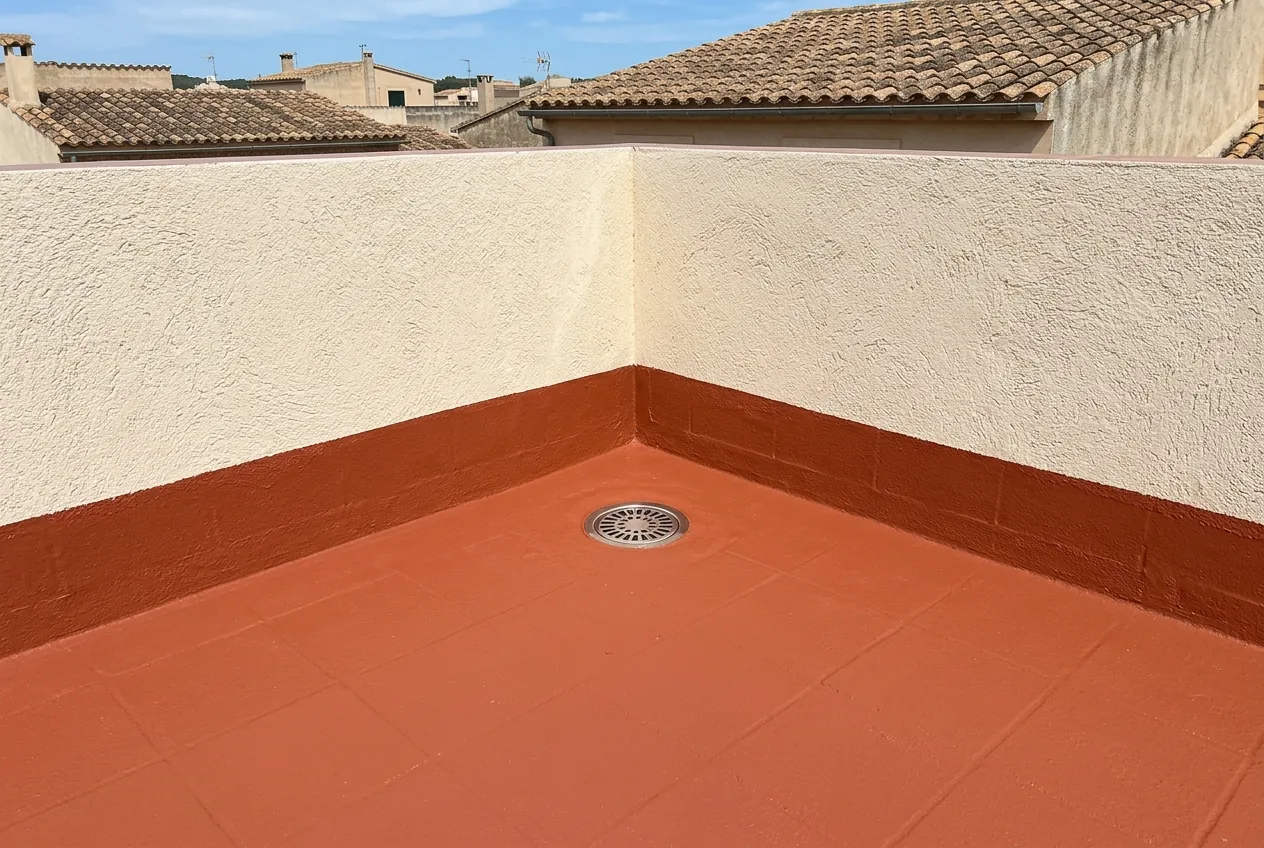
A terrace can be waterproofed without lifting the floor when the tiles are firmly bonded, the terrace falls towards its drains and the water gets in through the joints and hairline cracks, not through a structural crack or an old membrane with water trapped beneath it. In that case, a continuous liquid membrane over the existing paving, reinforced at junctions and drains, stops the leak for years. When the tiles sound hollow, there are puddles that do not drain or the water is already inside the roof build-up, putting a membrane on top covers the problem up rather than fixing it.
Why a tiled terrace leaks
A walkable terrace is a sandwich: structural slab, screed laid to falls, waterproof membrane, mortar and tile. The tile is not waterproof; the membrane underneath is. Over the years the joints open, water gets through, the mortar becomes saturated and the membrane, if it is more than 20 or 25 years old, ends up punctured somewhere, nearly always at a junction with a wall, at the drain or at an expansion joint. Mallorca's torrential autumn rain, with 80 or 100 litres per square metre falling in an afternoon, finds any way in.
There are two ways to solve it: strip everything back to the slab and rebuild the layers, or turn the current surface into the new waterproof layer with a liquid membrane. The second is quicker, creates no rubble, does not change the floor level at the doors and costs less, but it only works if the surface allows it.
When it works
- The tiles are bonded. Tapped with a handle, they sound solid; an odd hollow tile can be taken out and the gap filled.
- The terrace drains. After rain there are no puddles and the water reaches the drains.
- The leak appears with rain and disappears within days: water gets in from above and out again, with no reservoir inside.
- The visible cracks are fine and follow the tile joints.
- The whole perimeter can be treated: junctions with walls, thresholds, downpipes and expansion joints.
When it does not work
- Hollow tiles over a large part of the surface. The membrane will move with them and tear.
- Permanent puddles. Standing water eventually finds the defect, and acrylic membranes soften under prolonged immersion.
- The ceiling below keeps dripping for days after the rain. The water is inside the mortar or the old membrane and has to be let out; sealing over it leaves it trapped.
- Structural cracks that cross the terrace, have a step in them or are growing. The problem is the slab.
- Damp rising from below, as on terraces built directly on the ground.
- Terraces that will be covered with soil or permanent planters: they need a root-resistant membrane.
In these cases the honest answer is to lift the floor, at least in the affected area, and it is better to know that before paying for a membrane.
Types of liquid membrane
| Type | Appearance | Walkable | Typical life | Strengths | Limits |
|---|---|---|---|---|---|
| Single-component polyurethane | Coloured, matt or satin | Yes, with a wearing coat | 10 to 15 years | Elastic, resists standing water, bridges cracks | Covers the tile; needs a dry surface; smell |
| Elastomeric acrylic with mesh | Coloured | Moderate foot traffic | 5 to 8 years | Economical, water-based, easy to touch up | Less resistant to standing water and wear |
| Flexible two-component cementitious | Grey, gets covered | Under another floor | 10 years or more | Bonds to a damp surface, breathable | Cannot be left exposed |
| Clear polyurethane | Tile stays visible | Yes | 3 to 6 years | Keeps the look of the floor | Thin film, yellows slightly, frequent touching up |
| Sprayed polyurea | Coloured | Yes | 15 years or more | Cures in minutes, very tough | Specialist equipment, high cost |
Single-component polyurethane is the most balanced option for a walkable terrace over tiles. Clear polyurethane is what people ask for so as not to lose their floor, and it has to be explained that it lasts less than half as long and that the tiles will be seen through a film whose appearance changes.
Preparation: where the result is decided
- Thorough cleaning. Pressure washer, degreaser, algae treatment. Any residue prevents adhesion.
- Tile-by-tile check. The tiles are tapped; hollow ones are removed and the gap filled with mortar.
- Joints and cracks. Loose joints are filled and cracks are bridged with mesh.
- Junctions. Most leaks come in where the terrace meets a wall. A cove fillet is formed and the membrane runs 15 to 20 cm up the wall, with mesh.
- Drains. They are cleaned, the neck is checked, the junction is reinforced with mesh or a purpose-made piece, and the membrane runs a few centimetres into the pipe.
- Expansion joints. They are sealed with elastic sealant and covered with a band that allows movement. Covered with a rigid membrane, they crack in the first summer.
- Primer specific to the surface, essential on glazed tiles.
- Membrane in two or three crossed coats, normally 1.5 to 2 mm thick in polyurethane, with mesh at least at the risk points.
- Top coat resistant to ultraviolet radiation and foot traffic, with anti-slip aggregate.
All of this on a dry surface and with no rain forecast for 24 to 48 hours, which in Mallorca means avoiding the autumn storms and working in spring, early summer or the settled days of November.
Falls and drains
A membrane does not correct a badly designed terrace. The Spanish building code requires walkable flat roofs to have a fall of between 1 and 5%; if the terrace is completely flat, falls have to be created with a lightweight screed before waterproofing, which is already half a renovation. The drains must be at the real low point. An overflow through the parapet stops a single leaf in the drain from turning the terrace into a pond.
Possible finishes
A polyurethane membrane can be left exposed, in its own colour and with an anti-slip texture, which is usual on flat roofs and secondary terraces. On main terraces, a light floor can go on top: tiles on pedestals, composite decking or outdoor microcement over a compatible system, which gives a seamless surface without adding weight. The guide on outdoor microcement explains the conditions. You can also tile again over a cementitious membrane, although that adds weight and joints.
When to call a professional
A small terrace with sound tiles, a single drain and simple junctions can be waterproofed by a careful owner with a single-component polyurethane, following the primer, the thicknesses and the drying times. A company is worth calling when there is an active leak into the floor below and the entry point has to be found, when there are hollow tiles or puddles, when the terrace has expansion joints or several downpipes, when you want a permanent walkable finish on top, or when the terrace belongs to a comunidad de propietarios (the owners' association of a shared building) and a report is needed for the administrador de fincas, the property manager who runs it. The page on terrace waterproofing without lifting tiles explains how each terrace is assessed before deciding.