
Sealing and maintaining private asphalt
The asphalt on a finca track or a community car park ages under the sun and from the water that gets into its cracks. Sealing them in time, repairing potholes and renewing the surface costs a fraction of resurfacing, and here we explain what can still be done and what no longer can.
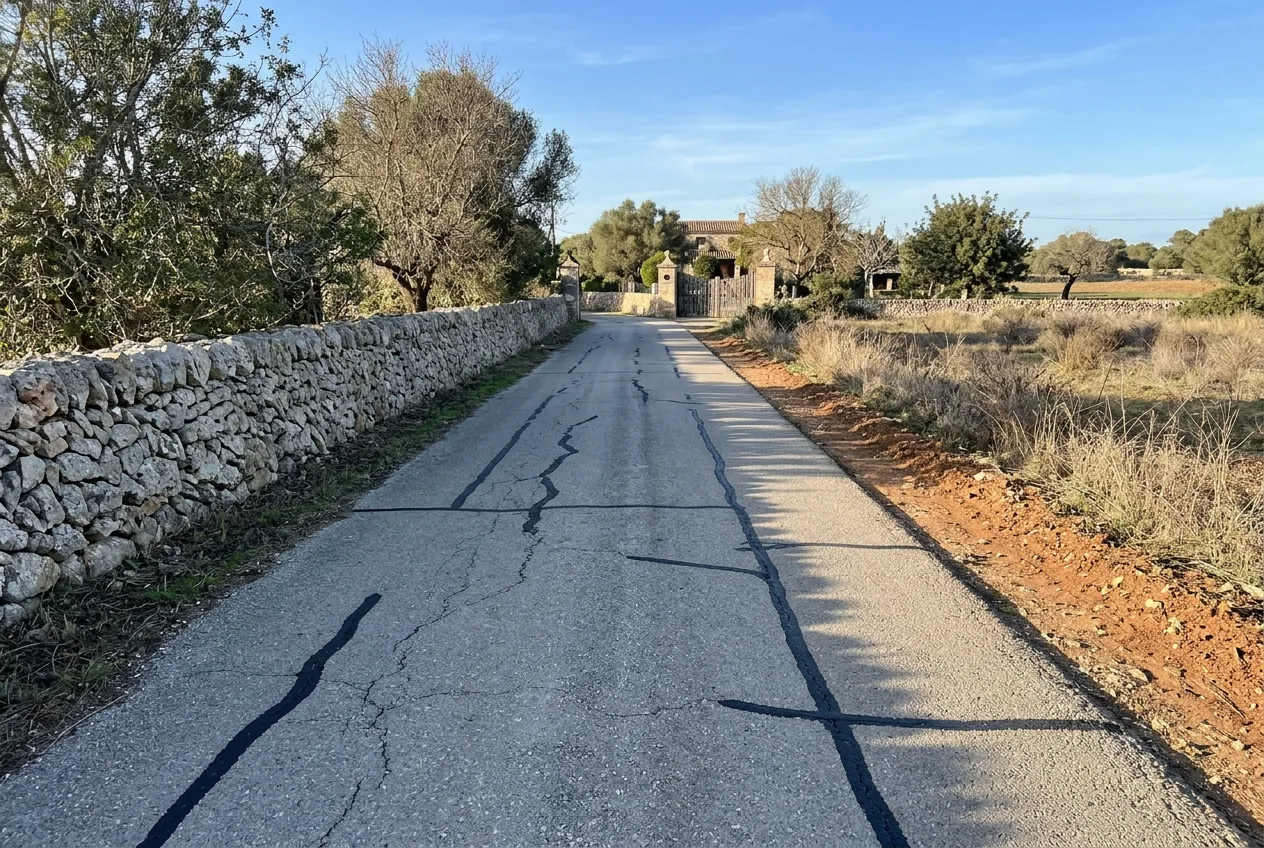
In Mallorca, asphalt is mostly a matter of roads and streets, and that is public works. But there are many kilometres of private asphalt: the access track to a finca in Llucmajor or Manacor, the car park of a comunidad de propietarios (the owners' association of an apartment building or development) in Marratxí, the forecourt of a hotel in Alcúdia, a garage ramp in Palma. Nobody comes to maintain them, and the sun and rain wear them down just as they do a road. This page explains what maintenance private asphalt needs, in what order it is done and at what point it stops making sense and resurfacing has to be considered.
How asphalt ages
Asphalt is aggregate bound with bitumen. Bitumen is flexible and black when new; in the sun it oxidises, loses its light oils, turns grey and brittle, and the aggregate starts to come loose. Fine cracks appear, then wide ones, and through them the water from the autumn storms gets down to the crushed stone sub-base. The base softens, the surface flexes under the wheels and potholes and depressions form. All asphalt maintenance comes down to breaking that chain as early as possible: protecting the bitumen from the sun and keeping the water out.
Crack sealing
It is the most cost effective work that can be done to asphalt. Cracks of 3 to 25 millimetres are blown out to remove soil and weeds, dried and filled with a bituminous sealant, hot applied for the wide ones and those with most traffic, cold applied for the fine ones. The sealant stays elastic and moves with the surface. Fine, interconnected cracking, known as crocodile cracking, is another matter: it shows that the base has failed, and it is treated as a pothole.
Pothole repair
Pothole repair deals with holes and sunken areas. On an isolated pothole the edge is cut back to sound asphalt, cleaned, primed and filled with cold mix asphalt compacted in layers. It is quick and holds up well on tracks with little traffic. On larger areas, in car parks with cars constantly coming and going or on ramps, we use hot mix asphalt, which gives a denser, longer lasting repair. Pothole repair and patching are not the same thing: a patch covers a damaged area without digging out; a pothole repair cuts back to the base.
Slurry and surface sealing
When the asphalt is intact but grey, with the aggregate showing and fine cracks spread across it, the surface is renewed without resurfacing.
- Bituminous slurry, or slurry seal. A mix of emulsion, fine aggregate and water, spread with a drag box in a layer of 3 to 6 millimetres. It closes fine cracks, restores texture and grip, and brings back the black. It takes traffic after 4 to 24 hours depending on the temperature. It is the option for finca tracks and car parks with general wear.
- Surface sealant, or sealcoat. A polymer modified bitumen emulsion, applied by squeegee or sprayer in one or two coats. It protects the bitumen from sun and water and renews the colour, with less thickness than a slurry. It is the periodic maintenance for asphalt in good condition, every 3 to 5 years, before it needs more.
In both cases, the cracks are sealed and the potholes repaired first; the surface layer does not fill holes or replace a sound base.
Line marking
Once the surface has cured, we repaint whatever was there: parking bays, arrows, crossings, reserved bays, kerbs and numbering, with acrylic road marking paint. In a community or hotel car park it is often the moment to rearrange the bays if the layout no longer works.
When the surface is beyond maintenance
There are clear signs that asphalt has reached the end of its life: wide depressions that come back after repair, crocodile cracking over more than a quarter of the surface, potholes going right through to the sub-base in many places, or a surface that crumbles when scraped. In that state, every layer put on top lasts one season. We will tell you after the inspection, with photos, and give you the area affected so that you can decide on the facts.
The difference from public works
We are clear about it: we maintain and repair private asphalt. Resurfacing a whole track, milling off the old surface and laying a new layer of hot mix with a paver and roller, or building a new road structure with its base, is civil engineering work that needs heavy machinery, an asphalt plant and, in many cases, a licence. When your track or car park needs that, we tell you and advise you on what to ask for, instead of selling you a surface coat that will not last. For everything short of that, cracks, potholes, slurry, sealing and marking, ask for a quote. The guide on sealing and maintaining private asphalt sets out the maintenance calendar in more detail.
Solera Mallorca
How we work
- 01
Inspection
We walk the whole surface and classify cracks, potholes, depressions and ravelling.
- 02
Cleaning
Mechanical sweeping, blowing out the cracks and removing weeds and soil.
- 03
Cracks
Filled with bituminous sealant, hot applied in the wide ones.
- 04
Potholes
Edges cut back, primed and filled with compacted asphalt mix.
- 05
Surface
Slurry or sealant in one or two coats, depending on wear.
- 06
Marking
Bays, arrows and crossings repainted once the surface has cured.
FAQ
Questions
Something else? Ask us when you request a quote.
How are cracks in asphalt filled?
They are blown out to remove soil and weeds, dried and filled with bituminous sealant, hot applied for wide cracks and those with traffic, cold applied for fine ones. The sealant stays elastic and moves with the surface. Interconnected crocodile cracking indicates a failed base and is treated as a pothole.
What is pothole repair and how does it differ from patching?
Pothole repair takes a hole back to the base: the edge is cut back, cleaned, primed and filled with compacted asphalt mix. Patching covers a damaged area at the surface without digging out. Pothole repair lasts longer; patching is a quick fix for areas with light loads.
How long does cold mix asphalt take to dry?
Cold mix can be walked and driven on as soon as it is compacted, but it hardens fully over days or weeks, depending on traffic and temperature. The more it is compacted and the more cars pass over it, the sooner it cures.
How thick is a slurry seal and how long does it last?
Bituminous slurry is applied in a layer of 3 to 6 millimetres, sometimes in two. It takes traffic after 4 to 24 hours. On a finca track or a car park with light traffic, it renews the surface for several years, provided the cracks and potholes have been dealt with first.
Can asphalt be laid or sealed in the rain?
No. Emulsions, slurries and crack sealants need a dry surface and a temperature above 10 degrees to break and cure. In rain or on damp asphalt, the product does not bond and washes away. We work with a forecast of 24 dry hours.
Do you resurface whole tracks?
No. Milling and laying a new layer of hot mix with a paver is civil works, with heavy machinery and an asphalt plant. We maintain and repair private asphalt: cracks, potholes, slurry, surface sealing and marking. If your track needs resurfacing, we will tell you.
Solera Mallorca
Tell us about your track or car park
The approximate square metres, a few photos of the cracks and potholes and a general view let us tell you whether it is maintenance or whether it needs something else.