Stamped concrete
Stamped concrete or tiles for terraces and pools
Stamped concrete versus ceramic and stone tiles on terraces and pool surrounds: joints, slip resistance, heat, cost factors, repairs and lifespan.
On a large terrace with irregular shapes, slopes or a curved pool edge, stamped concrete usually turns out simpler and cheaper to build than tiles, and it has no joints to open up and no pieces to come loose. On a small rectangular terrace, or where you want a particular material such as large-format porcelain or natural stone, tiles have a case. What follows compares the two on what matters after five summers, not on handover day.
What they have in common
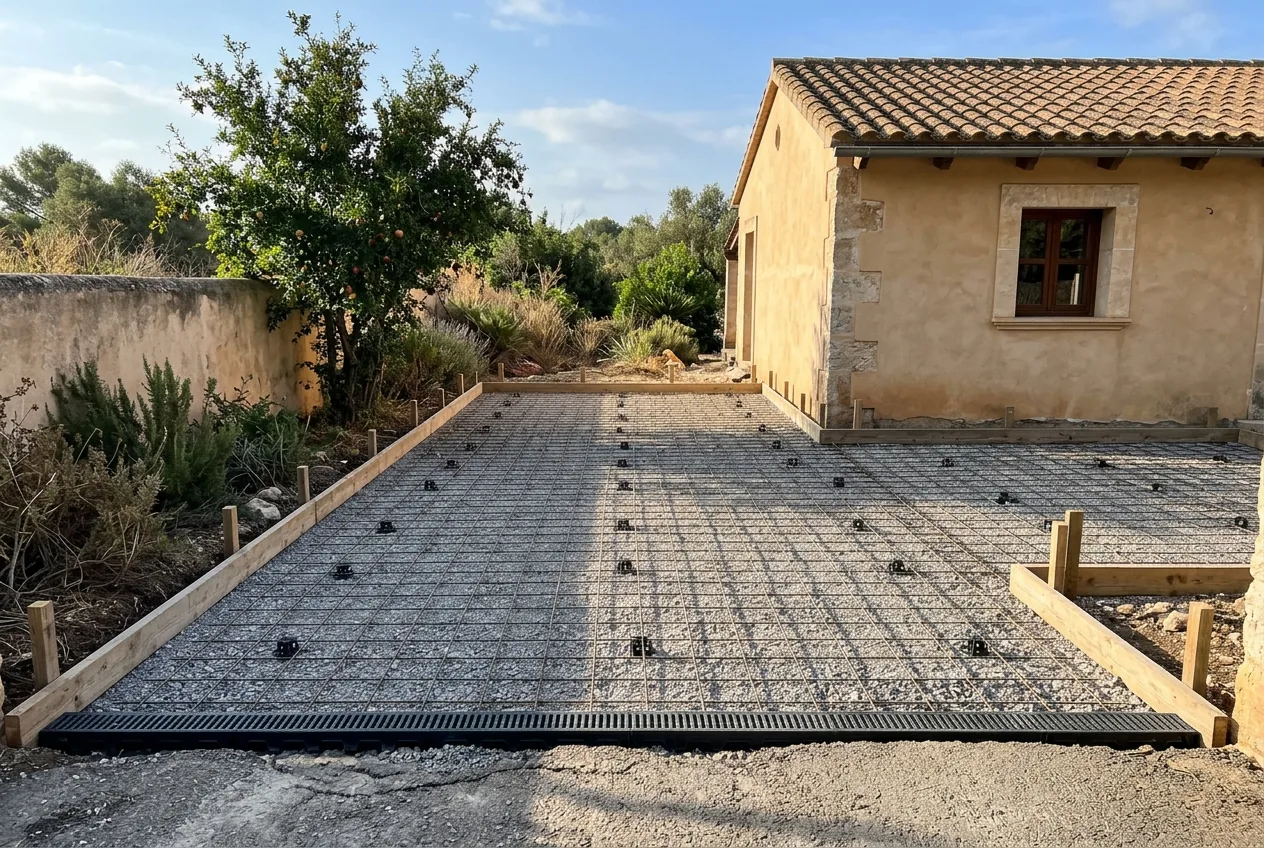
Both need the same thing underneath: a compacted sub-base and a concrete slab sloping towards the drains. Tiles are stuck to that slab with tile adhesive; stamped concrete is the slab itself, coloured and imprinted. The difference in cost is not in the base, which is the same for both, but in what goes on top and in the labour.
Comparison
| Criterion | Stamped concrete | Ceramic or porcelain tiles | Natural stone tiles |
|---|---|---|---|
| Joints | Only shrinkage joints, every 3 to 4 m, sealed | Around every piece; the grout gets dirty, cracks and lets water in | As with ceramic, with wider joints in irregular stone |
| Grip when wet | High thanks to the texture; additive in the sealer for class 3 | Depends on the tile; there is class 3 porcelain and there is porcelain that is slippery | High in a flamed or bush-hammered finish, low when polished |
| Heat in the sun | Depends on colour; light shades are walkable | Light porcelain is among the coolest; dark scorches | Light limestone stays cool; slate and basalt scorch |
| Shapes and slopes | Follows curves, ramps and steps without cuts | Needs cuts and setting out; curves show | The same, with more expensive cuts |
| Repair | Patched with colour and texture; shows close up | The tile is replaced if there are spares from the same batch | The piece is replaced; new stone has a different tone |
| Typical failure | Crack away from a joint, colour loss without resealing | Hollow tiles that lift in the heat, open grout | Loose pieces, rust or damp stains |
| Maintenance | Resealing every 2 to 4 years | Cleaning the joints; regrouting every 8 to 12 years | Water-repellent treatment every 2 to 5 years |
| Lifespan with maintenance | Decades | Decades, if it was laid well | Decades |
| Appearance | Imitation stone, cobbles or timber; continuous | Endless design options; modular | The real material, with its veining |
Joints: the difference that shows most over the years
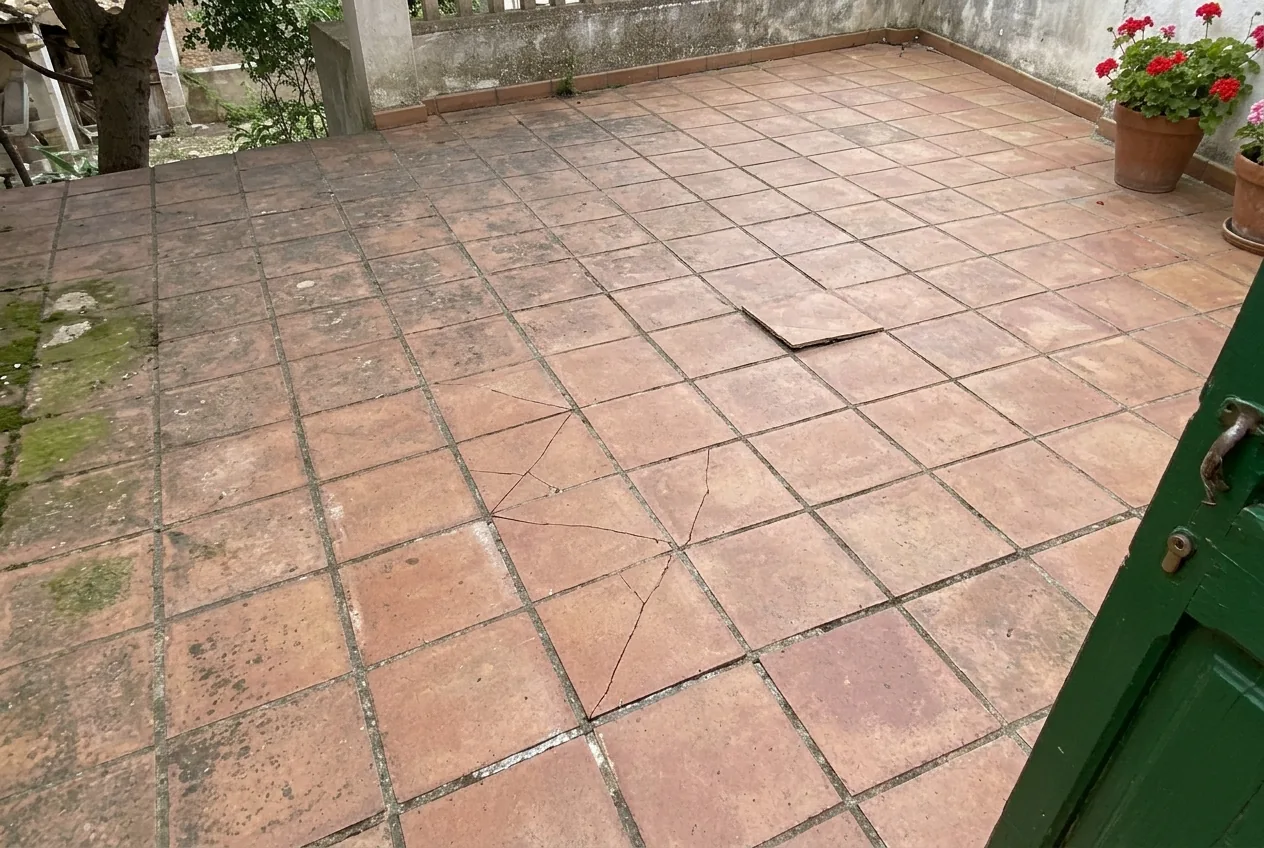
A 60 m² terrace in 30 by 30 cm tiles has more than 600 pieces and close to 400 linear metres of joint. Every metre is a place where water gets in, where algae grows in the shade of the pines and where the grout eventually cracks with summer expansion. The water reaches the tile adhesive and, within a few years, the tiles sound hollow and lift during heatwaves. On a flat roof, that water also finds its way to the ceiling below.
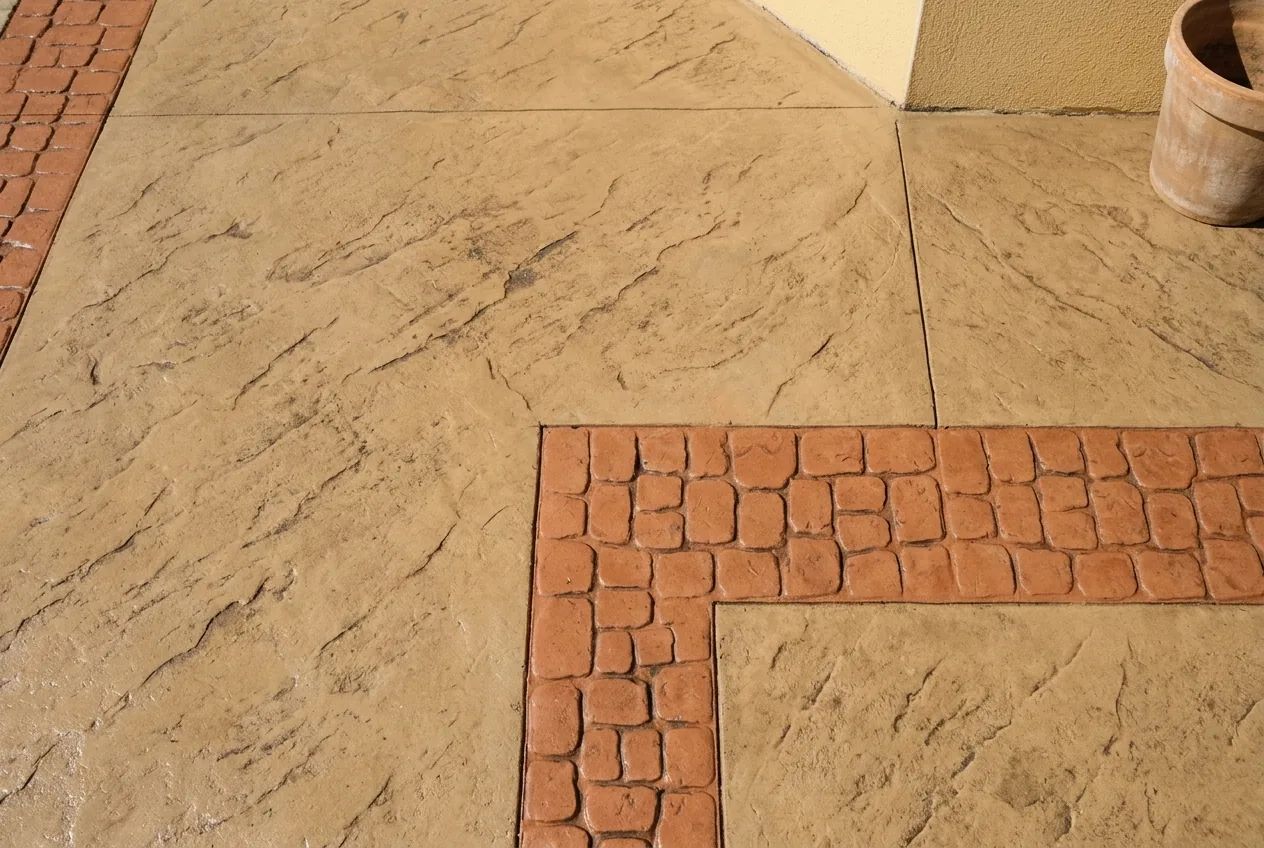
Stamped concrete has joints every 3 or 4 metres, sealed with polyurethane, and a continuous surface. On the other hand, if the sealer is neglected it loses colour, and if the sub-base fails it cracks away from the joints. The guide on repairing cracks in stamped concrete explains what can be done then.
Slip resistance
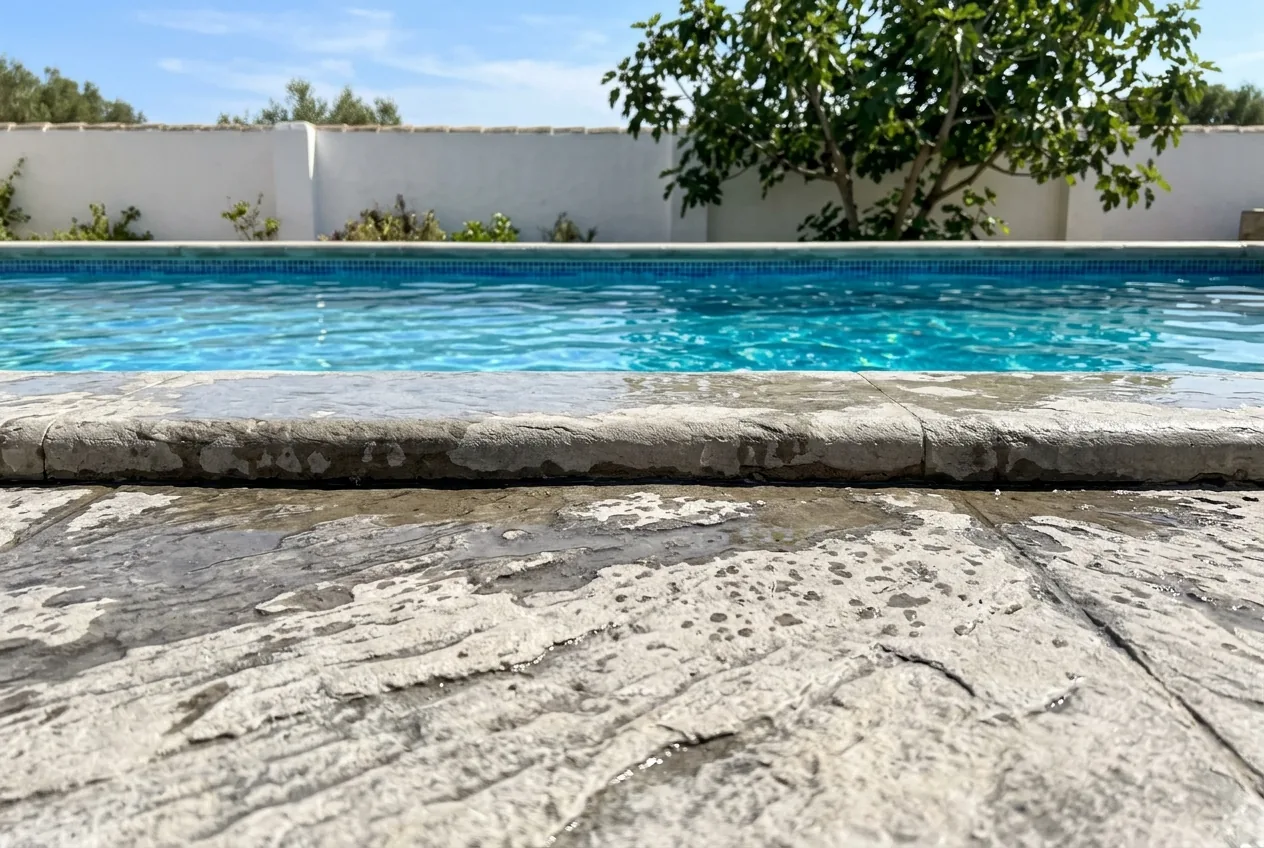
This is where tiles can be very good or very bad, depending on the tile. A porcelain stoneware tile rated class 3 under the Spanish building code, or R11 on the German scale printed on many boxes, is a safe floor when wet. A glossy indoor porcelain tile on a terrace is slippery underfoot when wet. Stamped concrete has texture by nature, and with an anti-slip additive in the final coat of sealer it reaches the class the regulations require around pools.
Heat underfoot
This depends more on colour than on material. An off-white porcelain and a sand-coloured stamped concrete are quite similar in the middle of August; a brown stamped concrete and a black slate scorch alike. Porcelain has less mass and heats up sooner in the sun, but it also cools sooner in the shade. The guide on colours and patterns covers which shades stay walkable.
What makes each one more expensive
We do not give figures, because they depend on each job, but we can say what they depend on:
Stamped concrete. The total area (the more square metres, the lower the cost per metre), access for the mixer lorry or the need for a pump, the thickness, the number of colours and moulds, edges and steps, and the type of sealer. A terrace with complicated shapes does not add much to the cost, because the mould adapts.
Tiles. The price of the tile, which varies several times over from basic ceramic to large-format porcelain and natural stone; the labour per metre, which rises the smaller the tile and the more cuts it needs; the waste on irregular shapes; special pool edge and step pieces, which cost several times as much as a flat tile; and the grouting.
That is why, on a 25 m² rectangular terrace, tiles may come out cheaper, and on a 120 m² one with a curved pool and steps, stamped concrete almost always does.
Repairs
Tiles are repaired piece by piece, and done well the repair is invisible, on one condition: having spares from the same batch. Ranges are discontinued within a few years, and a different batch has a different tone; it is worth keeping a box when the job is finished. Stamped concrete is repaired with mortar, colour and texture, and the patch is disguised but shows close up, especially when wet. On the other hand, it does not suffer the most common failure of outdoor tiles in Mallorca: tiles lifting in a block during a heatwave because the adhesive did not cover the whole back of each tile.
Appearance
Tiles allow any design: large formats, wood effect, patterned encaustic designs, real stone. Stamped concrete imitates, and its imitation of irregular stone or cobbles is convincing; its imitation of timber, less so. In traditional village houses, natural stone or terracotta has an authenticity stamped concrete cannot match. On villas with large gardens, sand-coloured stamped concrete with a stone mould blends into the landscape.
When to call a professional
Both options depend on the sub-base and the slope, and those are decided before choosing a material. Whoever is going to do the job should see the ground, where the water drains, access for the concrete and how the terrace is used. If a tiled terrace leaks into the room below, the first question is not which surface to lay but whether it needs waterproofing without lifting the tiles. If there is already an old stamped floor, the first thing is to see whether it can be restored. The page on stamped concrete for terraces and pool surrounds describes how the work is planned.