Sealing
Sealing and maintaining private asphalt in Mallorca
How to maintain the asphalt on finca tracks, community and hotel car parks and garage ramps: crack sealing, patching, slurry seal, the right time of year and when it is not enough.
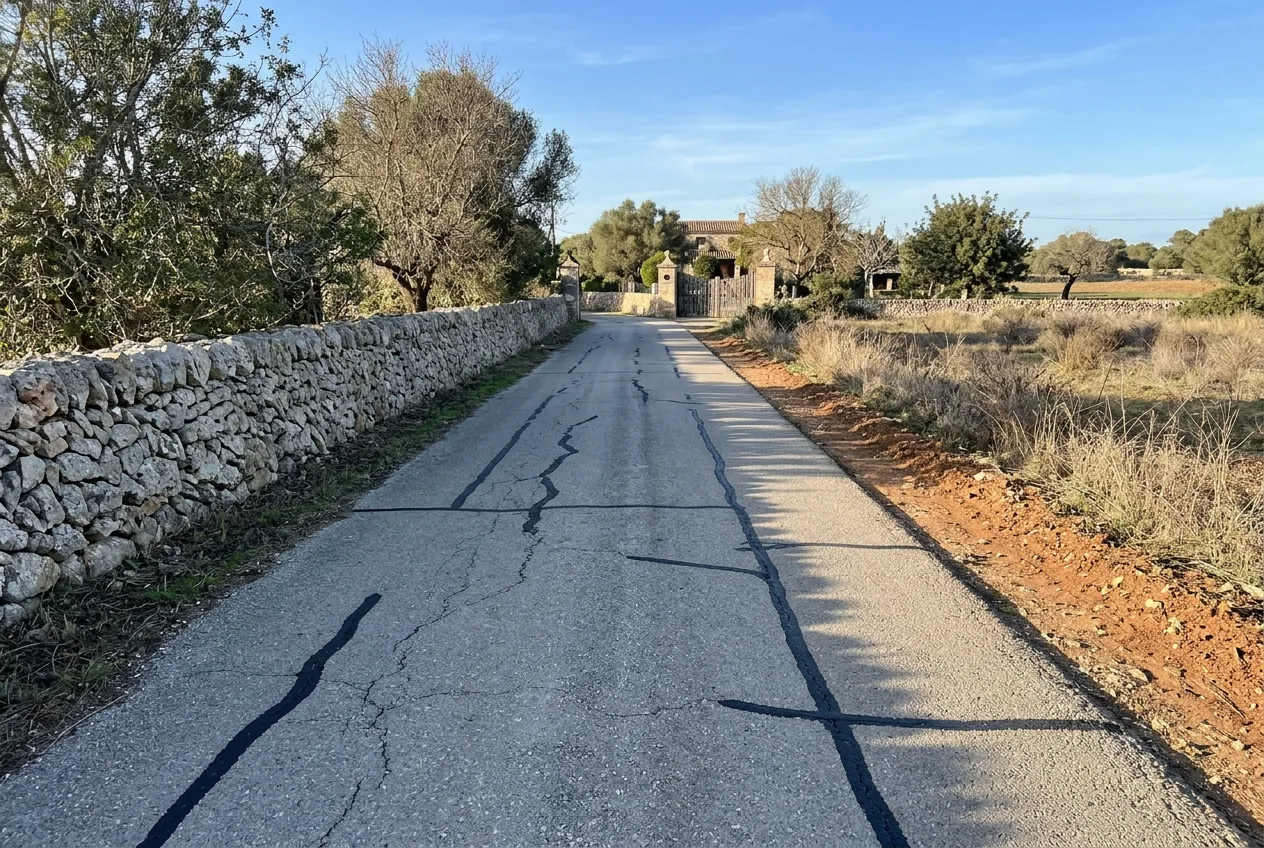
Private asphalt, whether it is a finca track, a community car park or a garage ramp, is maintained at three levels: sealing cracks as soon as they appear, repairing potholes with the right method, and renewing the surface every 5 to 8 years with a slurry seal or a surface seal before water reaches the base. When it shows crocodile cracking over wide areas, ruts, or potholes that keep coming back in the same place, the problem is underneath and maintenance will no longer fix it: the surface has to be milled off and a new layer laid, which is a road construction job.
Why asphalt ages
Asphalt is aggregate bound with bitumen. The bitumen oxidises in the sun and loses flexibility, and the surface goes from black to grey and starts to shed aggregate. Water gets in through hairline cracks, and in Mallorca it arrives in autumn downpours that saturate the base in a single afternoon. A saturated base loses bearing capacity, and the next lorry pushes the wearing course down. Oils dissolve the bitumen; roots lift the edges. All maintenance comes down to slowing the oxidation and closing the way in for water.
The three usual situations on the island
Finca tracks. Thin asphalt on a crushed aggregate base, often built with limited means, edges with nothing to hold them, roadside ditches that do not drain, tractors and lorries. Maintenance is mainly crack sealing, pothole repair and clearing the ditches; renewal is done in sections.
Car parks of hotels and of comunidades de propietarios (owners' associations of shared developments). Flat surfaces, slow traffic and parked vehicles that drip oil. Here it is the surface that deteriorates: oxidation, stains, faded bay markings and cracks along the joints between paving passes. It is the ideal case for a slurry seal or an emulsion seal, which closes the pores and allows the markings to be repainted, normally out of season.
Garage ramps. Gradients of 15 to 20%, wheels turning and water running down in every storm. The asphalt suffers under braking and acceleration, and it is also slippery. It is maintained with spot repairs and anti-slip treatments of resin and aggregate; when it is badly worn, it often pays to replace it with grooved concrete.
Treatments, from smallest to largest
| Treatment | What for | How it is done | Typical life |
|---|---|---|---|
| Crack sealing | Cracks of 3 to 25 mm | Cleaning, drying, hot-poured sealant or cold-applied filler | 3 to 5 years |
| Pothole filling with cold mix | Isolated potholes, urgent cases | Fill and compact; temporary | Months to 2 years |
| Patching with hot mix | Potholes and sunken areas | Straight cut, base repaired, tack coat, compaction | 10 years or more |
| Emulsion surface seal | Oxidised but sound asphalt | Emulsion in one or two thin coats | 2 to 4 years |
| Slurry seal | Aged surface, hairline cracks | Emulsion, fine aggregate, water and filler at 3 to 10 mm | 5 to 8 years |
| Milling and resurfacing | Damaged base, crocodile cracking, ruts | Mill, correct the base, lay 4 to 6 cm of hot mix asphalt | 15 to 20 years |
Crack sealing
It is the cheapest treatment and the one that pays back most. An open crack is a way in for water to reach the base; once sealed, it no longer is. The cracks are cleaned with compressed air or a brush, dried and filled with a polymer-modified bituminous sealant applied hot, which stays elastic. For a few cracks there are cold-applied fillers, which do not last as long. Cracks under 3 mm are dealt with by a surface seal; those over 25 mm or with a step are breaks, and they are patched.
Pothole filling and patching
Filling a pothole with bagged cold mix just plugs the hole so that it does not grow; sometimes it lasts a winter. Proper patching cuts the edges straight back to sound asphalt, repairs and compacts the base if it is soft, applies a tack coat, lays hot mix and compacts it. That patch lasts as long as the rest of the road. On a finca track far from the asphalt plant, hot mix arrives with little time to spare, which is why so many tracks collect cold patches.
Bitumen slurry: the slurry seal
This is the surface renewal treatment par excellence. A mix of bitumen emulsion, fine aggregate, water and filler is spread with a spreader box in a layer 3 to 10 mm thick. It rejuvenates the surface bitumen, closes hairline cracks, restores the texture and brings back the black colour. It can take traffic again within a few hours. It does not correct potholes or wide cracks, which are repaired first, and it adds no bearing capacity: it is a new skin on a body that has to be sound.
The time of year
Emulsions and slurries need temperatures above 10 °C, a dry surface, no rain in the following 24 hours and a few hours of sun to cure. In Mallorca, that leaves April to June and September to November as the easiest periods; summer works if the job starts early. Hot crack sealing can be done almost all year round as long as the crack is dry, and it is best finished before the September downpours.
What maintenance cannot fix
- Crocodile cracking over wide areas: a network of cracks that points to fatigue in the layer or a weak base. A slurry seal on top hides it for a season.
- Ruts deeper than 2 cm: a soft base or an unsuitable mix.
- Potholes that come back in the same place after proper patching: water in the base or a ditch that does not drain.
- Asphalt less than 4 cm thick on a poor base, typical of old finca tracks: there is no layer to maintain.
In these cases the solution is to mill or scarify, correct the drainage and the base, and lay hot mix asphalt with road paving machinery. It is a paving project, on another scale of equipment and cost, and it is often worth planning in phases.
How it differs from public works
Most of the asphalting you see in Mallorca is public: roads of the Consell de Mallorca (the island council), streets maintained by the ayuntamientos (municipal councils), public tenders with an asphalt plant, paver, heavy rollers and road closures. A community car park or a finca track has neither that volume nor that access: small crews, hot mix in modest quantities, work in phases so that residents can still park. It is pavement maintenance, not road building. The page on sealing and maintaining asphalt describes how we approach it.
When to call a professional
A finca owner can seal a few cracks with cold filler and plug a pothole with bagged mix to get through the winter. A company is worth calling when crack sealing runs to more than a few tens of metres, because hot sealant needs a heated melter; when patching with hot mix is needed; whenever a slurry or surface seal is planned; and when there is doubt about whether the road surface can still be maintained or needs renewing. The page on asking for a quote lists which photos help us assess asphalt from a distance.