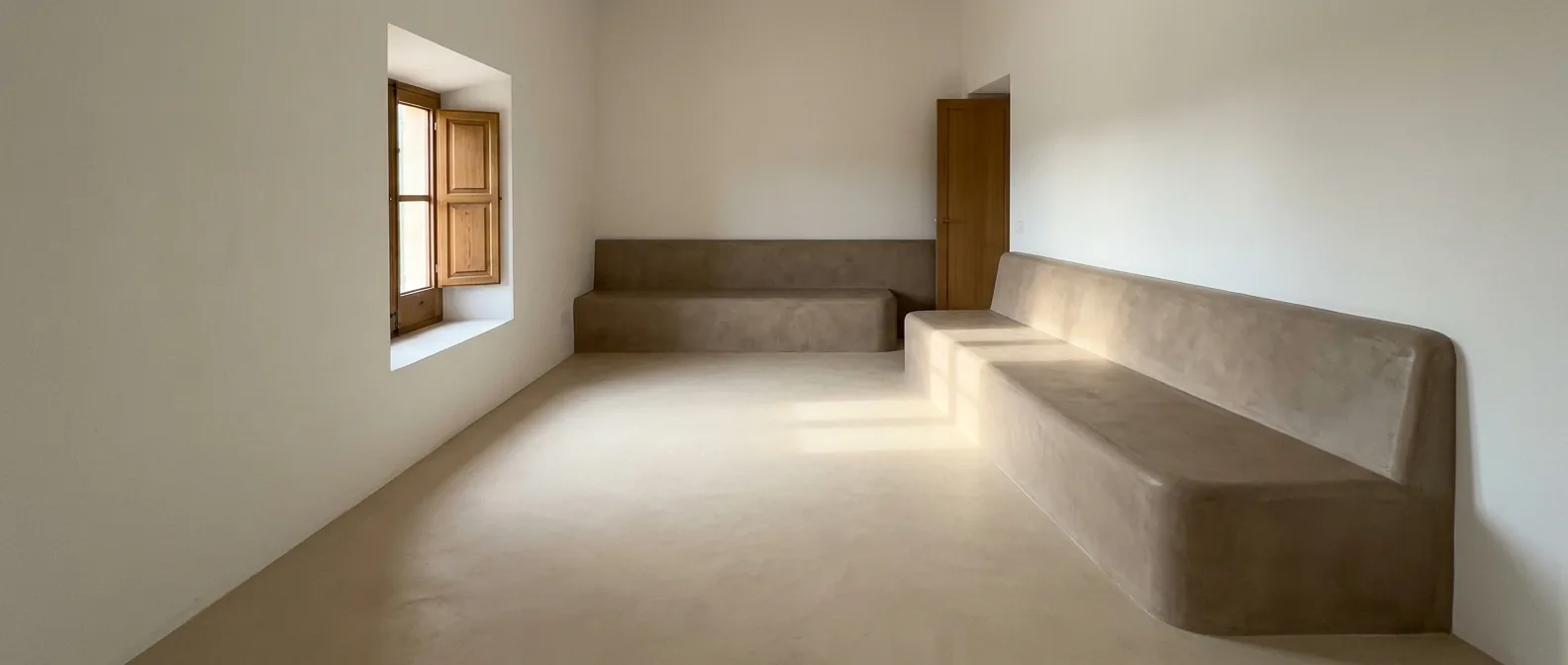
Microcement colours and finishes
Microcement colours come from pigment mixed into the mortar itself, and the final result is decided by the sealer, the texture and the light in each house. Here we explain how the colour is made, which family suits each space and which finish suits each use.
Six colour families
 Off-whiteA warm white rather than a pure one. Makes bathrooms and small rooms feel larger and shows fewer marks than pure white.
 SandA warm tone that goes with marès, timber and lime. Works indoors and out, and stays cooler in the sun.
 Pearl greyA light, neutral grey. The look of cement without darkening the room, in modern flats with white walls.
 Cement greyThe mid grey most people picture as microcement. Kitchens, clean-lined living rooms and stairs.
 TaupeA brownish grey between sand and grey. Goes with timber and stone and hides dust very well.
 AnthraciteA very dark grey for contrast on a feature wall, a unit or a staircase. Shows dust and lime more.
The same microcement shade changes with the sealer, the grain of the finish, the light from each window and the area it covers, so it is not chosen from a printed chart. Above, you will find the six families we usually start from. The layers and sealing are explained on the main microcement page.
How microcement colour is made
Microcement is not painted: the colour is inside the mortar. A mineral pigment is added to the base of white or grey cement, resins and fine aggregates, and mixed into every batch until the colour is even. It goes into the two finish coats, the ones left on view, and because it runs through their full thickness, a scuff in the sealer does not reveal a different colour underneath.
The hard part is repeating the shade in every batch. That is why the pigment is weighed, not added by eye, and the dose is fixed for the whole surface before starting. Each coat on a floor or wall is applied in one go, without stopping halfway, so there are no jumps in shade.
Why the colour is chosen from a sample in your home
The sealer deepens the colour, like water on a stone, and gloss saturates it more than matt. Light does the rest: a north-facing window cools greys, evening sun on a west-facing house warms sands and a warm bulb turns off-white yellowish. And a small sample looks darker than the same colour across a whole living room.
So we prepare samples with the planned pigment, grain and sealer, and they are viewed where the microcement will go, by day and at night. Any colour can be mixed to match a stone, a fabric or a photo, but approval is always given on the sealed sample.
Microcement colours: six families for Mallorca homes
The six families shown at the top of the page are a starting point: each has a range of shades, and any colour can be mixed to order.
- Off-white. Bathrooms, kitchens and bright interiors; it makes small rooms feel larger. A pure white microcement is also possible, but it shows every footprint or stain, and next to large south-facing windows it needs a sealer that does not yellow.
- Sand. The warm tone that goes with marès, the island's soft sandstone, with timber beams and with the lime-washed walls of village houses and fincas. Sand microcement works indoors and out, and around a pool it stays relatively cool.
- Pearl grey. A light, neutral grey for modern apartments in Palma with aluminium windows and white walls: the look of cement without darkening the room.
- Cement grey. The mid grey most people associate with microcement. It suits kitchens, clean-lined living rooms and stairs.
- Taupe. A brownish grey, between sand and grey. It goes with wood and stone and hides dust very well.
- Anthracite. For contrast on a wall panel, a vanity unit, a kitchen island or a staircase. It gets very hot in the sun, and it is the colour that shows dust and limescale most.
Light or dark: what shows in daily life
In Mallorca the dust is pale limestone and the water is hard, and both show on dark tones. Scratches in the sealer look whitish, so they also stand out on dark colours and on gloss. Light tones hide the dust but show coffee, wine and soil brought in from outside.
| In daily life | Light: off-white, pearl grey | Mid: sand, taupe, cement grey | Dark: anthracite |
|---|---|---|---|
| Limestone dust and sand | Hidden | Hidden | Shows at once |
| Limescale in the bathroom | Barely visible | Slightly visible | White film |
| Scratches and scuffs | Barely visible | Barely visible | Very visible |
| Footprints and stains | Show more | Show least | Bare footprints show |
| Heat in the sun | Cool | Warm | Very hot |
How to remove limescale without damaging the sealer is covered in the guide to cleaning and maintaining microcement.
Finishes: matt, satin or gloss
The sheen comes from the polyurethane sealer, not from the microcement, and it is chosen separately from the colour.
- Matt. The most mineral look. It hides scratches, marks and slight undulations in the surface, and it is the usual choice on floors and outdoors.
- Satin. A soft sheen that lifts the colour a little and is slightly easier to clean. The middle ground for bathrooms, kitchens and walls.
- Gloss. It saturates the colour and brings out the cloudy effect, but it reflects every scratch, every footprint and every irregularity, and it is slippery when wet. We do not use it on outdoor floors or in showers.
Smooth or textured, even or cloudy
A smooth finish, with a very fine grain, is the usual choice for walls, built-in furniture, worktops and bathrooms. A textured one, with the grain on view, gives more grip and hides wear on busy floors and outdoors, where it also gets anti-slip aggregate in the sealer.
The cloudy effect is the drifts of tone that the trowel leaves in the final coat. You can ask for it calm, almost even, or pronounced, but never flat like paint: the hand of the applicator, the absorbency of the substrate and the humidity on the day leave a pattern of their own. That is why no two floors are identical, and why the sample shows the character of the finish, not an exact copy.
Colour outdoors and in the sun
Mineral pigments stand up to the sun; what yellows is the wrong sealer, which is why outdoors we always use an aliphatic polyurethane with a UV filter. Even so, colours lighten slightly over the years, intense ones more than greys and sands. When the sealer wears, the shade looks dull; after resealing, it comes back. And heat matters: anthracite on a south-facing terrace burns bare feet in August. We go into detail on the page on outdoor microcement and pools.
Floor, walls and worktop: matching or combining colours
The same colour on floor and walls gives continuity, although a wall catches the light from the side and usually looks a shade lighter. In kitchens the worktop can match the floor or go a tone darker to hide wear; we cover this on microcement walls and kitchens.
Two colours combine well when the change coincides with a change of plane: floor and wall, tread and riser, built-in unit and wall. On the same plane they are separated by a masked straight line or a profile. Each colour adds masking and drying time, which is why it is one of the things that move the microcement cost. The floor system itself is on microcement floors.
Microcement colours for bathrooms
Limescale leaves a white film that shows clearly on anthracite and cement grey, especially in the shower. Off-white, sand, pearl grey or taupe make a small bathroom feel larger and hide limescale and soap; a dark tone looks better on the basin wall or a built-in unit than inside the shower. The shower tray gets anti-slip aggregate and a matt or satin finish, and the silicone at the junctions is chosen in the colour of the microcement. The waterproofing and the rest of the system are on microcement bathrooms.
Solera Mallorca
How we choose the colour
- 01
Visit and light
We look at orientation, natural and artificial light and the materials that are staying: wood, stone, window frames.
- 02
Proposal
We suggest two or three shades from the families that suit the space and its use.
- 03
Sample
We prepare samples with the planned pigment, grain and sealer, and you look at them in place, by day and at night.
- 04
Dosing
We fix the weight of pigment for the whole surface before the first batch.
- 05
Application
Each coat on a surface is done in one go, without breaks, so there are no jumps in shade.
- 06
Sealing
Two coats of polyurethane in the chosen sheen; the final colour shows once the sealer has cured.
FAQ
Questions
Something else? Ask us when you request a quote.
What colours does microcement come in?
Almost any, because the colour comes from pigment mixed into the mortar. The usual starting point is a set of neutral families such as off-white, sand, pearl grey, cement grey, taupe and anthracite, each with several shades, with the final shade adjusted on a sealed sample viewed in your own home. Stronger colours such as greens or terracottas are possible too, although in the sun they lighten a little more over the years.
Can microcement be white?
Yes. A pure white is made on a white cement base, although off-white is more common because it shows fewer marks. Bear in mind that white shows footprints, hair and stains more than a mid tone, and that next to sunny windows or outdoors it needs an aliphatic sealer that does not yellow.
Which microcement colour hides dirt best?
Mid tones: sand, taupe and cement grey. They hide limestone dust, sand from outside, limescale and fine scratches better than anthracite, and stains and footprints better than white. With a matt finish and a slightly textured grain, the floor needs even less attention.
Can two microcement colours be combined?
Yes. It works best when the change of colour coincides with a change of plane, such as floor and wall, tread and riser or unit and wall. On the same plane the colours are separated by a masked straight line or a profile. Each extra colour adds working time and shows in the quote.
Does microcement change colour outdoors?
A little, over the years. With an aliphatic polyurethane sealer with UV filter it does not yellow, but colours lighten slightly in the sun, intense ones more than greys and sands. When the sealer wears, the shade looks dull and water darkens the surface; with resealing every 2 to 4 years depending on exposure, the colour comes back.
Solera Mallorca
Choose the colour with a sample in your home
Send us photos of the space in its usual light and of the wood, stone or floors that are staying, and we will suggest two or three shades to see as samples.