Microcement
Microcement or epoxy resin: the differences and when to choose each
Microcement and epoxy resin compared in homes, on terraces, in garages and in commercial spaces: what each is, looks, sun, chemicals, damp, grip, repairs and cost.

In a home, especially if the finish has to carry on up walls and stairs or into a bathroom, or out onto a sunny terrace, microcement is usually the better fit: it is mineral, it goes on vertical surfaces too and, properly sealed, it stands up to the sun. In a garage, a workshop or a commercial space with oil and tyres, epoxy resin resists chemicals and wear better. Choose by use, substrate and exposure.
What each one is
Microcement is a cement based mortar with resins, fine aggregate and pigments, trowelled on in four coats over mesh to a total of 2 to 3 mm and sealed with two coats of polyurethane. What you see is mineral; what protects it is the sealer.
An epoxy resin floor is a two component plastic coating, resin and hardener, laid over a prepared concrete slab. Self-levelling epoxy is poured to 2 to 4 mm and sets smooth and glossy; a rolled or multi-layer coating is thinner and usually has quartz aggregate broadcast between coats.
Epoxy paint is something else, even though people search for it with the same words: a film a few tenths of a millimetre thick, often water based. It adds colour to a garage or storeroom with light use, but it does not level, does not hide defects and soon lifts where the wheels run.
Microcement or epoxy resin: comparison
| Criterion | Microcement | Epoxy resin |
|---|---|---|
| Thickness | 2 to 3 mm | Tenths of a mm as paint; 2 to 4 mm self-levelling |
| Look and feel | Mineral, with clouding; matt or satin | Uniform, often glossy; plastic |
| Walls and stairs | Yes | Floors only |
| Outdoors in the sun | Yes, with aliphatic polyurethane | Yellows without a protective topcoat |
| Oil and chemicals | Oil stains if left | Highly resistant |
| Car tyres | Wears where the wheels run | Resists as self-levelling or multi-layer |
| Damp in the substrate | Needs a dry substrate | Needs a dry substrate; more sensitive |
| Grip when wet | Class 3 with aggregate in the sealer | High with quartz; smooth is slippery |
| Repairs | The patch shows; reseal | The patch shows; recoat |
Look and feel
Microcement has clouding, shifts of tone and trowel marks, because it is applied by hand. It comes in matt, satin or gloss, and feels like fine stone. It does not give a flat colour. More on microcement colours.
Epoxy gives the opposite: a uniform colour and, when self-levelling, a lacquer-like gloss that shows scratches. It can take a matt topcoat, colour flakes or effects such as the so-called 3D epoxy floor, but it still feels plastic. Next to the stone and the marés, the local sandstone of Mallorcan houses, it stands out more.
Walls, stairs and bathrooms
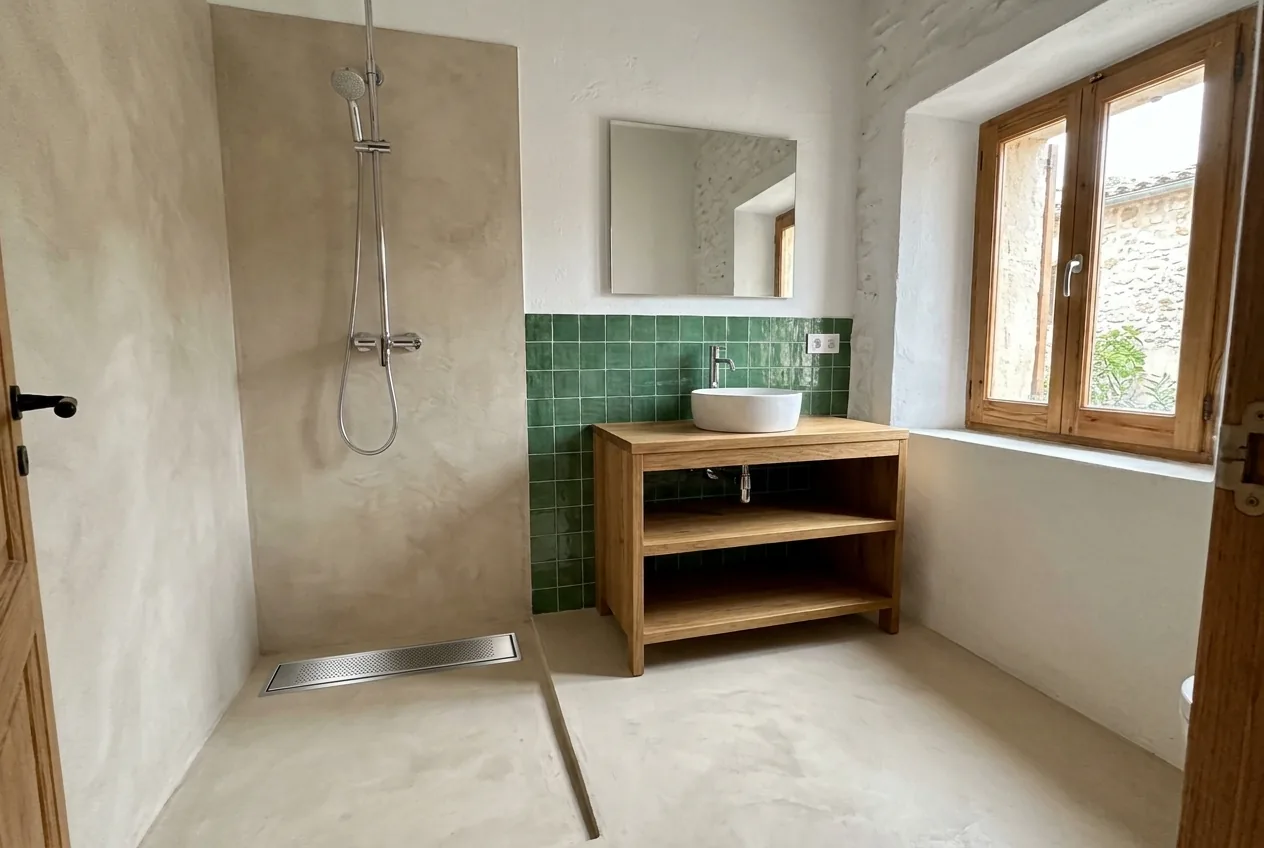
Microcement goes up the wall without changing material: the bathroom floor carries on into the shower and up the walls, and a staircase is coated on treads and risers, as explained in microcement on walls and stairs. Epoxy is a floor system: self-levelling resin will not stay on a vertical surface, and on stairs it only covers the treads. There are epoxy wall paints for commercial kitchens, but they are not a decorative finish.
Outdoors and sun: what matters most in Mallorca
Epoxy is not made for the sun: ultraviolet light yellows it within months, and the surface loses its gloss and turns powdery, known as chalking. It is also rigid, and a terrace in Mallorca goes from 10 degrees at a winter dawn to 50 at midday in August. An outdoor resin floor that works has an aliphatic polyurethane topcoat or uses a different resin.
Outdoor microcement is sealed with aliphatic polyurethane with a UV filter and resealed every 2 to 4 years in the sun, as we explain on outdoor microcement and pools and in outdoor microcement. For an open-air driveway, the usual choice is stamped concrete.
Garages, workshops and commercial spaces
Here epoxy wins. A self-levelling or multi-layer resin does not absorb oil or fuel and is cleaned with a scrubber dryer: it is the floor of workshops, warehouses, car parks and commercial kitchens. Garage floor paint, by contrast, peels off under hot tyres.
Microcement in an enclosed garage is possible with a tougher system and a high-traffic sealer, but it wears faster where the wheels turn, and oil left sitting on a worn sealer gets into the mortar. It makes sense if the garage is part of the house and you want the same finish; on ramps, no. In a restaurant dining room it copes with foot traffic; in the kitchen, resin is the usual choice.
Damp in the substrate
Both need a dry substrate, but they fail differently. With microcement, damp rising from the ground stains the mortar and blisters the sealer. Epoxy forms a closed film that does not let vapour out: pressure builds up and the resin blisters or lifts in sheets. It is less tolerant. On the ground floors of old stone houses with slabs laid without a membrane, or in basements, have the moisture measured before choosing.
Slip resistance
Smooth and wet, both are slippery. Microcement reaches slip resistance class 3 with a fine aggregate in the last coat of sealer. Epoxy gains grip from quartz broadcast between coats; glossy self-levelling resin without aggregate is very slippery with water or oil on it.
Joints, cracks and repairs
Neither bridges an active crack: both copy the substrate, and with both the expansion joints are cut in the same place and filled with elastic sealant. Repairs show on both. On microcement, a patch shows in the tone, although renewing the sealer brings the sheen back across the whole floor. On epoxy, matching a patch is hard once the rest has aged, and the usual answer is to sand and recoat the whole surface.
What drives the cost of each
For microcement, cost depends on the substrate, levelling the joints, the share of wall, the cuts, the colours and the sealer; it is hand work spread over several days. For resin, it depends on the system, the thickness, preparing the concrete by diamond grinding or shot blasting, cracks, damp and the topcoat. Epoxy paint is the cheapest and the shortest lived. Self-levelling epoxy and microcement sit in similar ranges: resin gets cheaper on large open areas, because it is poured, and microcement competes better where there are walls, stairs or cuts. More on microcement cost.
When to choose microcement
- A home with the same finish on floors, walls, stairs or in the bathroom.
- A mineral, handmade look.
- Terraces, porches and pool copings in the sun.
- Renovating over the existing tiles, without breaking them out.
- A garage that is part of the house, with light traffic, accepting earlier resealing.
When to choose epoxy resin
- Garages in daily use, workshops, warehouses and car parks.
- Commercial kitchens and premises with grease and chemicals.
- A uniform, glossy colour, or decorative effects.
- Large open areas on a dry, sound slab.
- Interiors or covered areas out of direct sun.
When to call a professional
Both depend more on the substrate and on who applies them than on the material. Before deciding, have someone measure the moisture in the slab, look for active cracks, tap the tiles if there are any and see how much sun the area gets. Ask for the quote to set out the system: for microcement, the coats, mesh and sealer; for resin, the type, thickness and preparation. Two quotes for an "epoxy floor" can be a paint and a self-levelling resin. More on microcement floors.